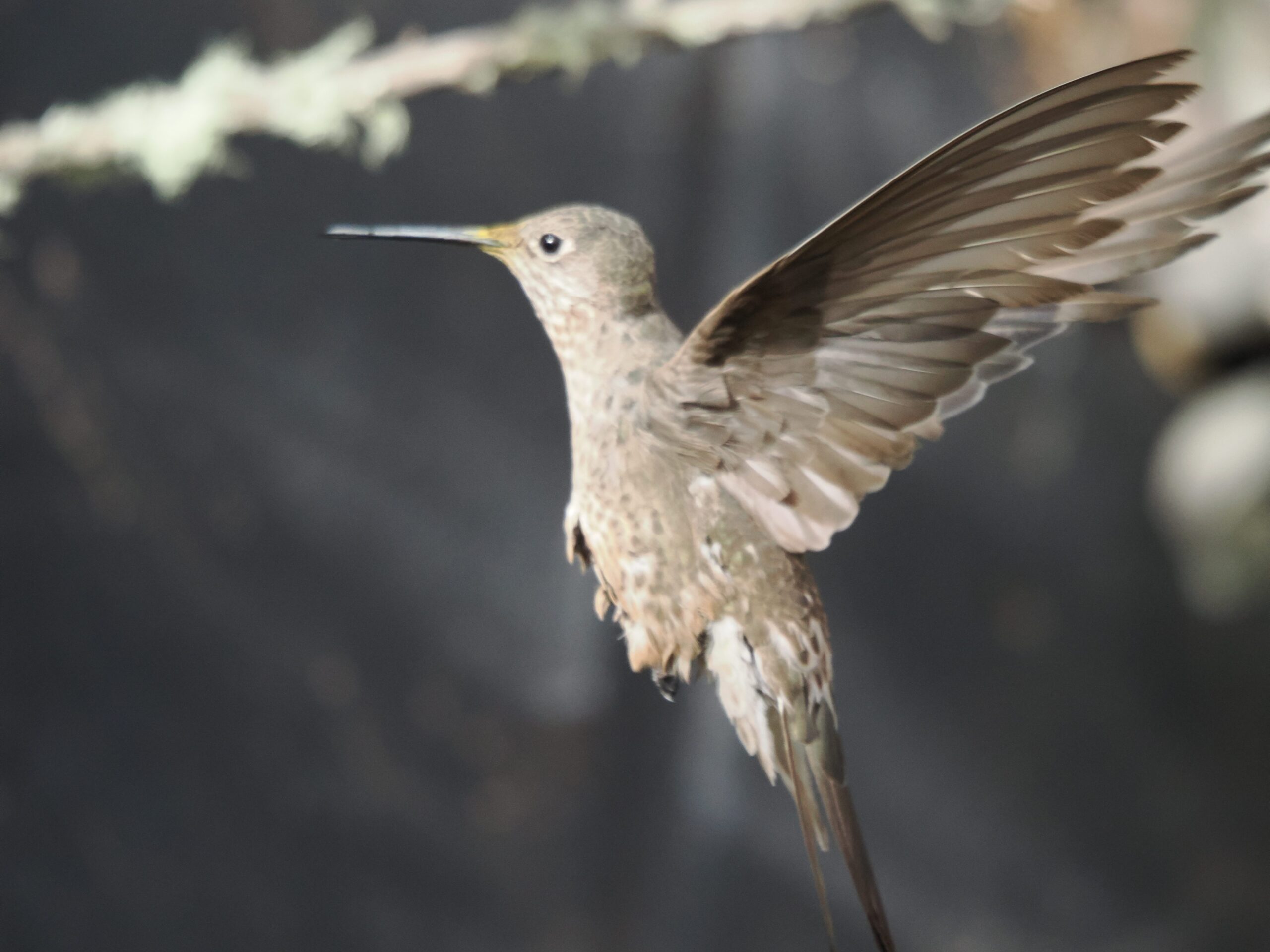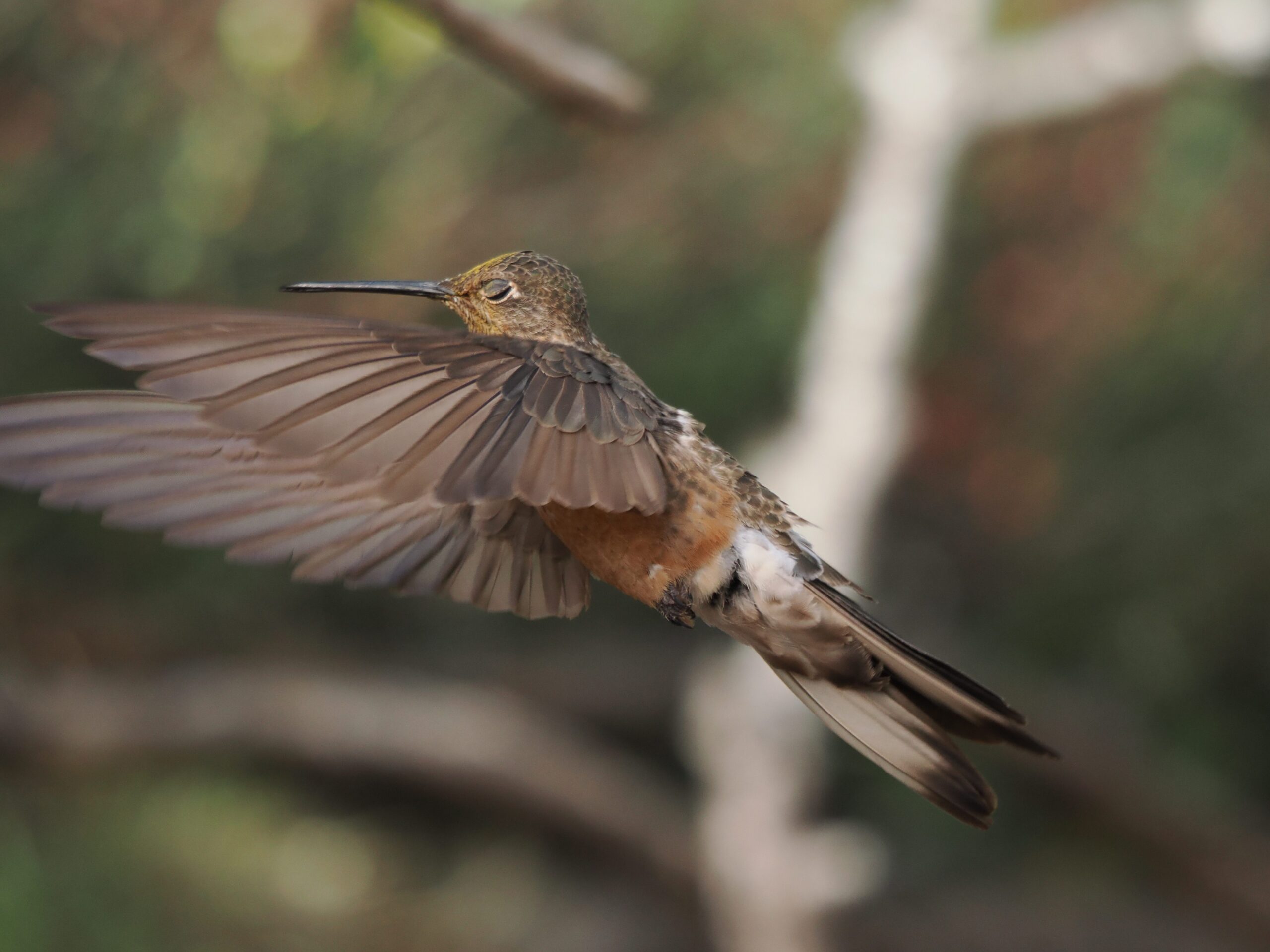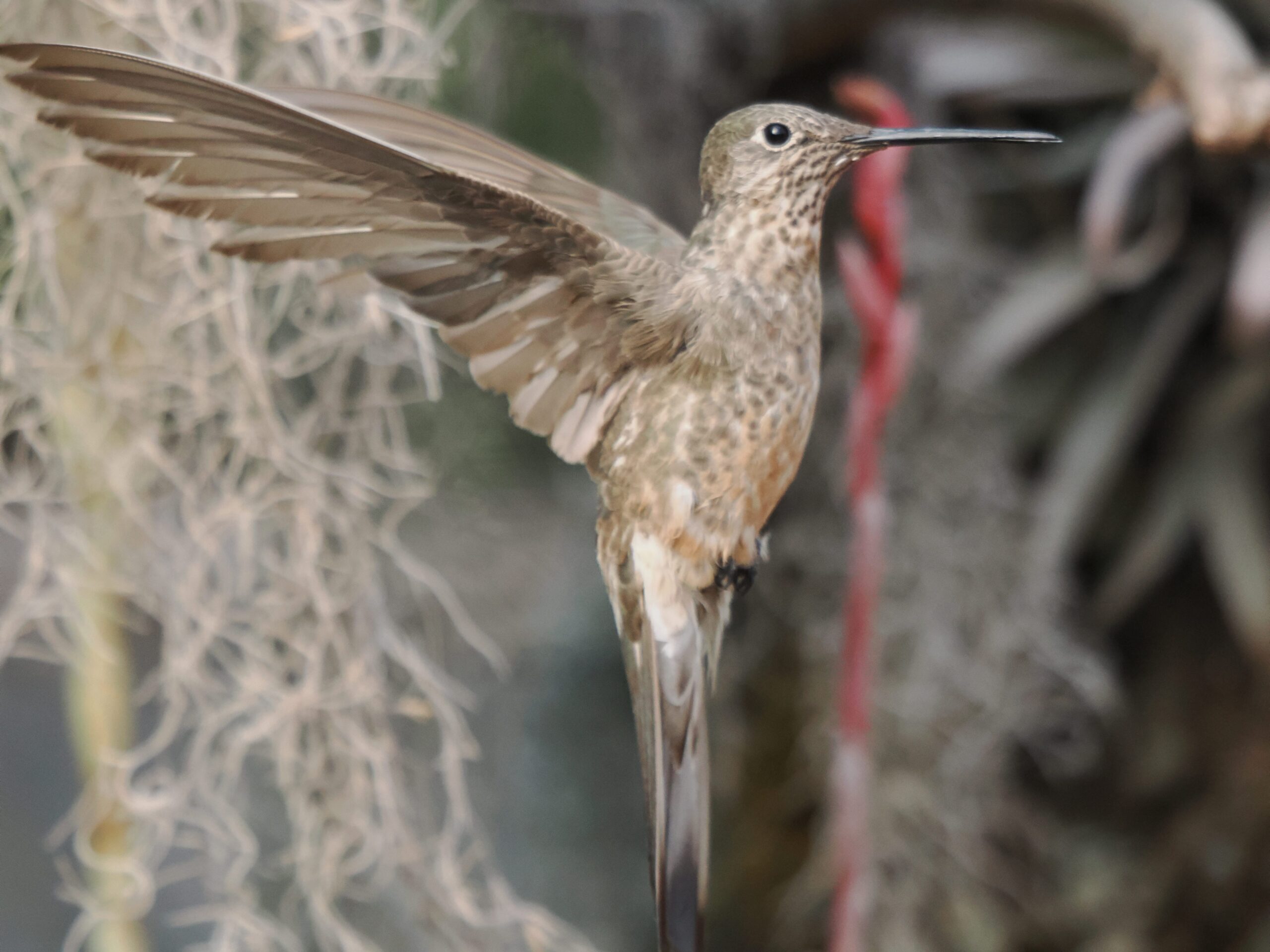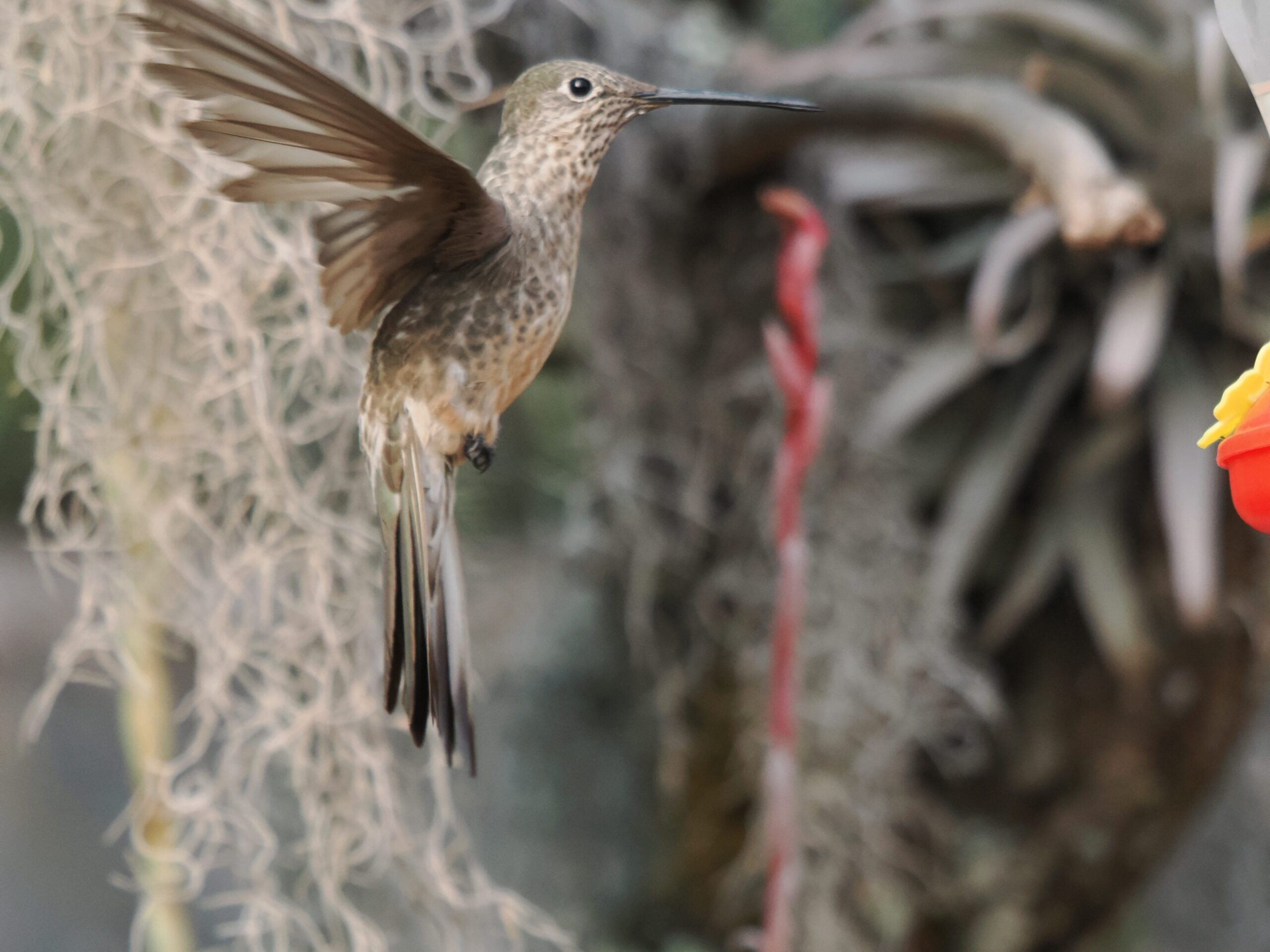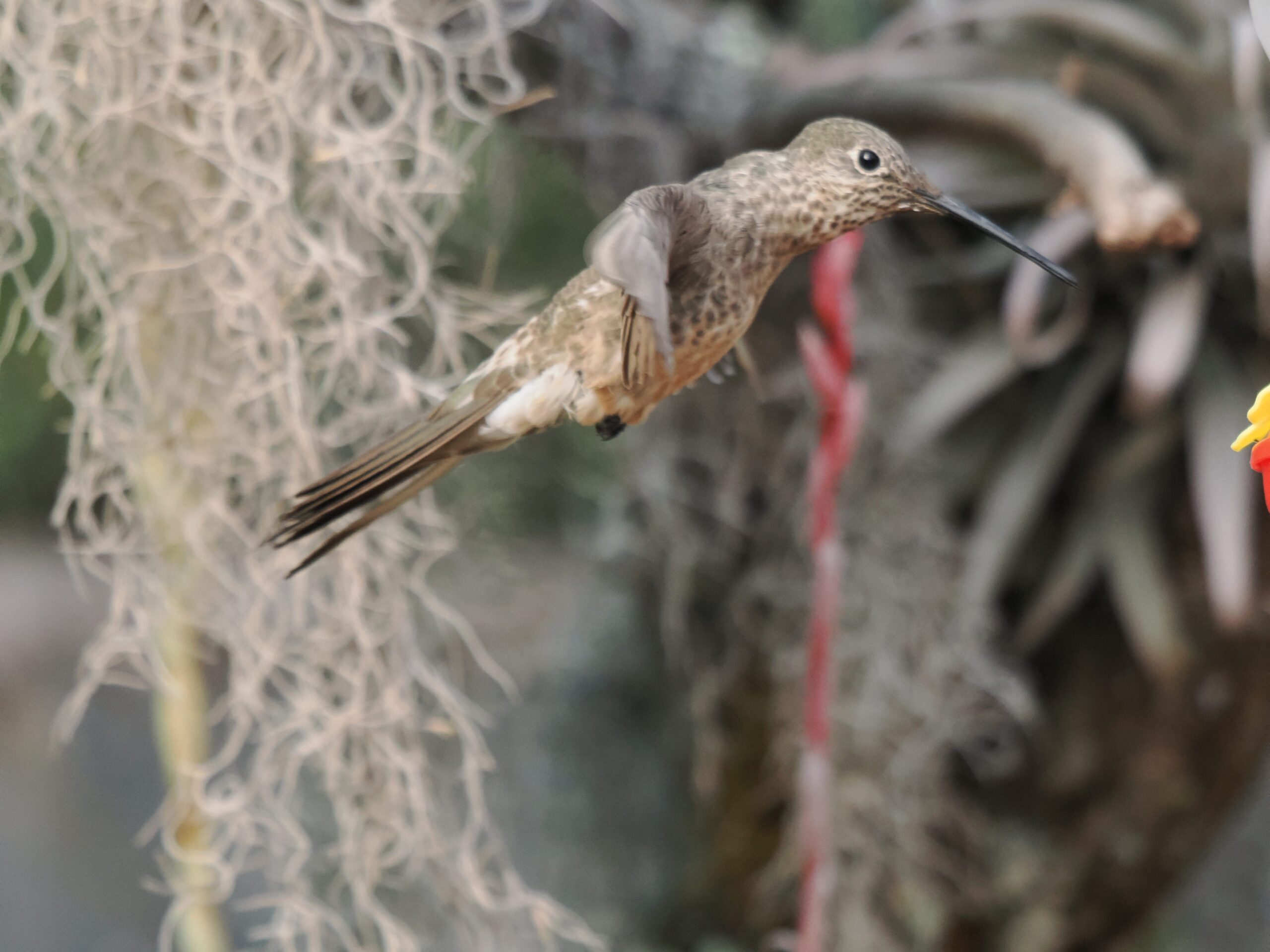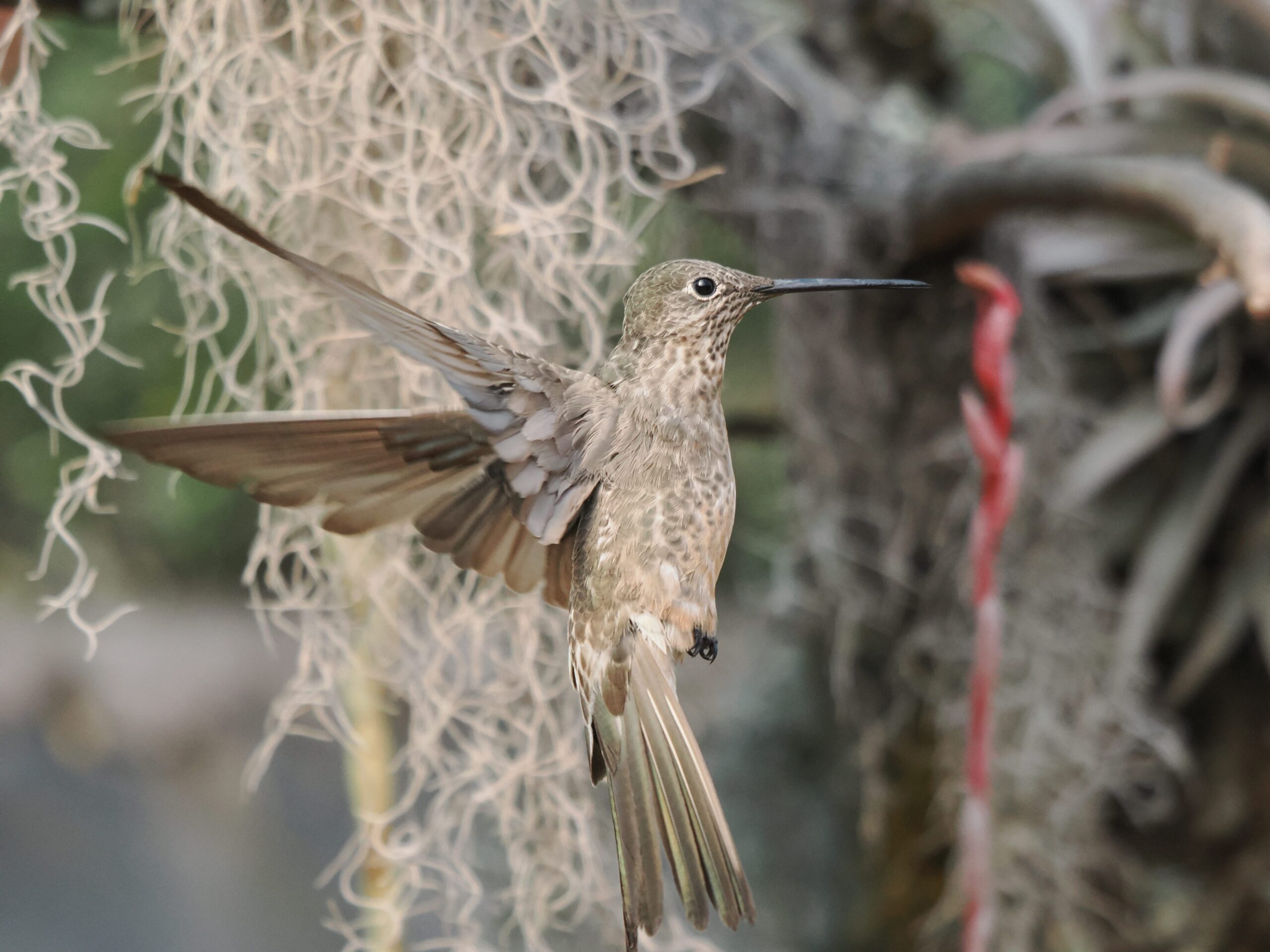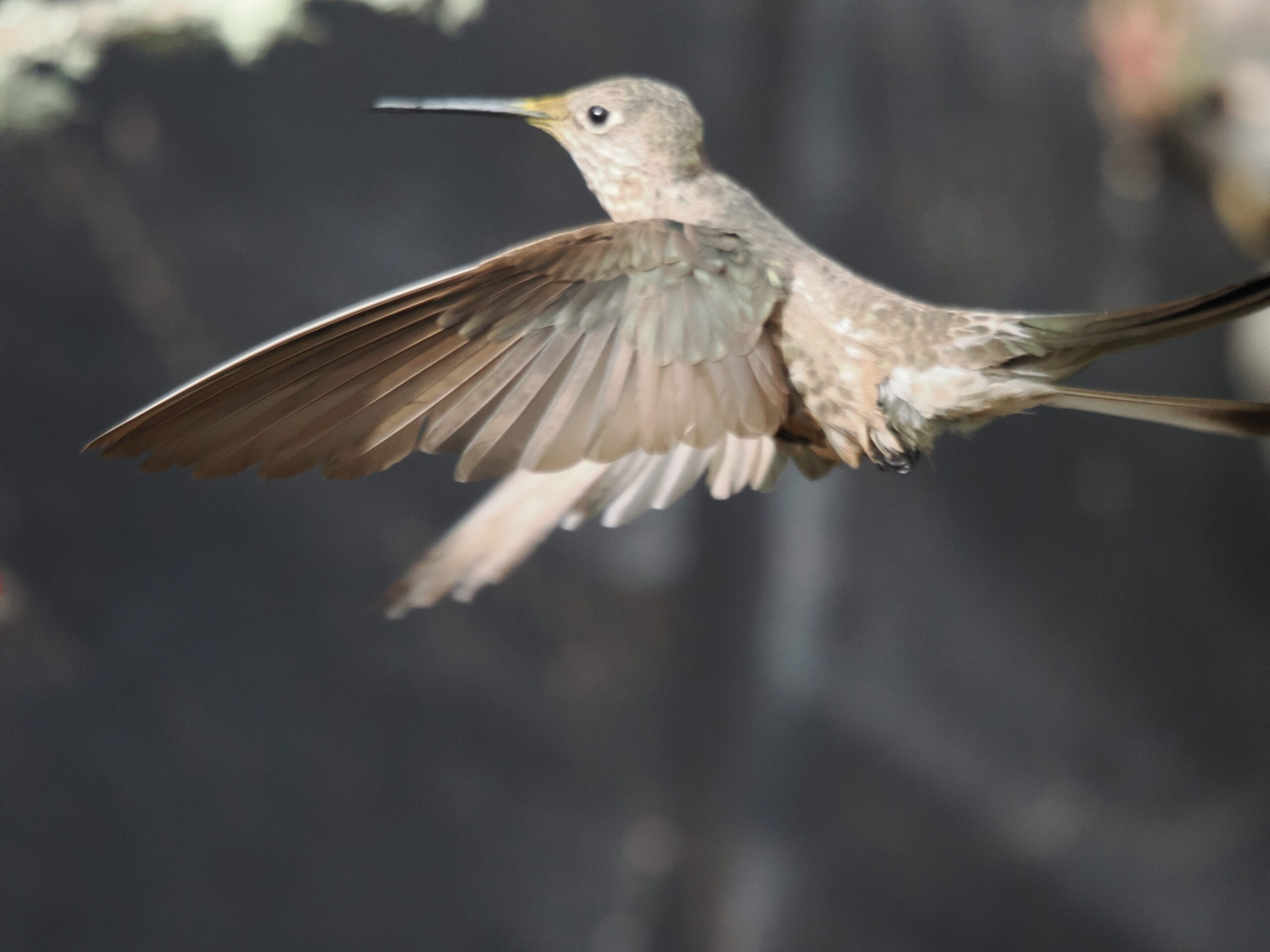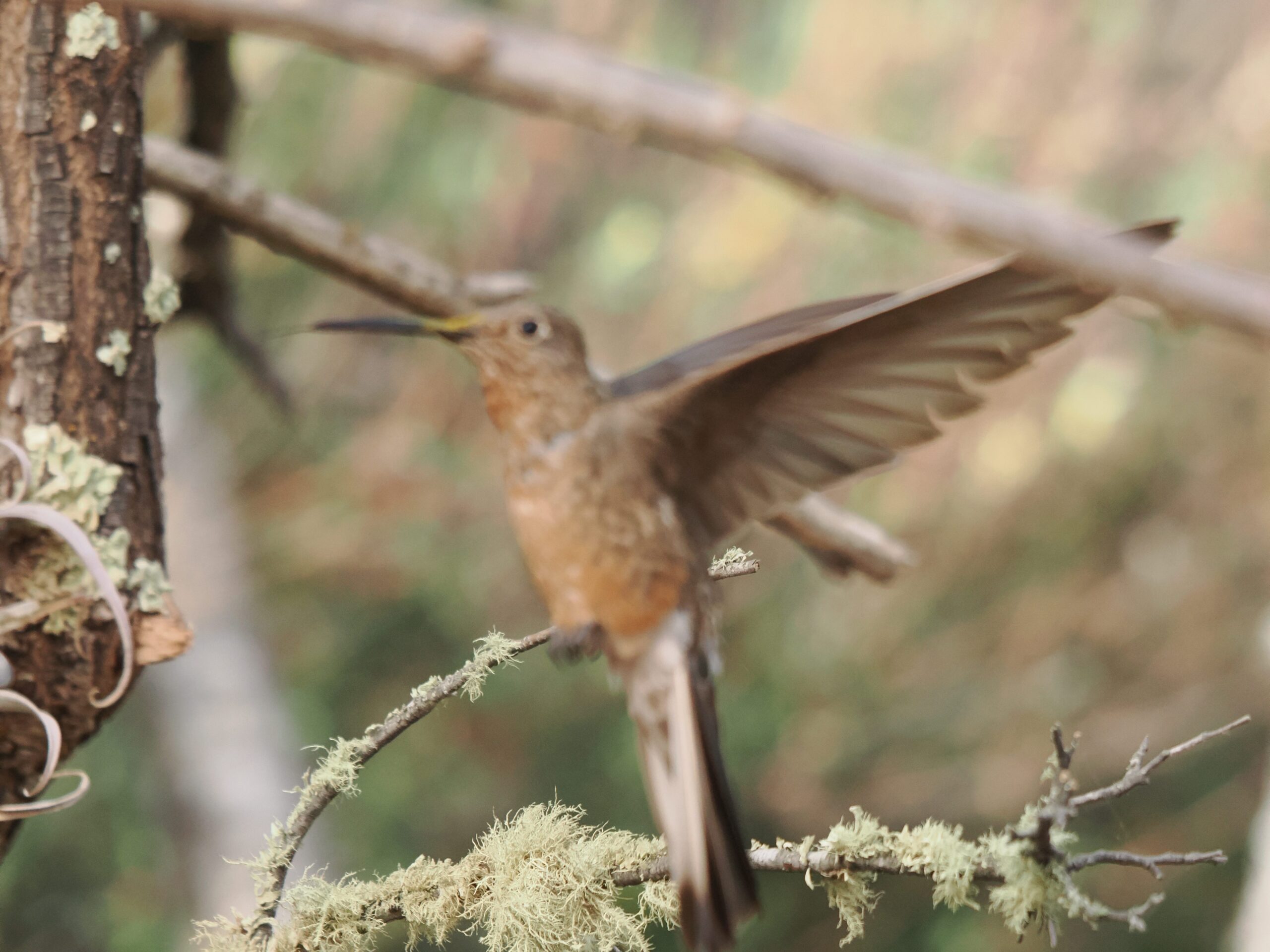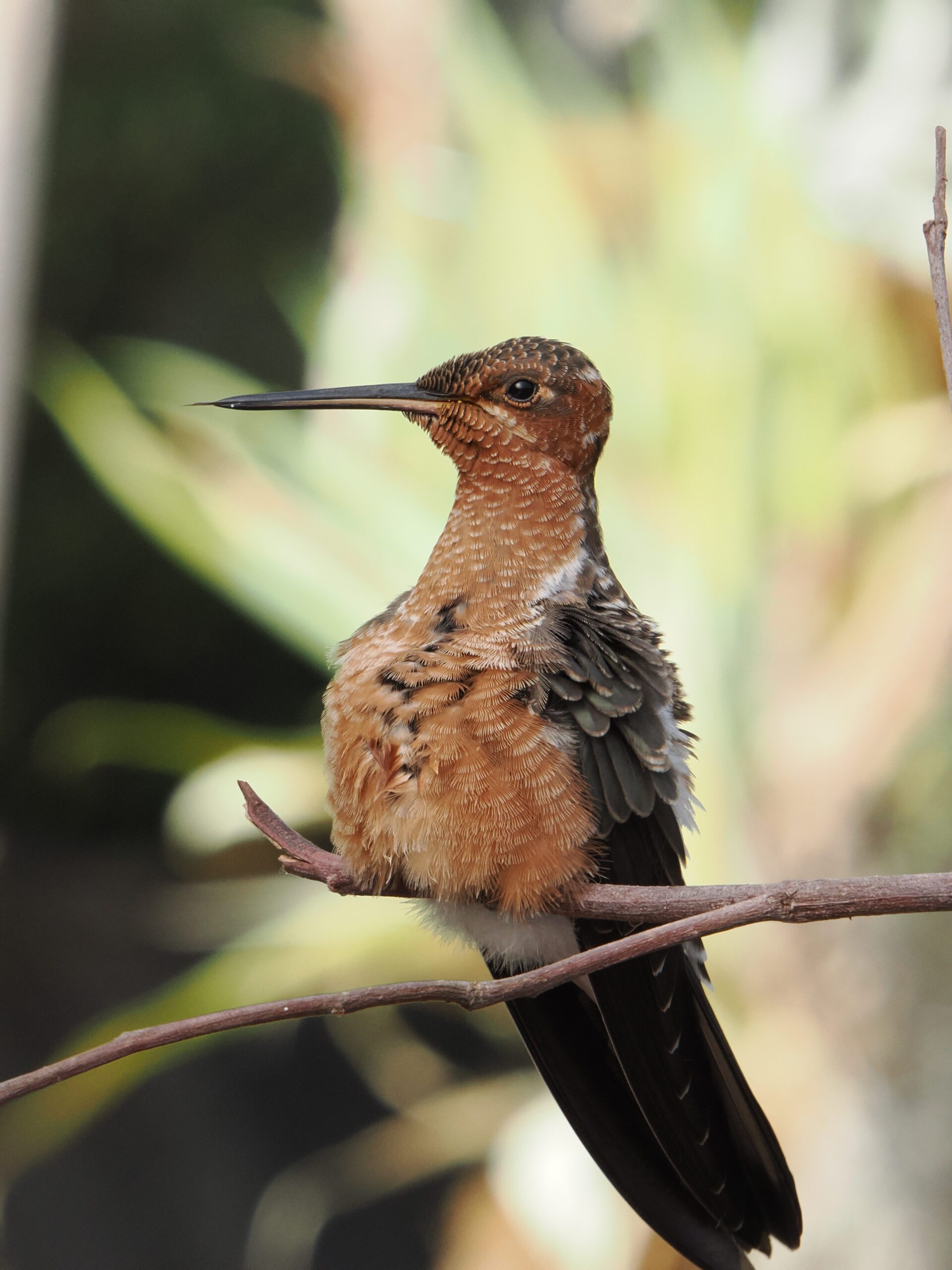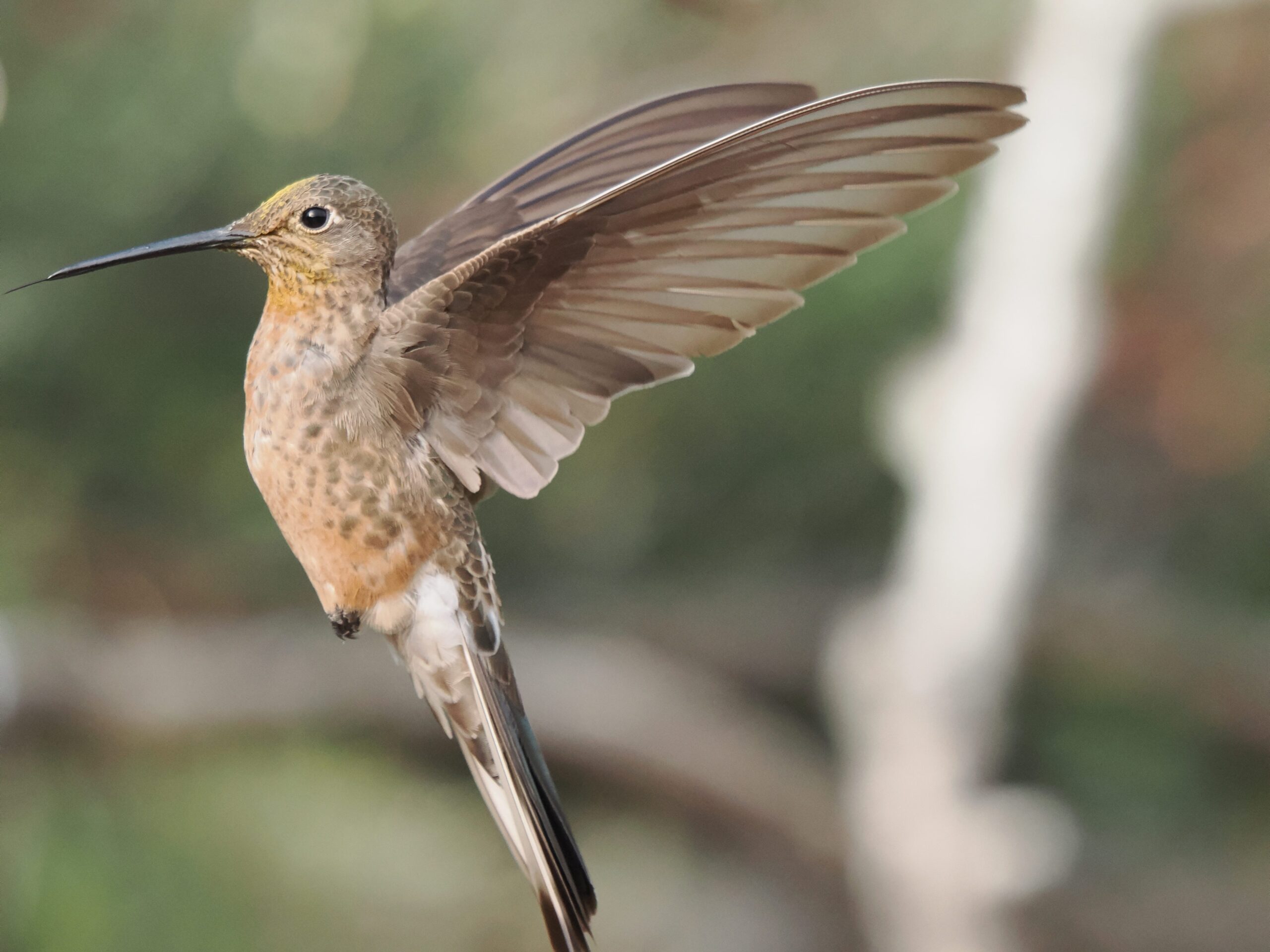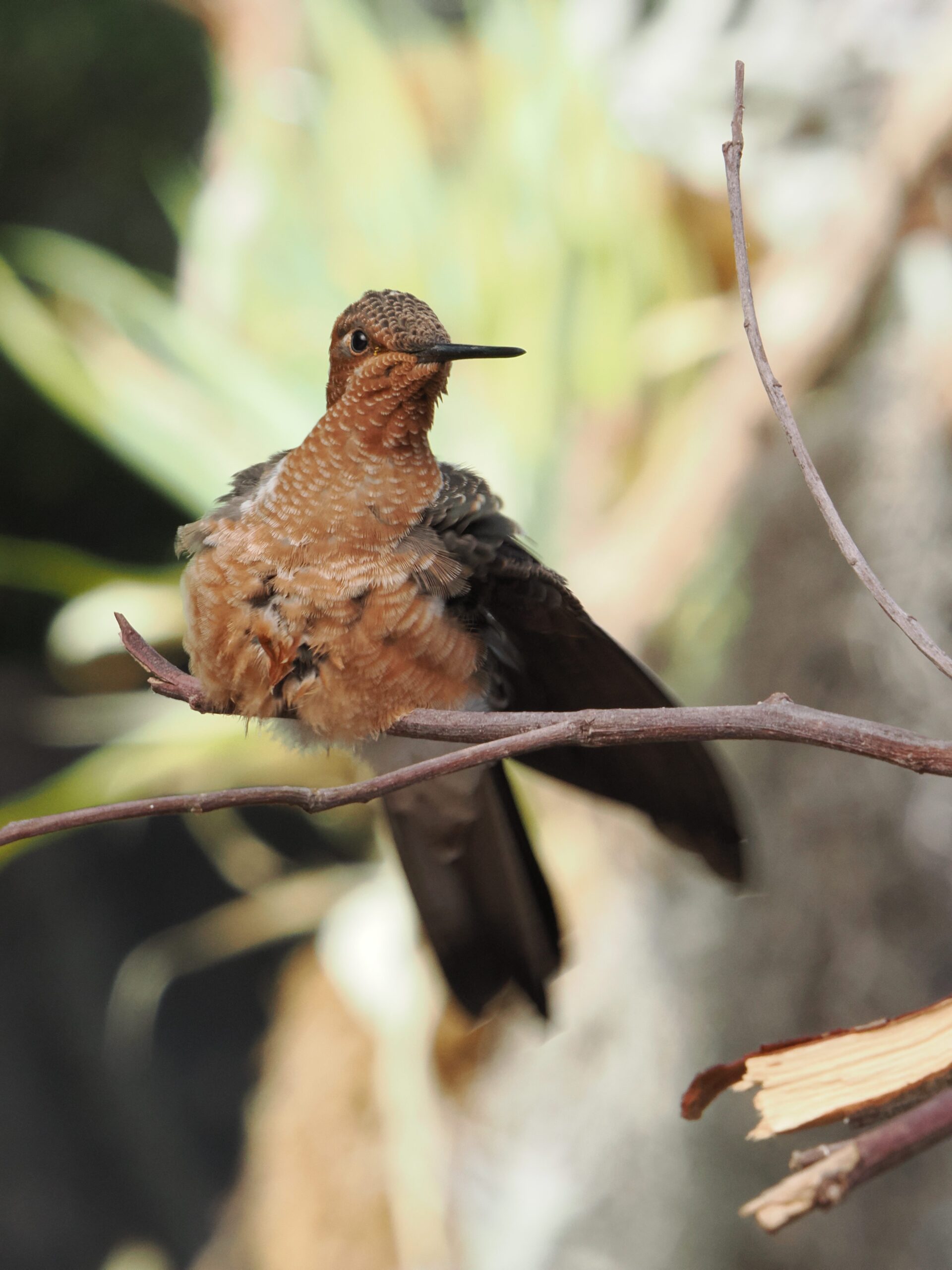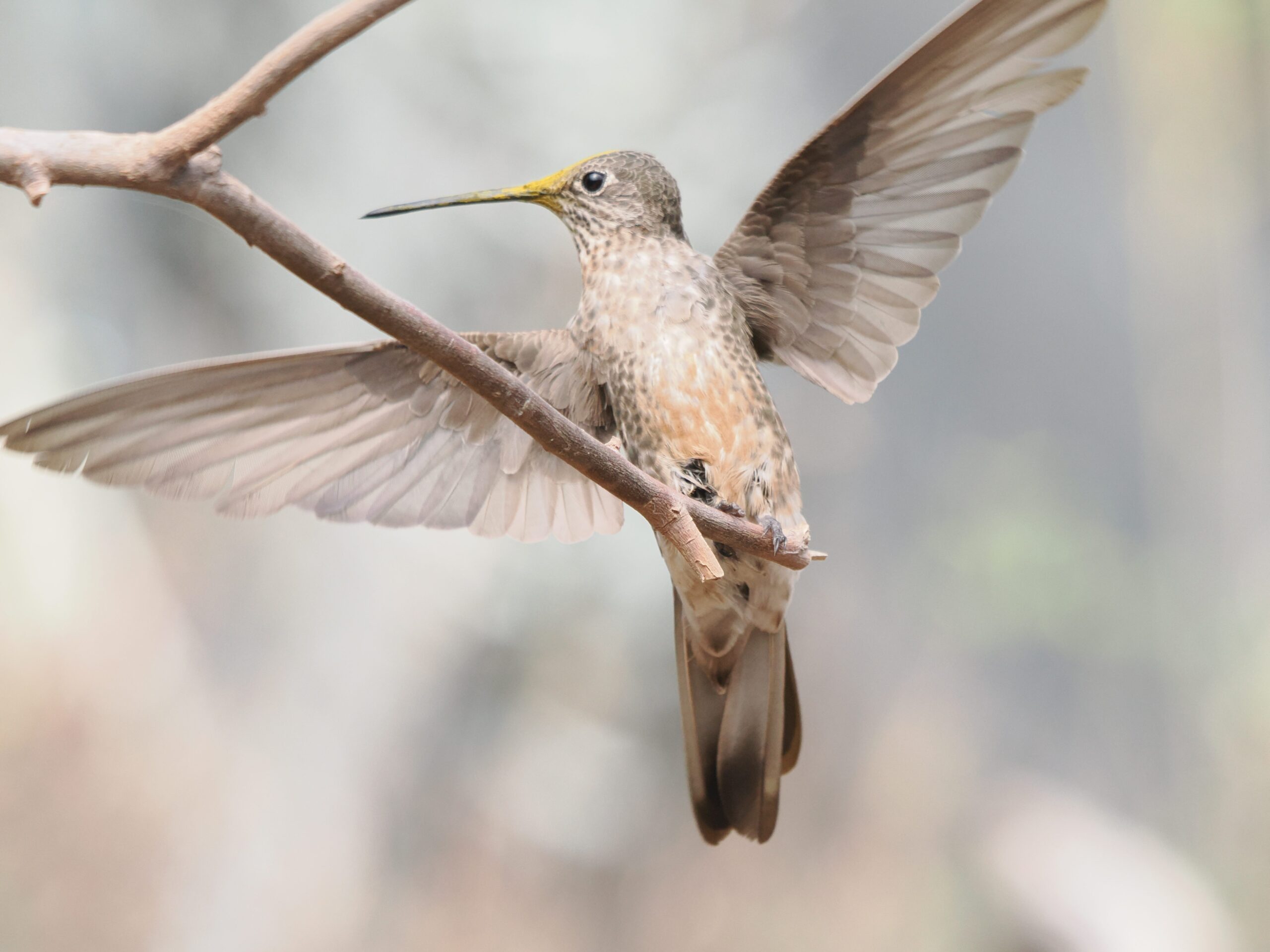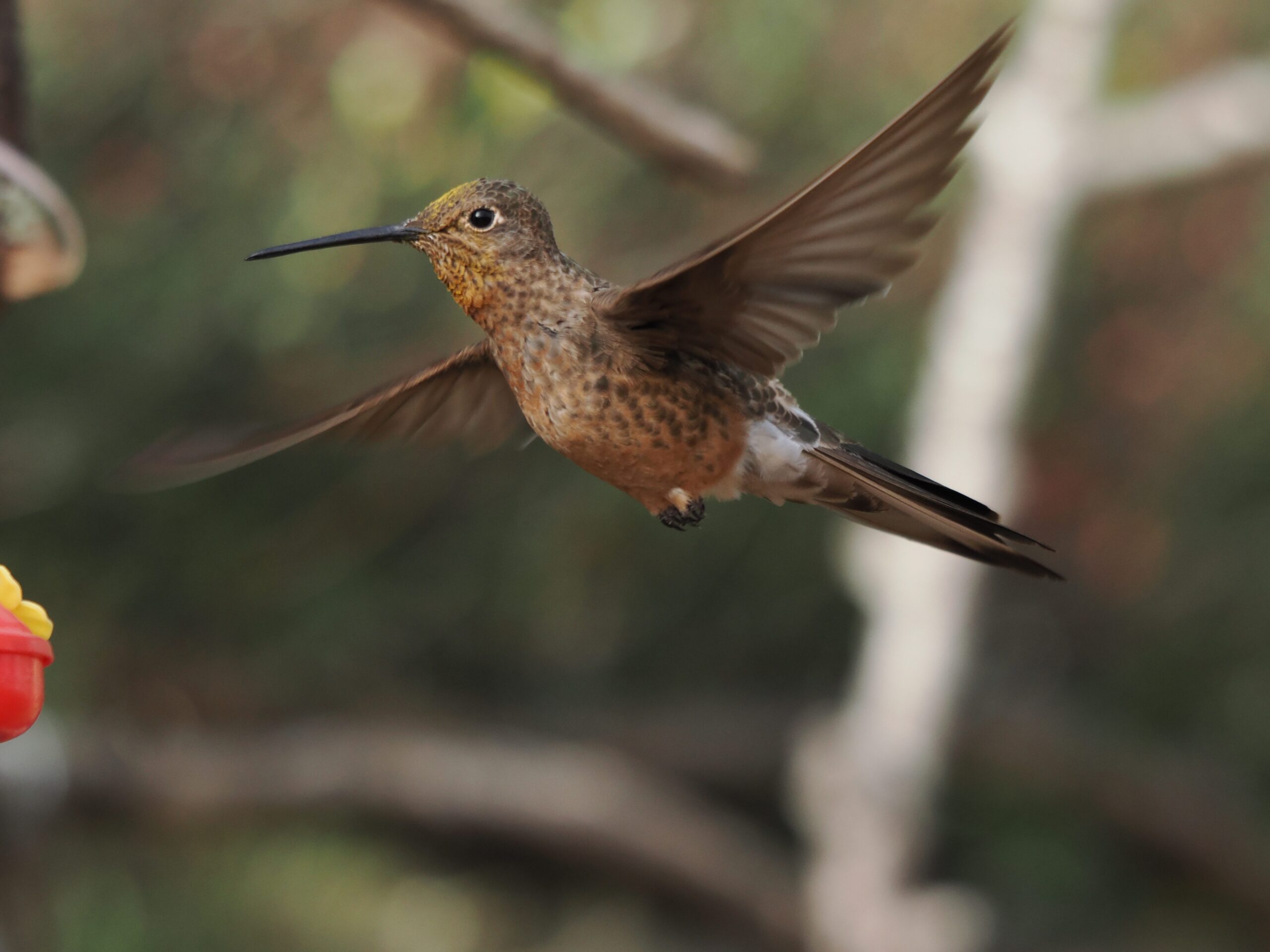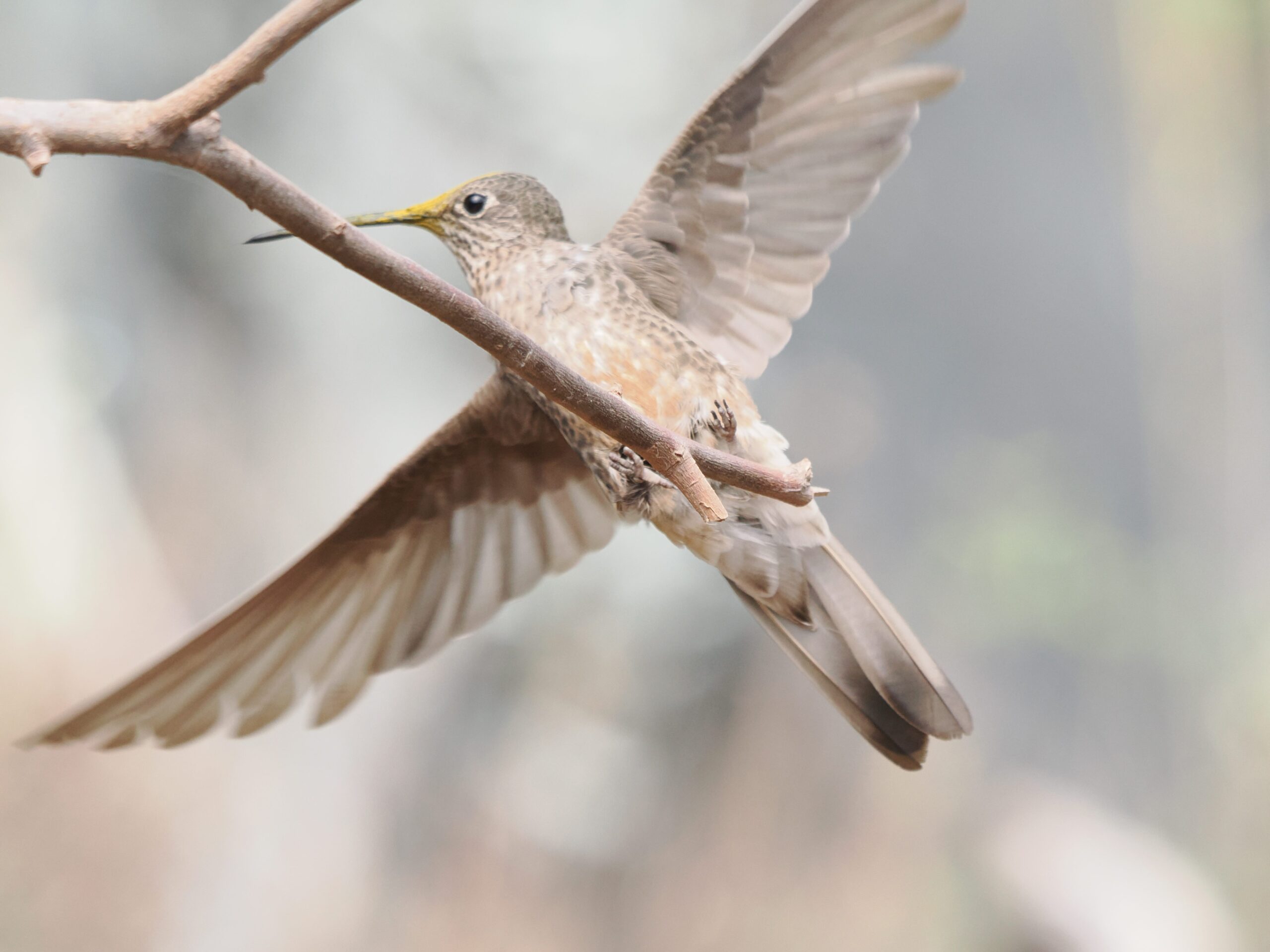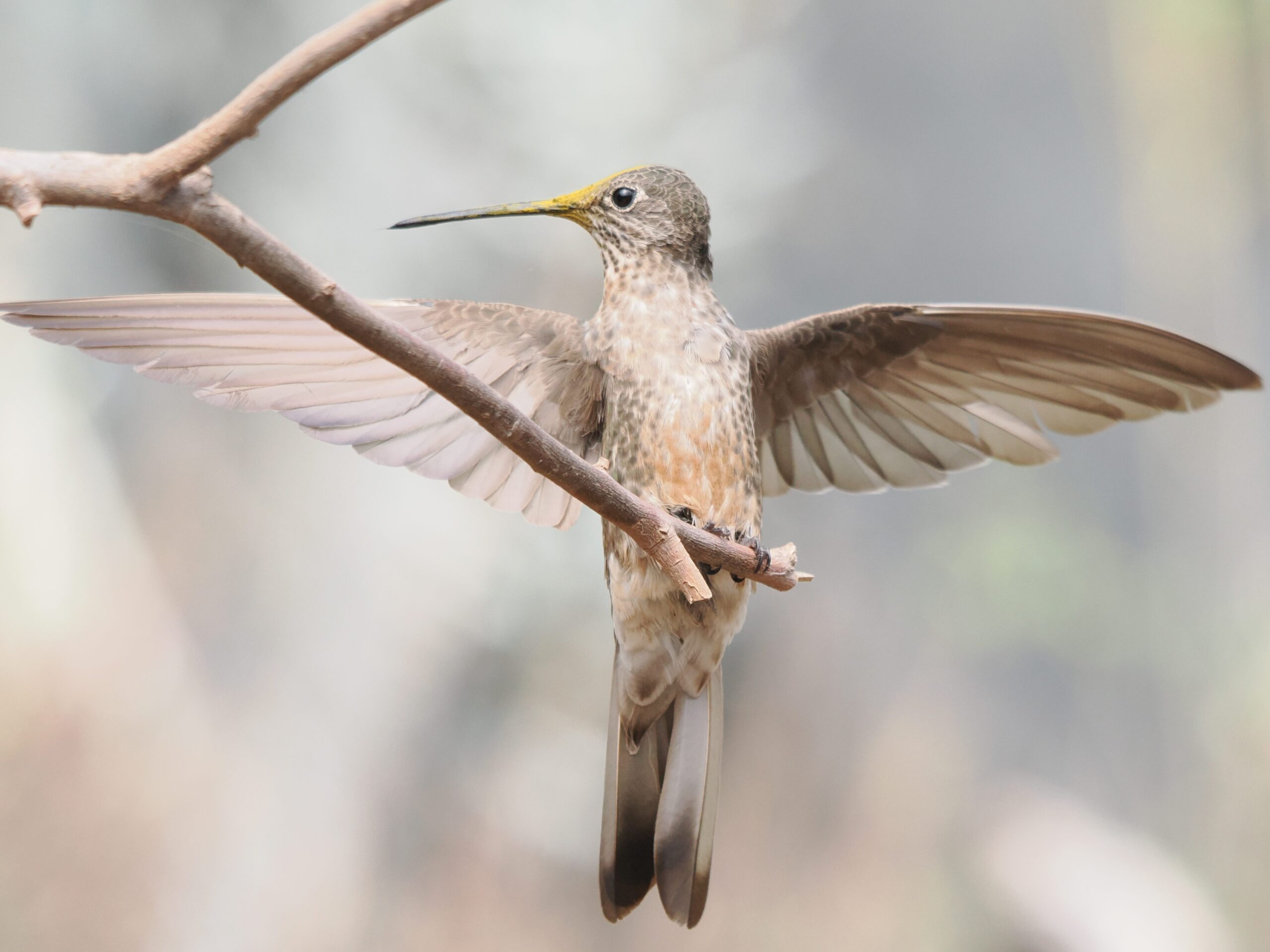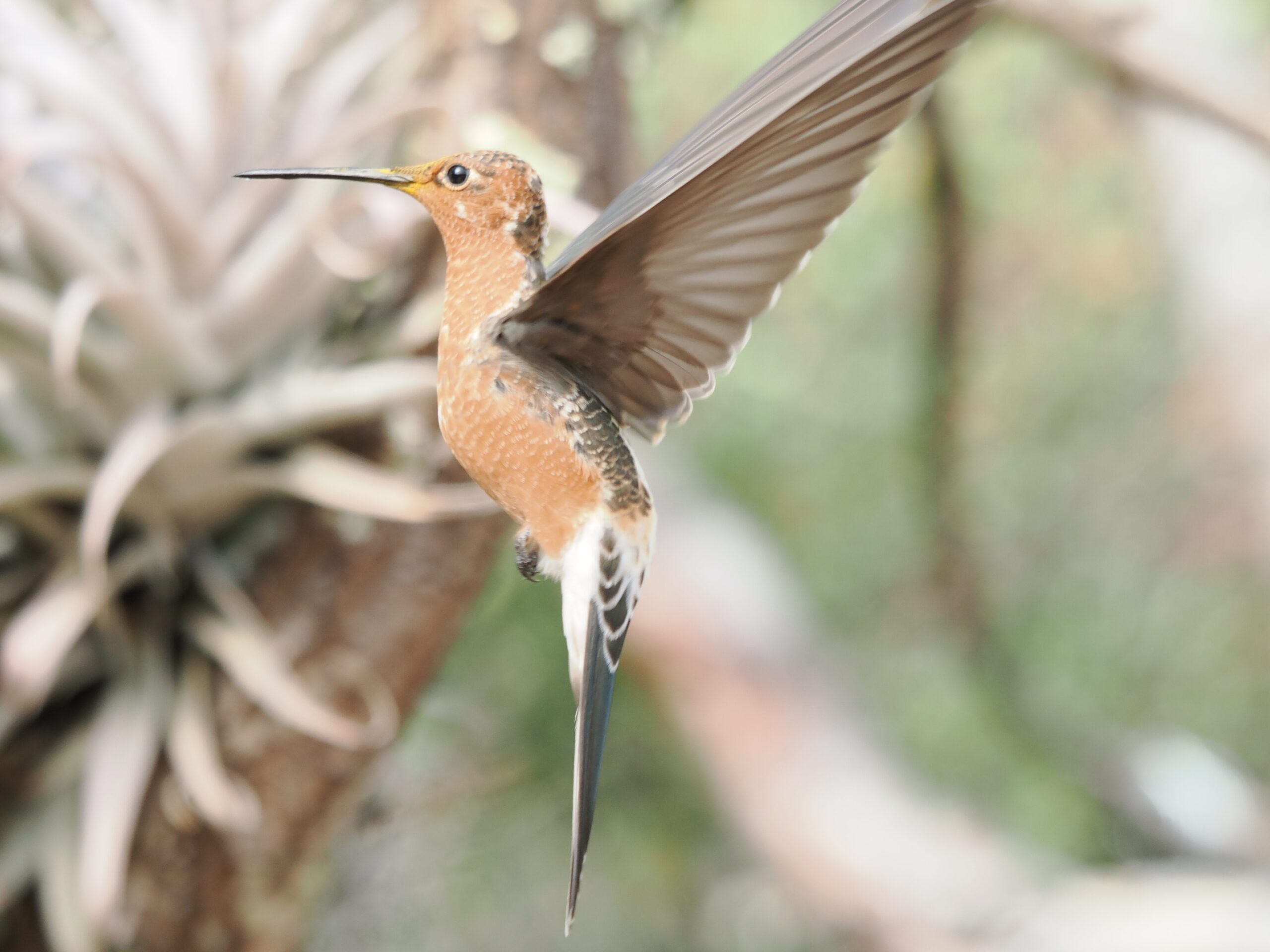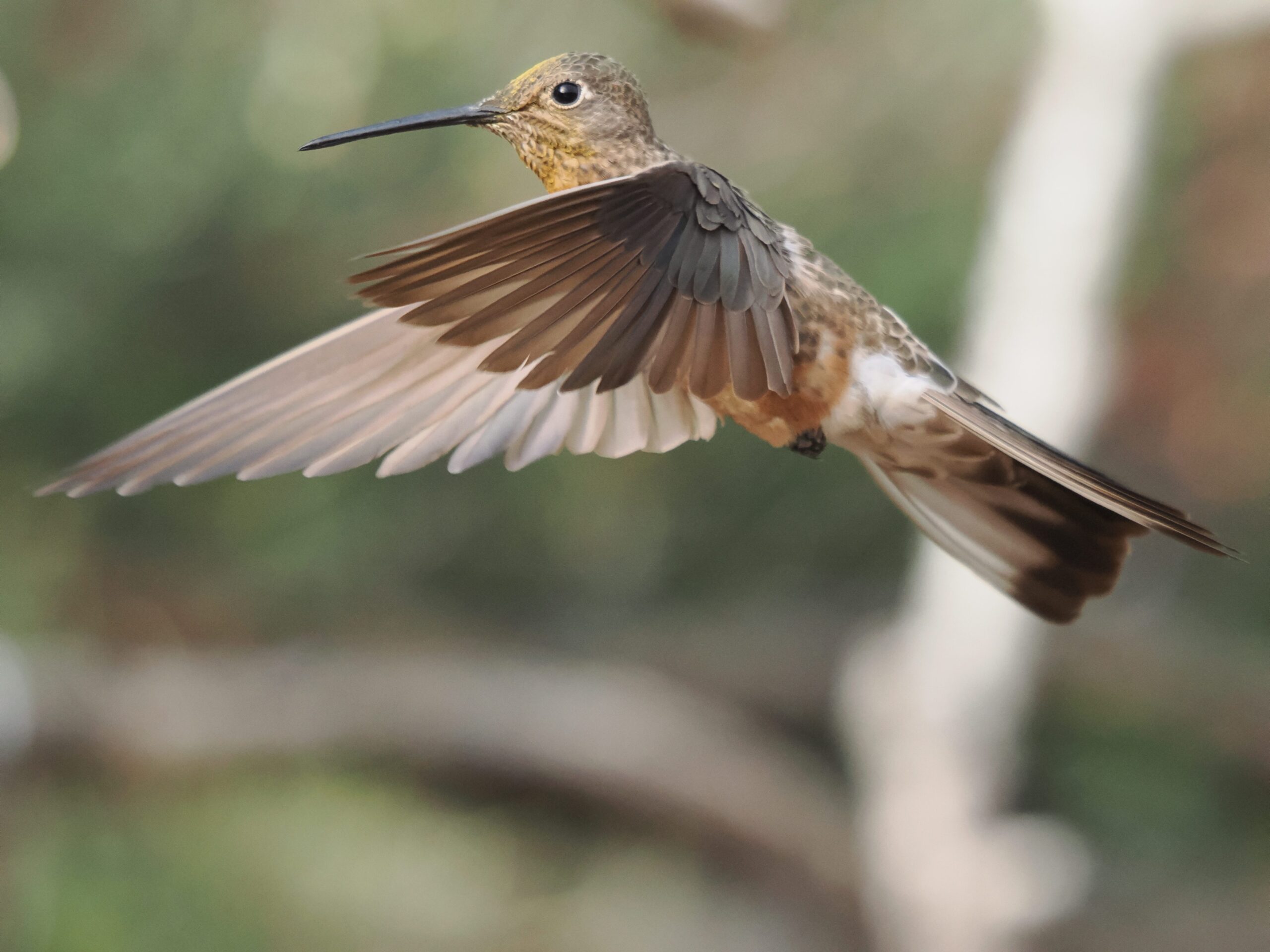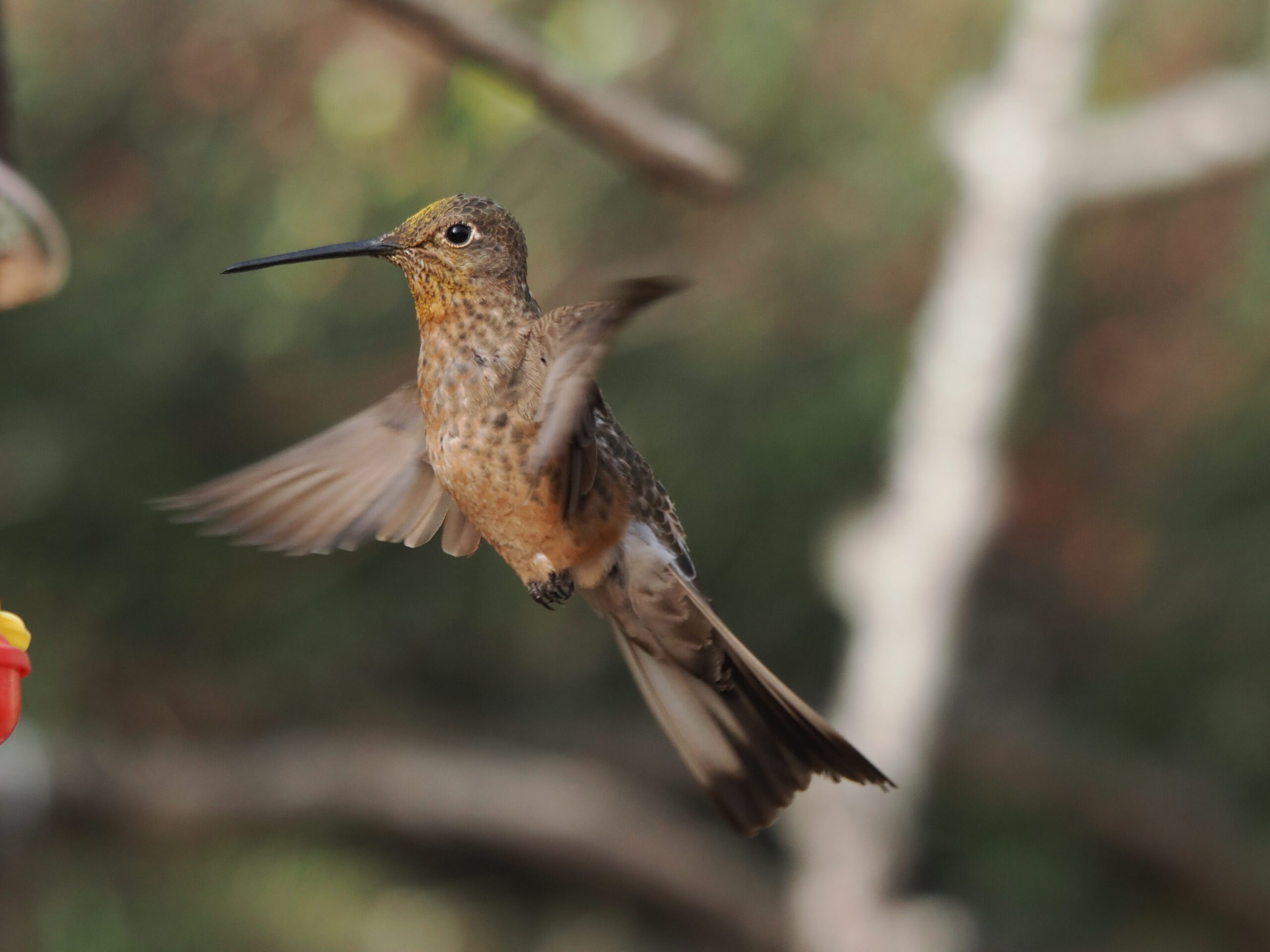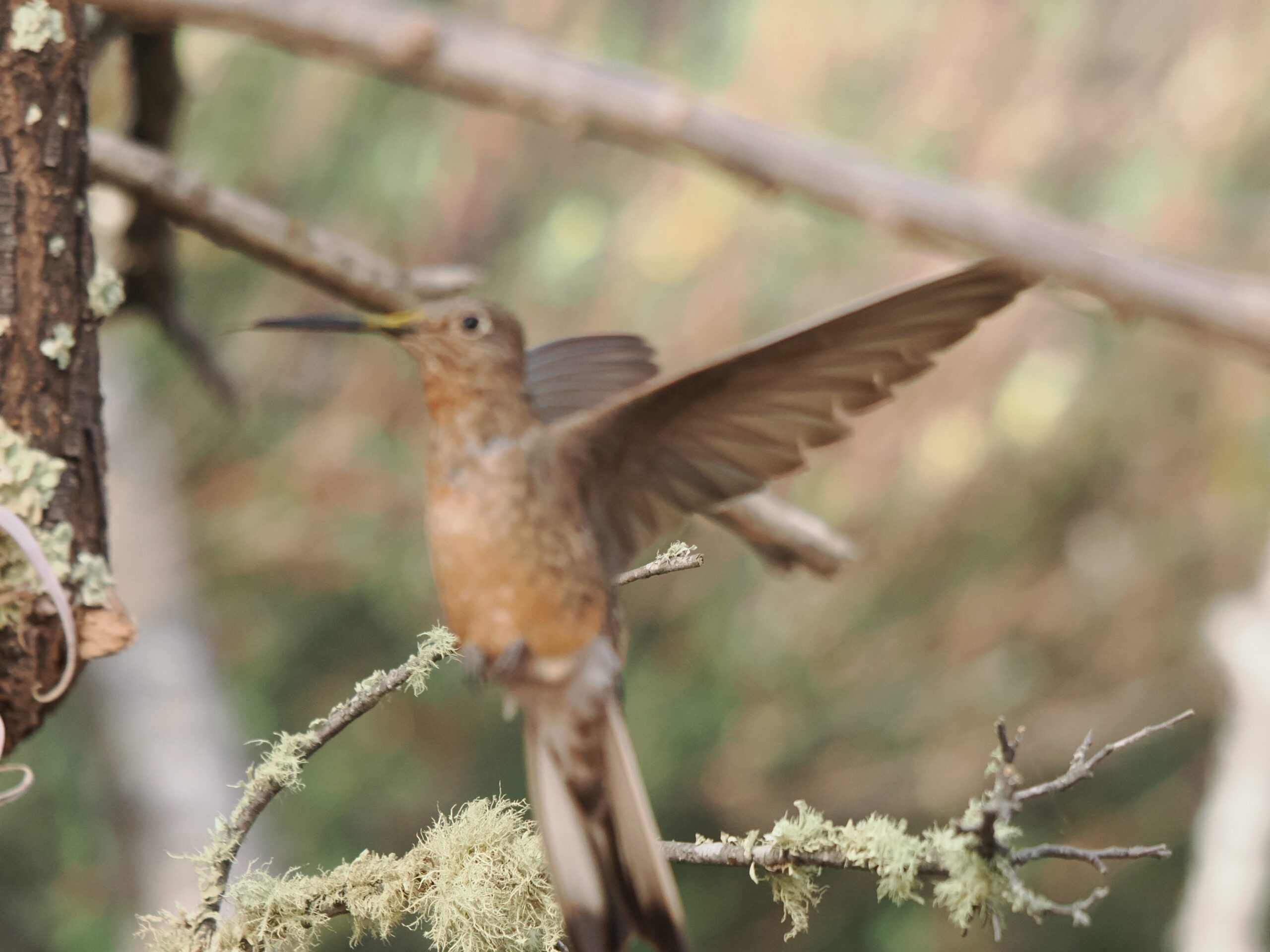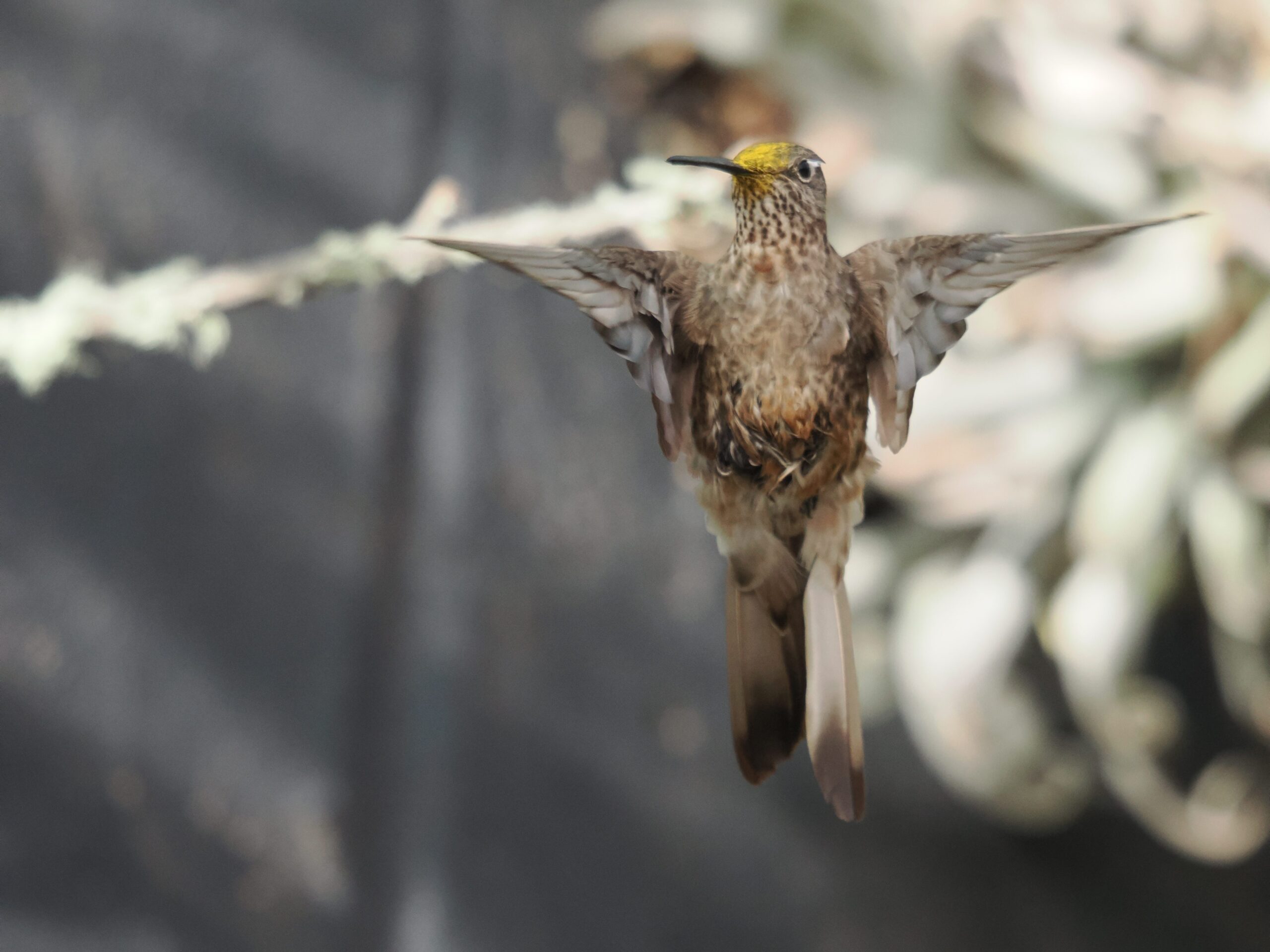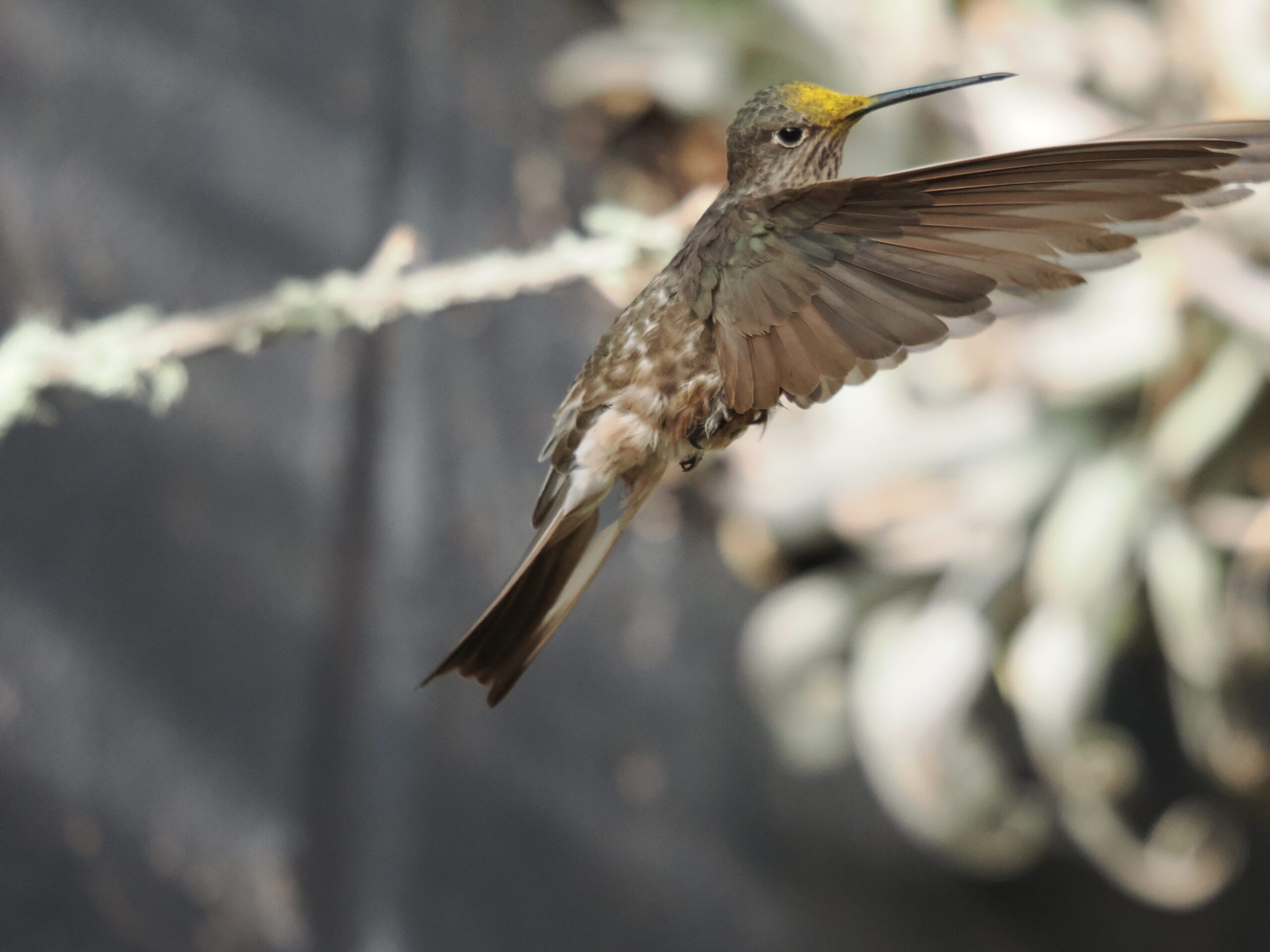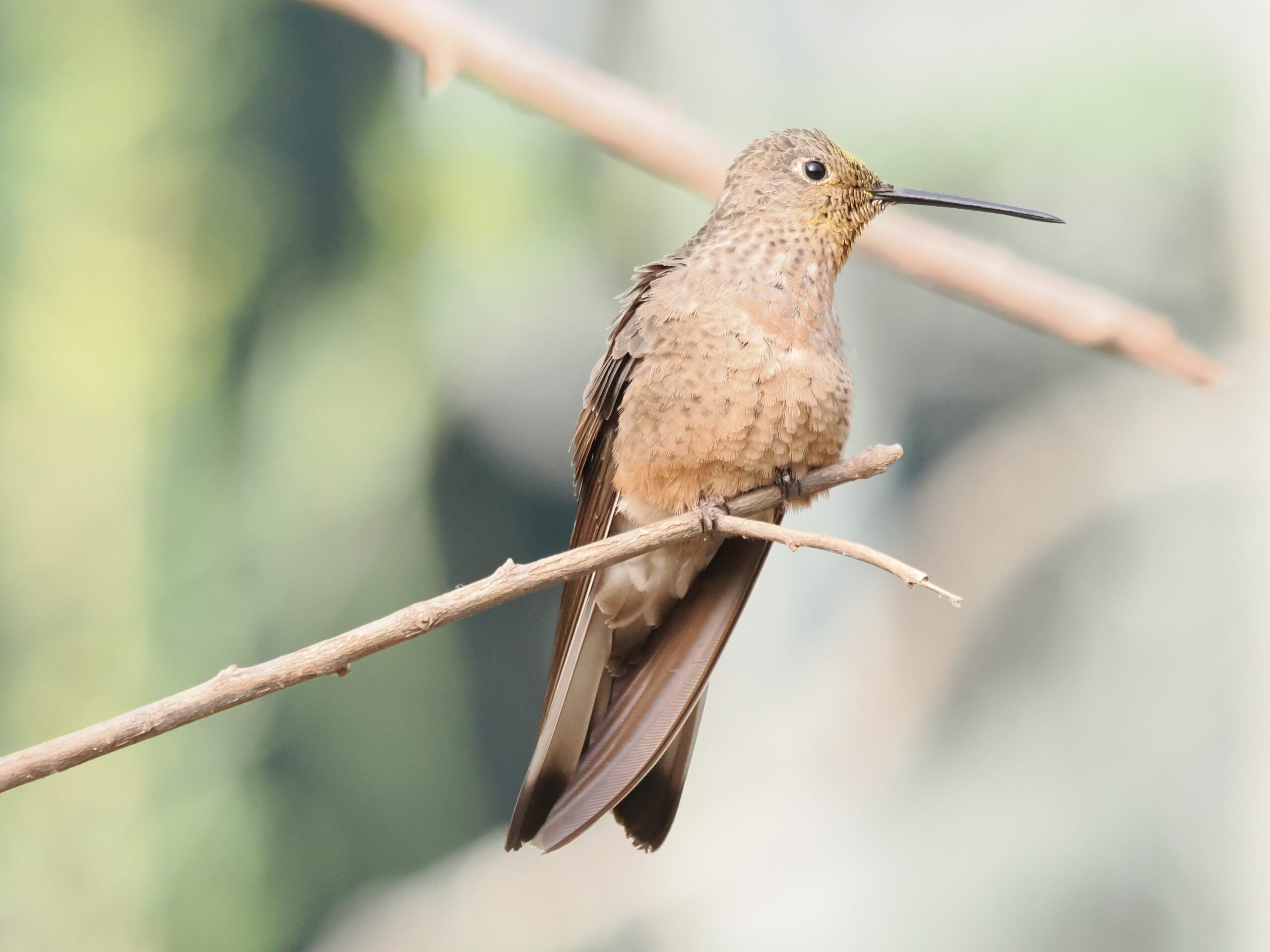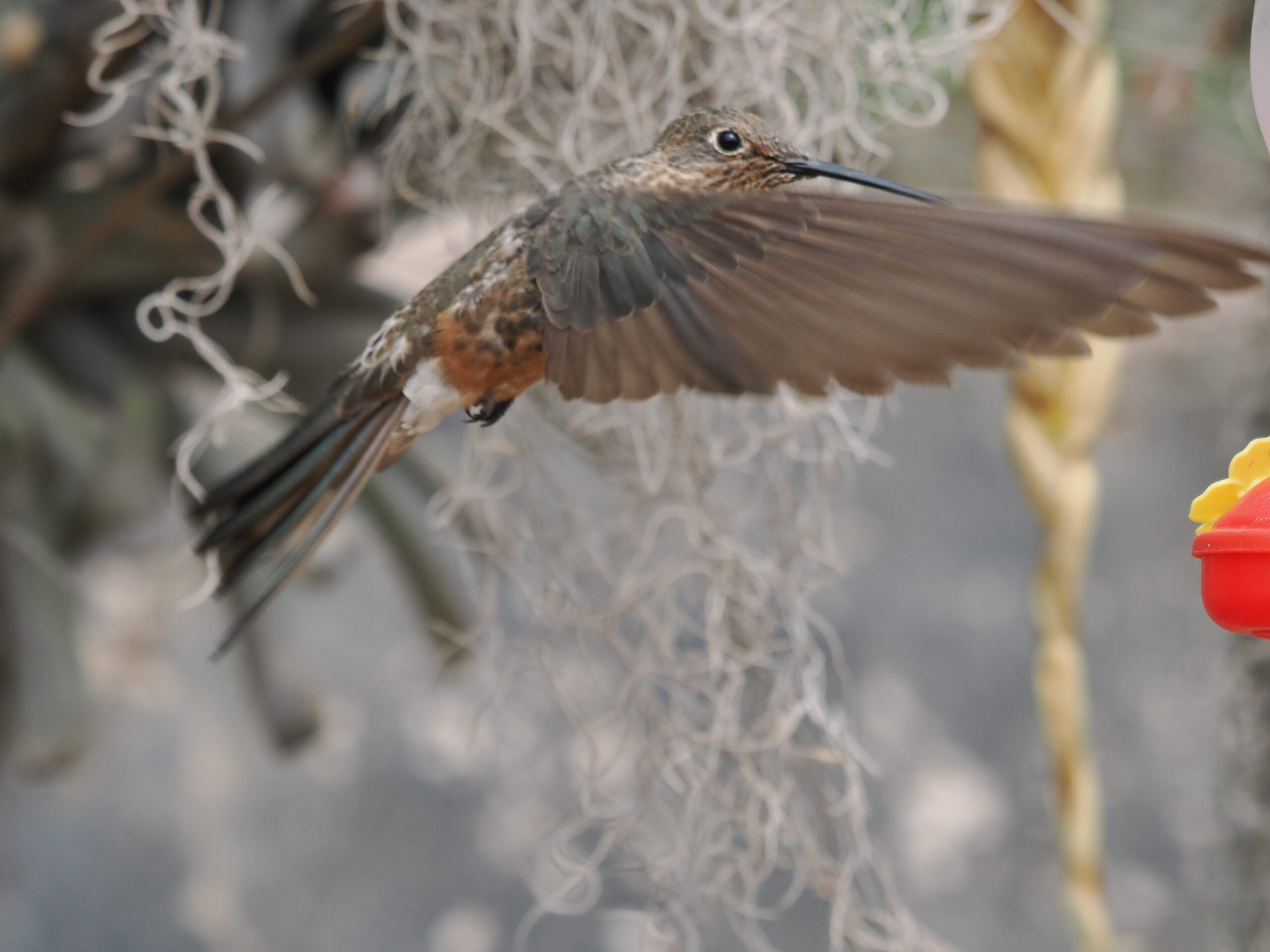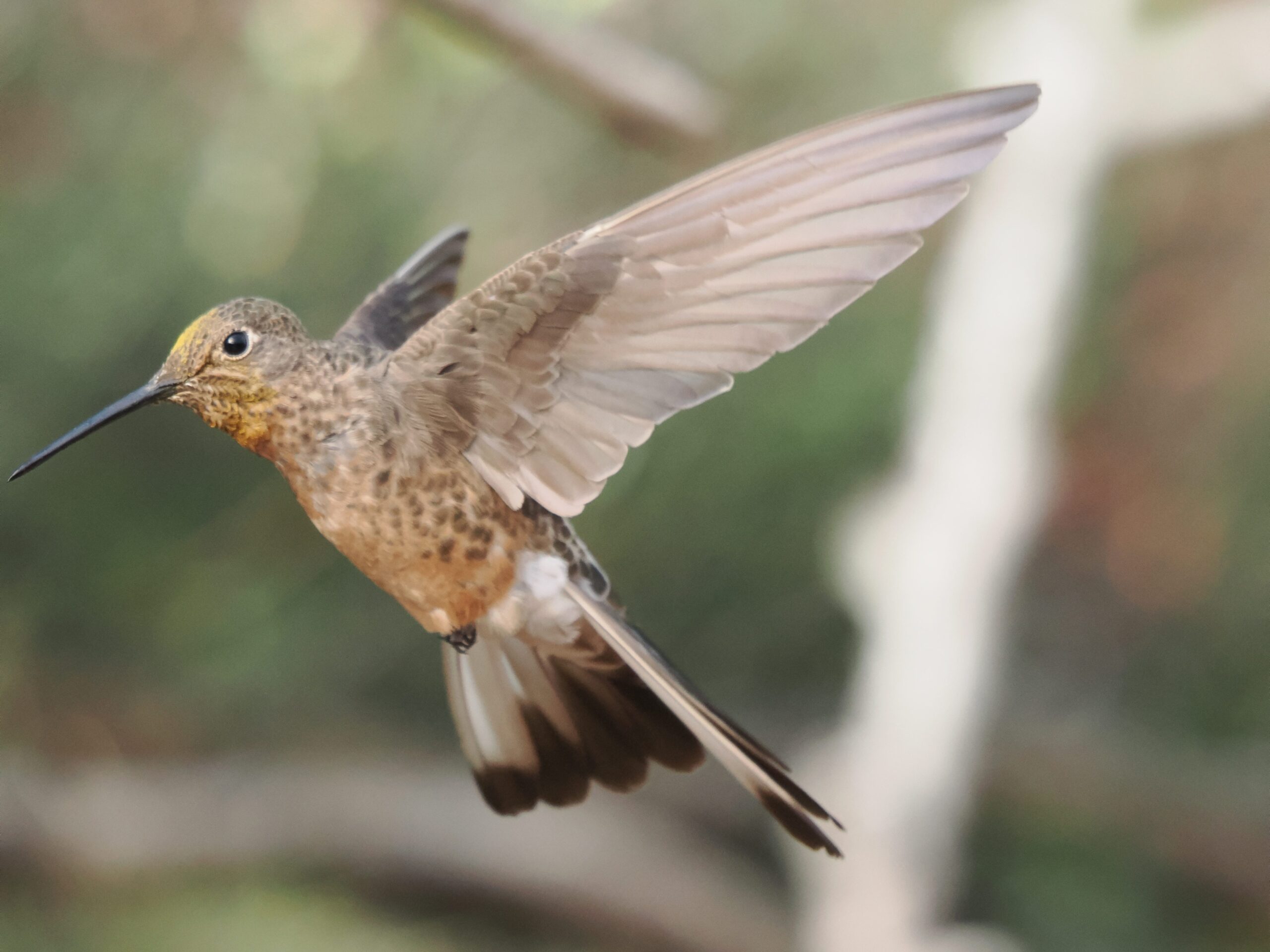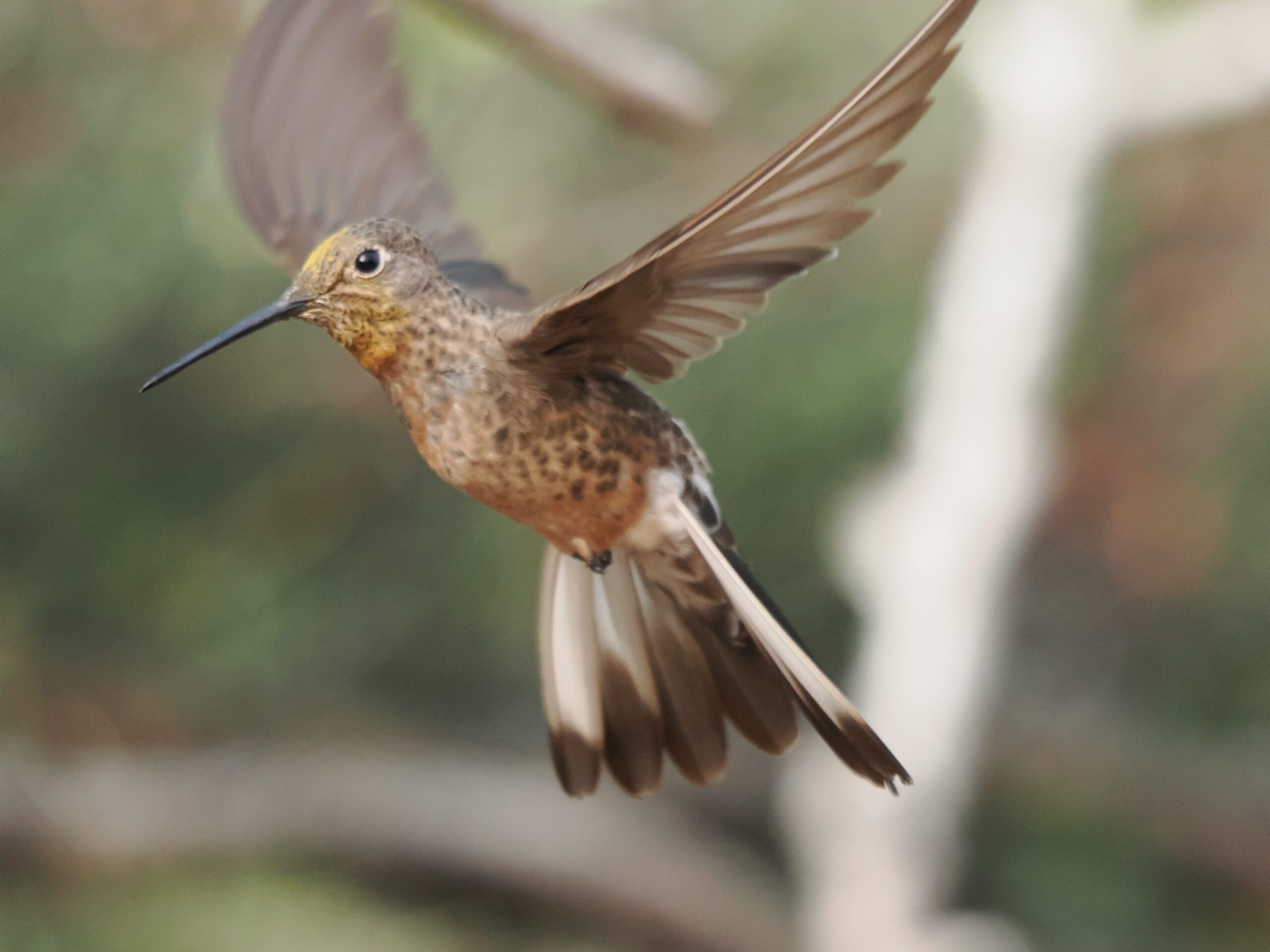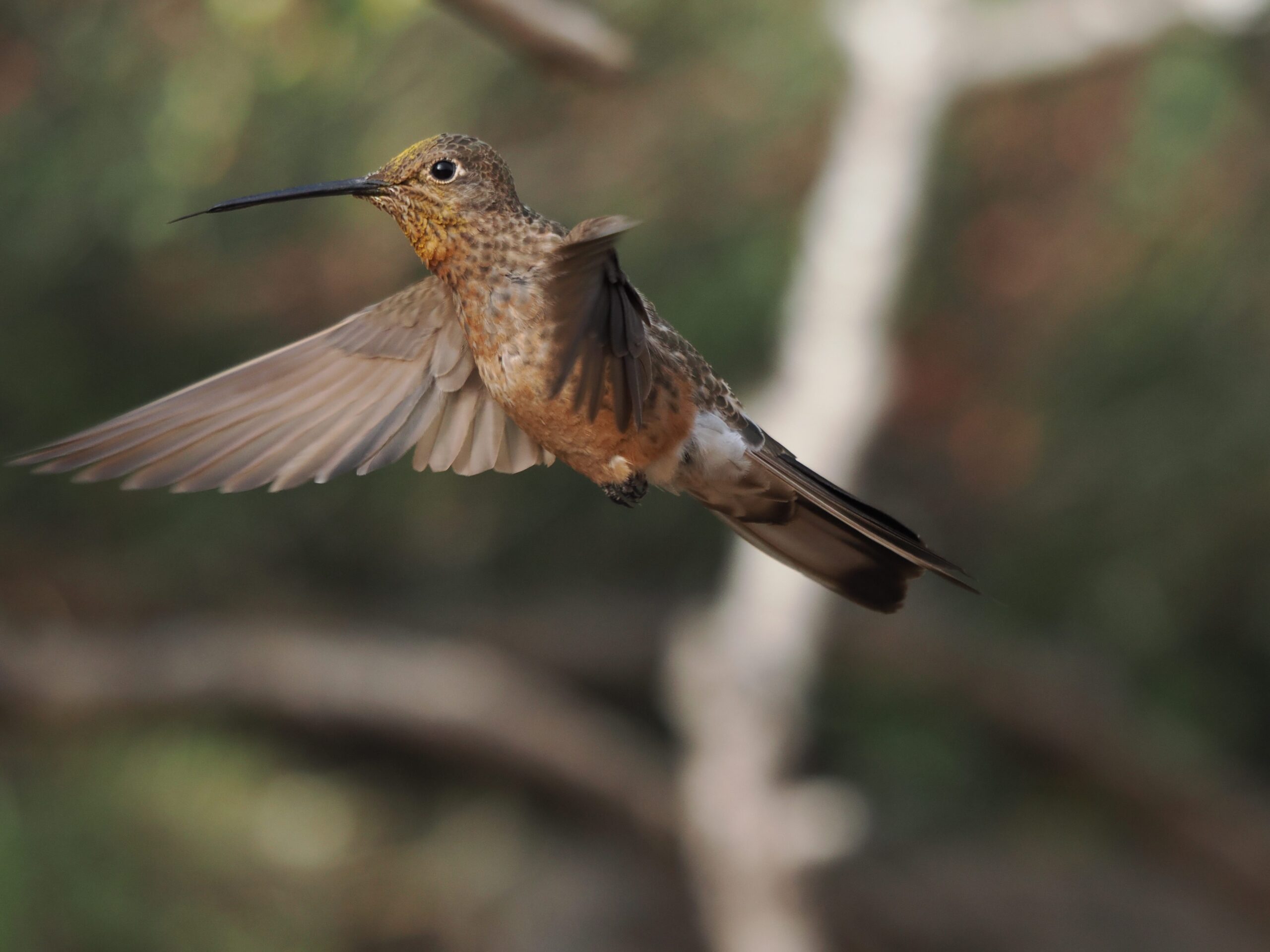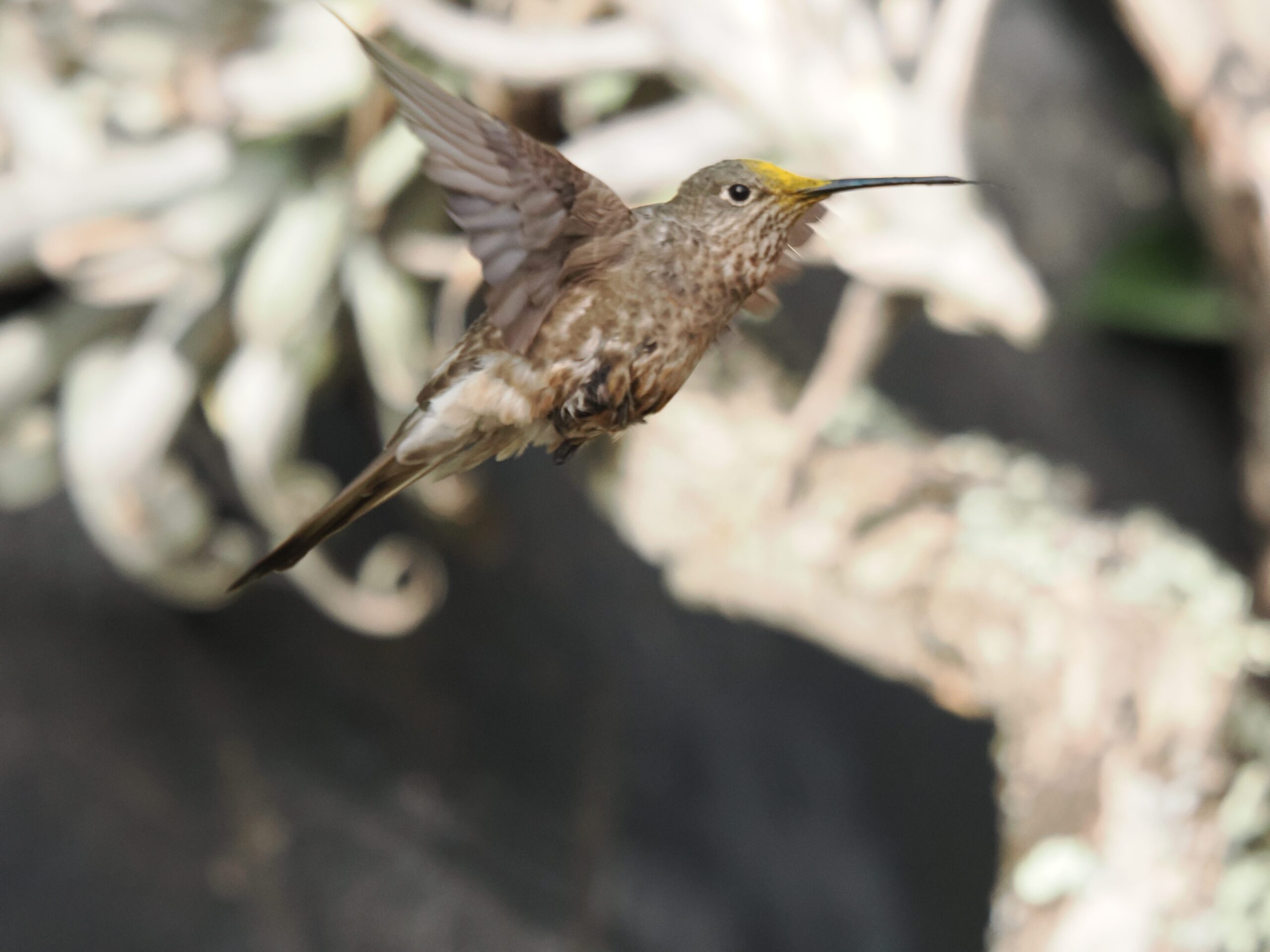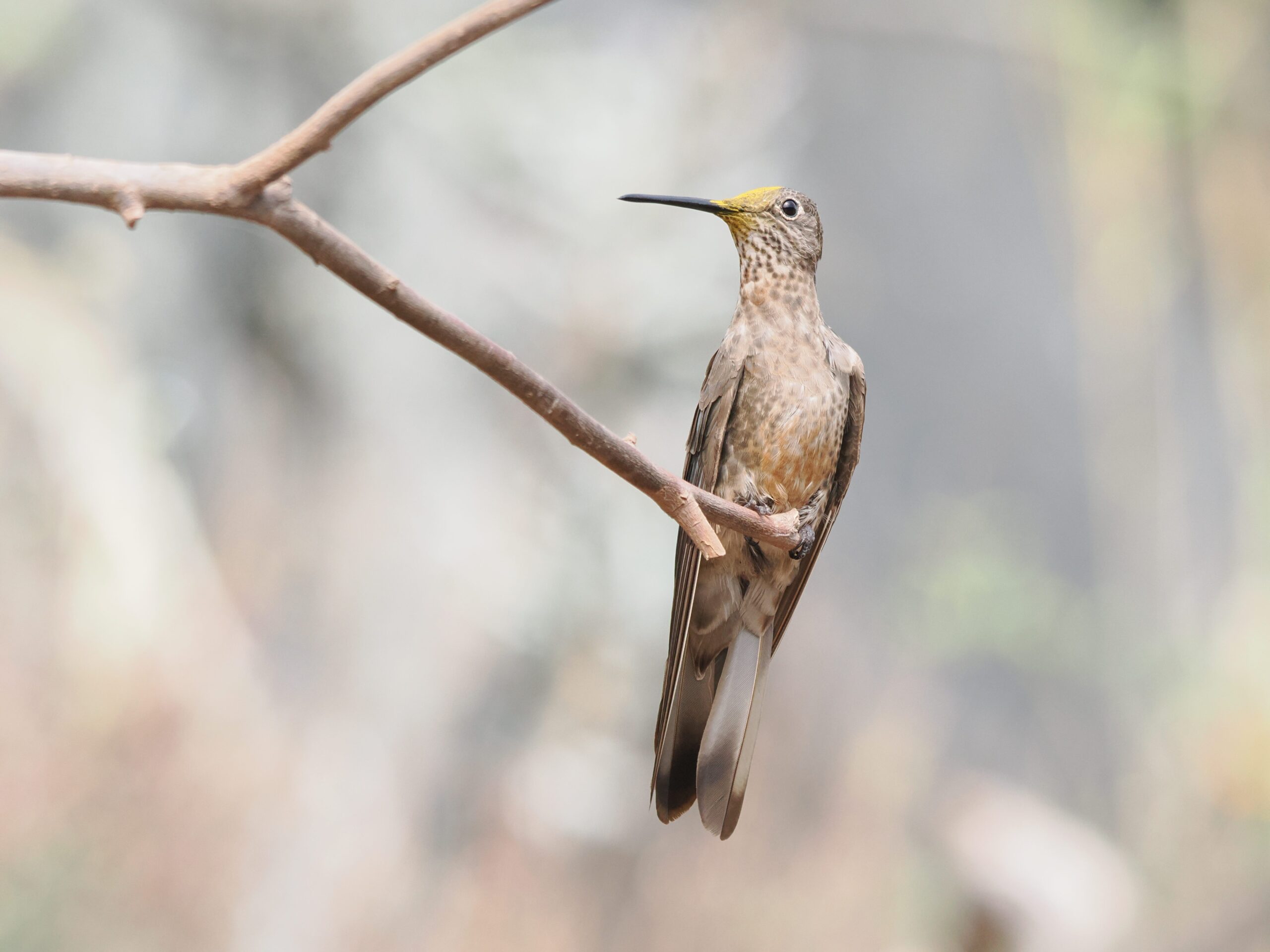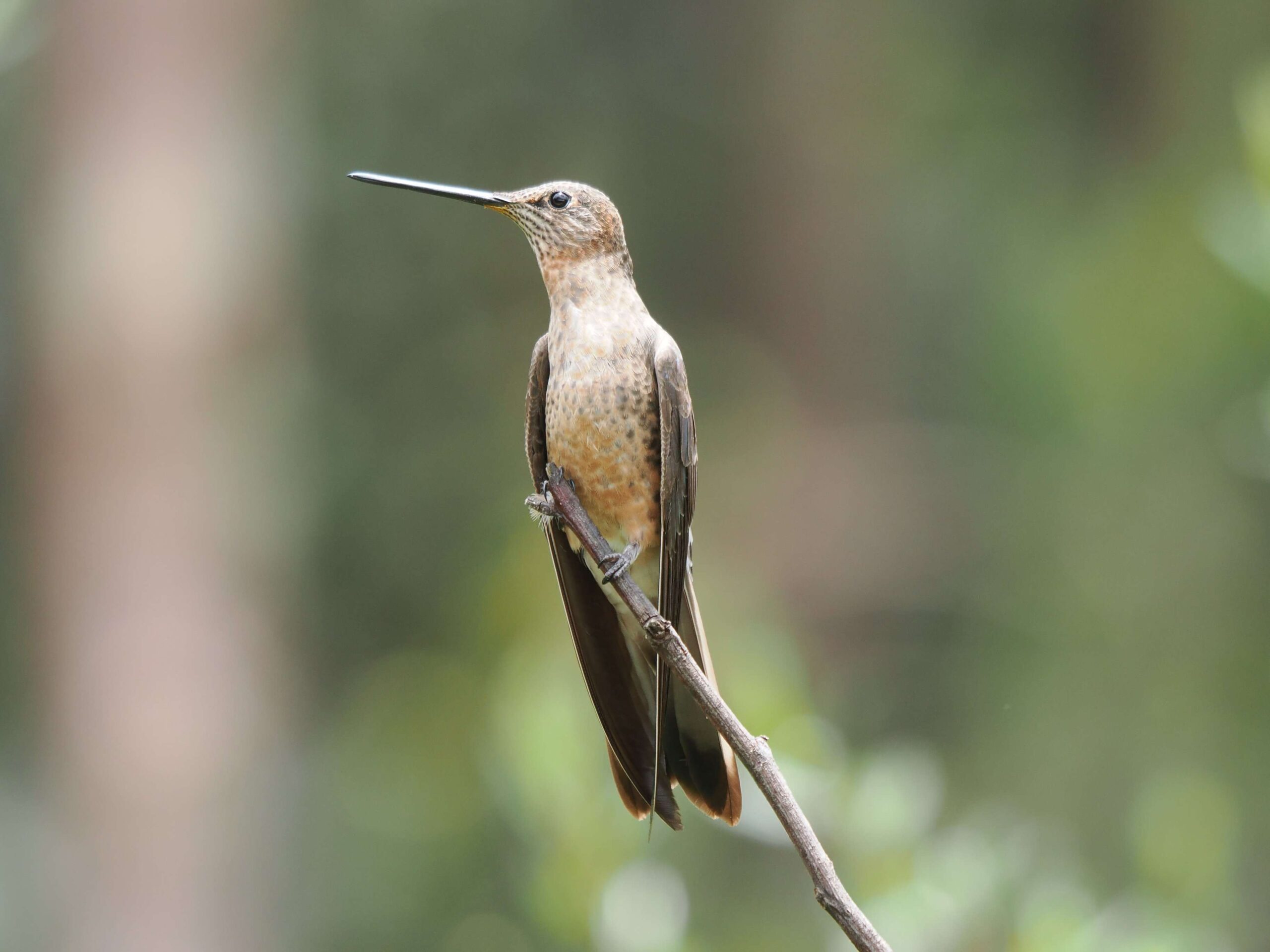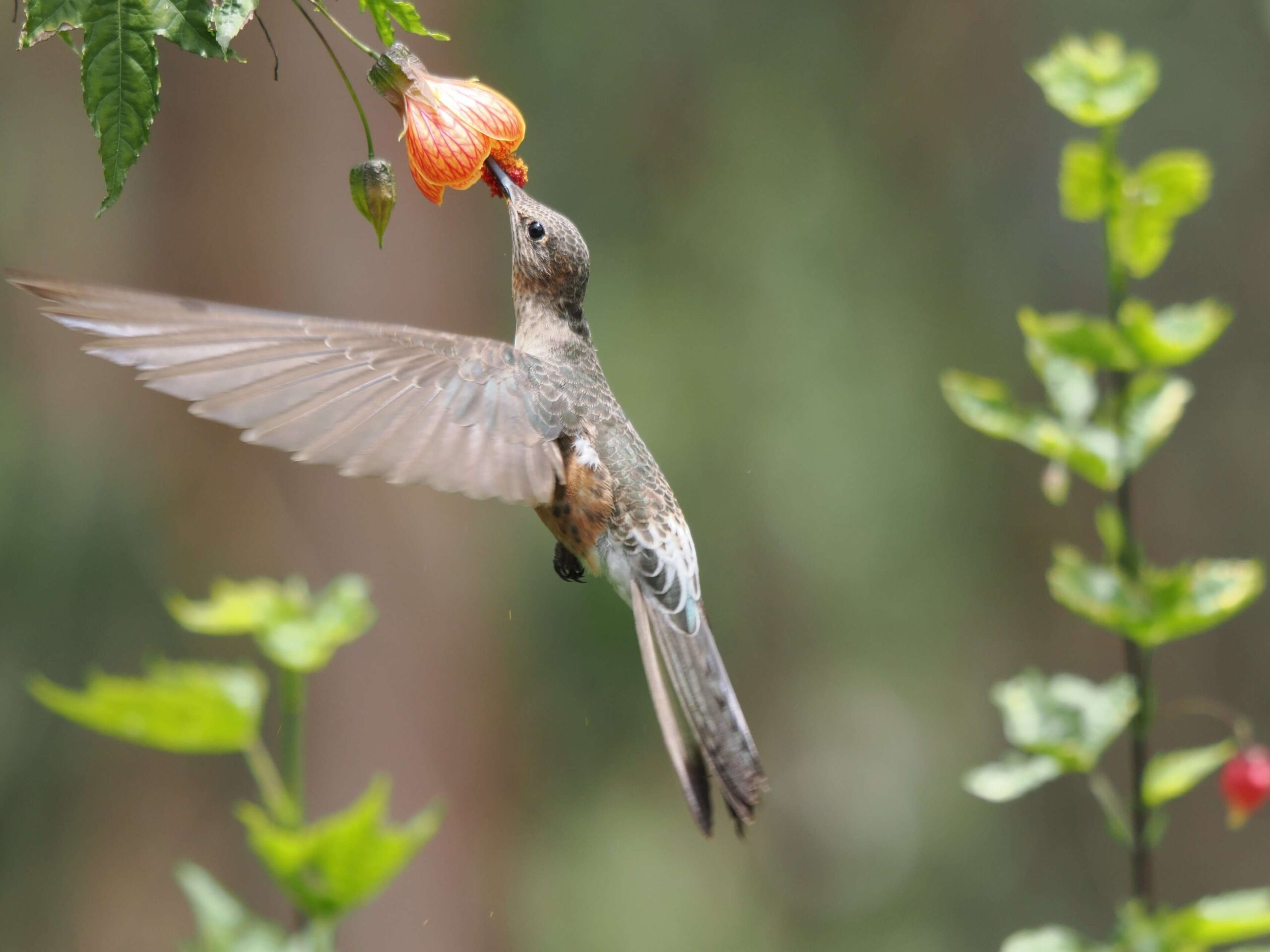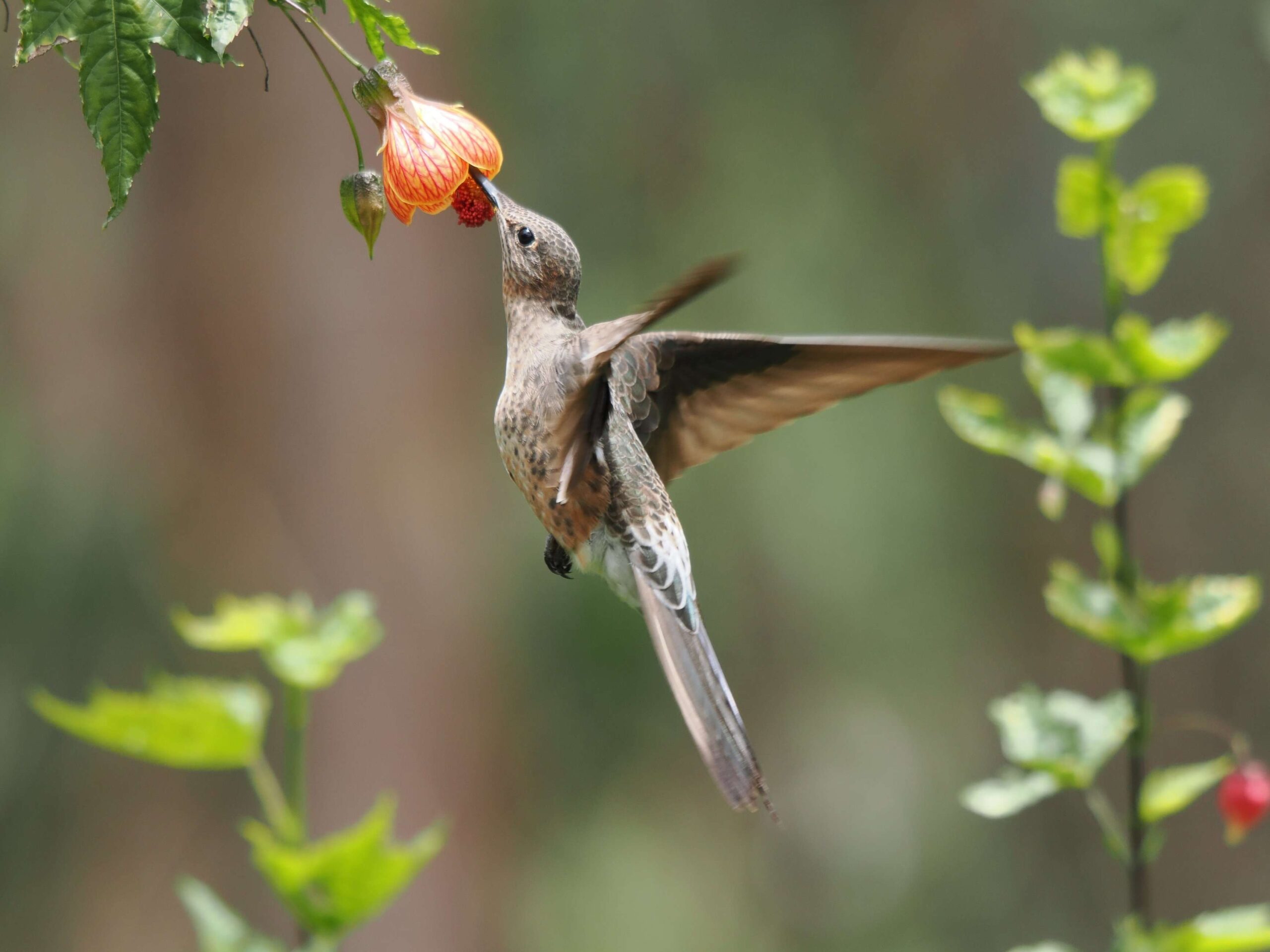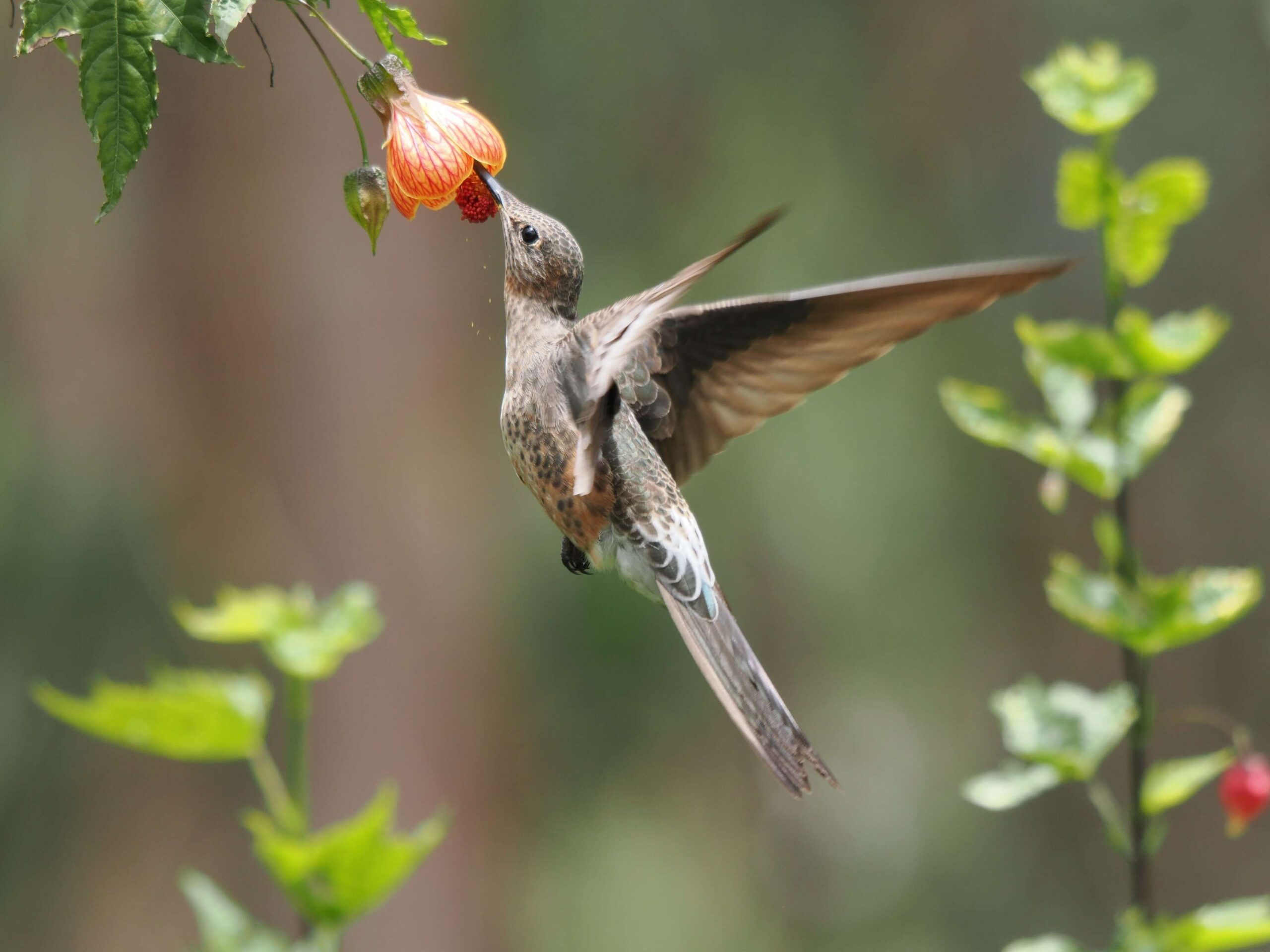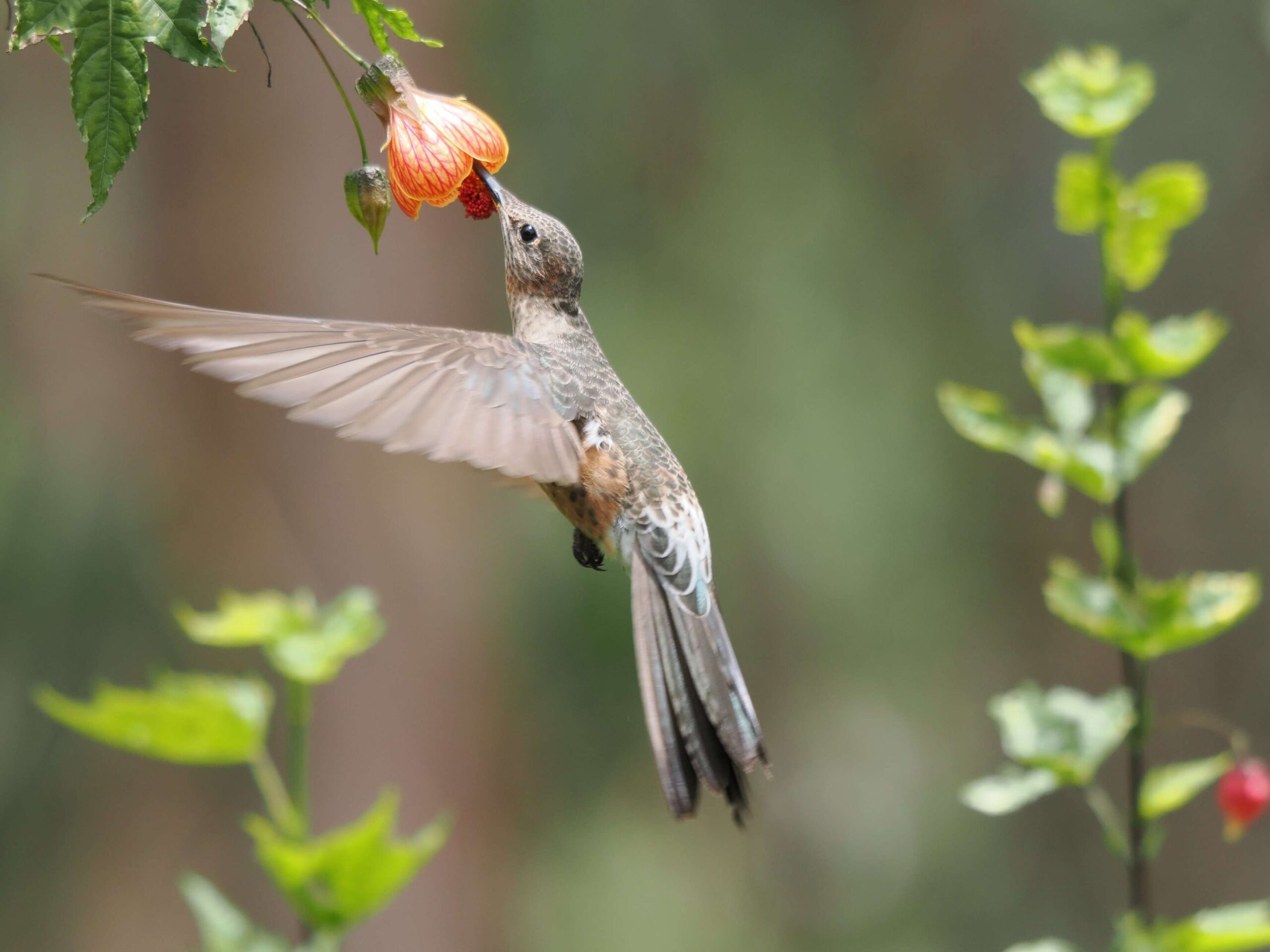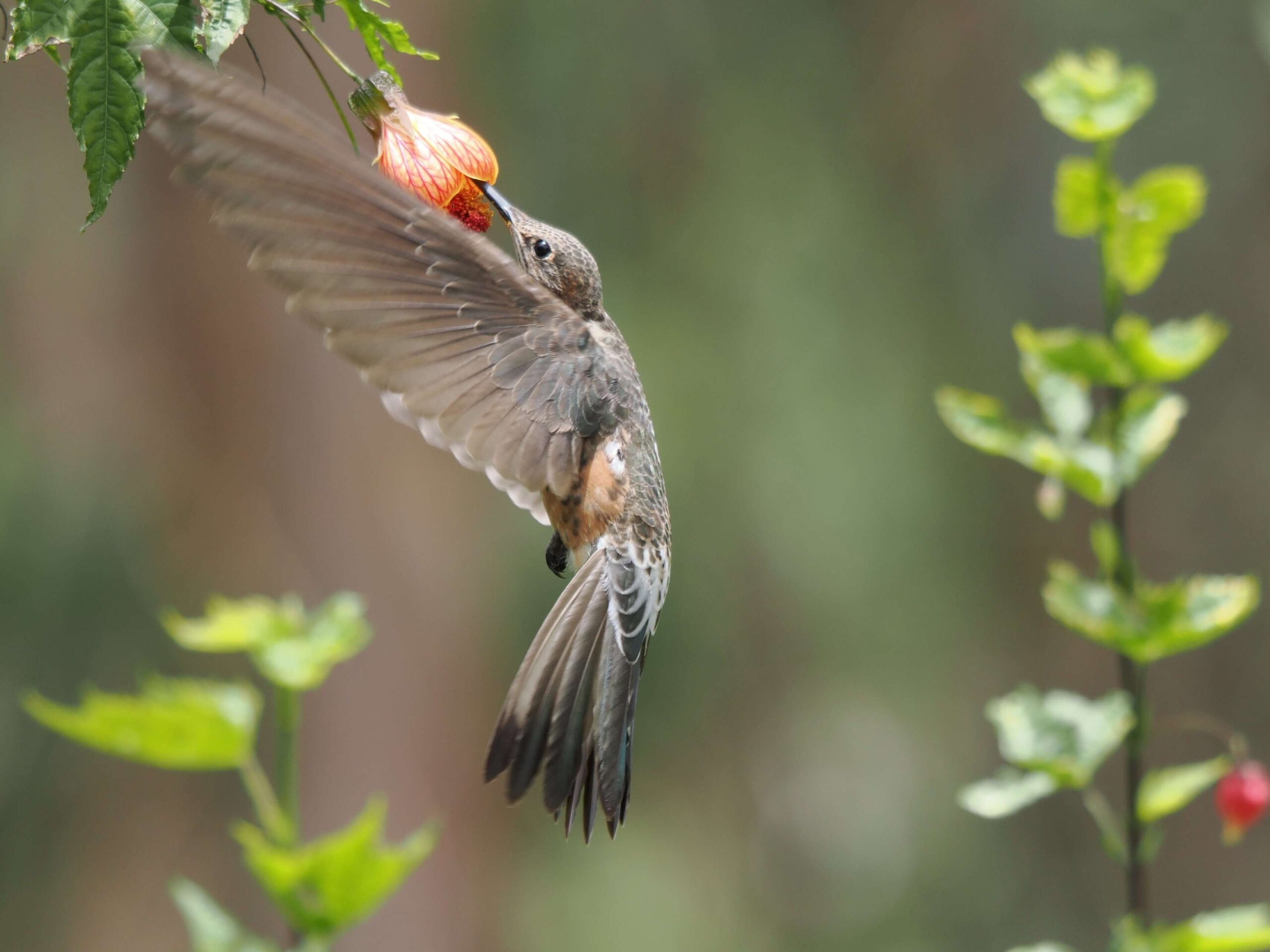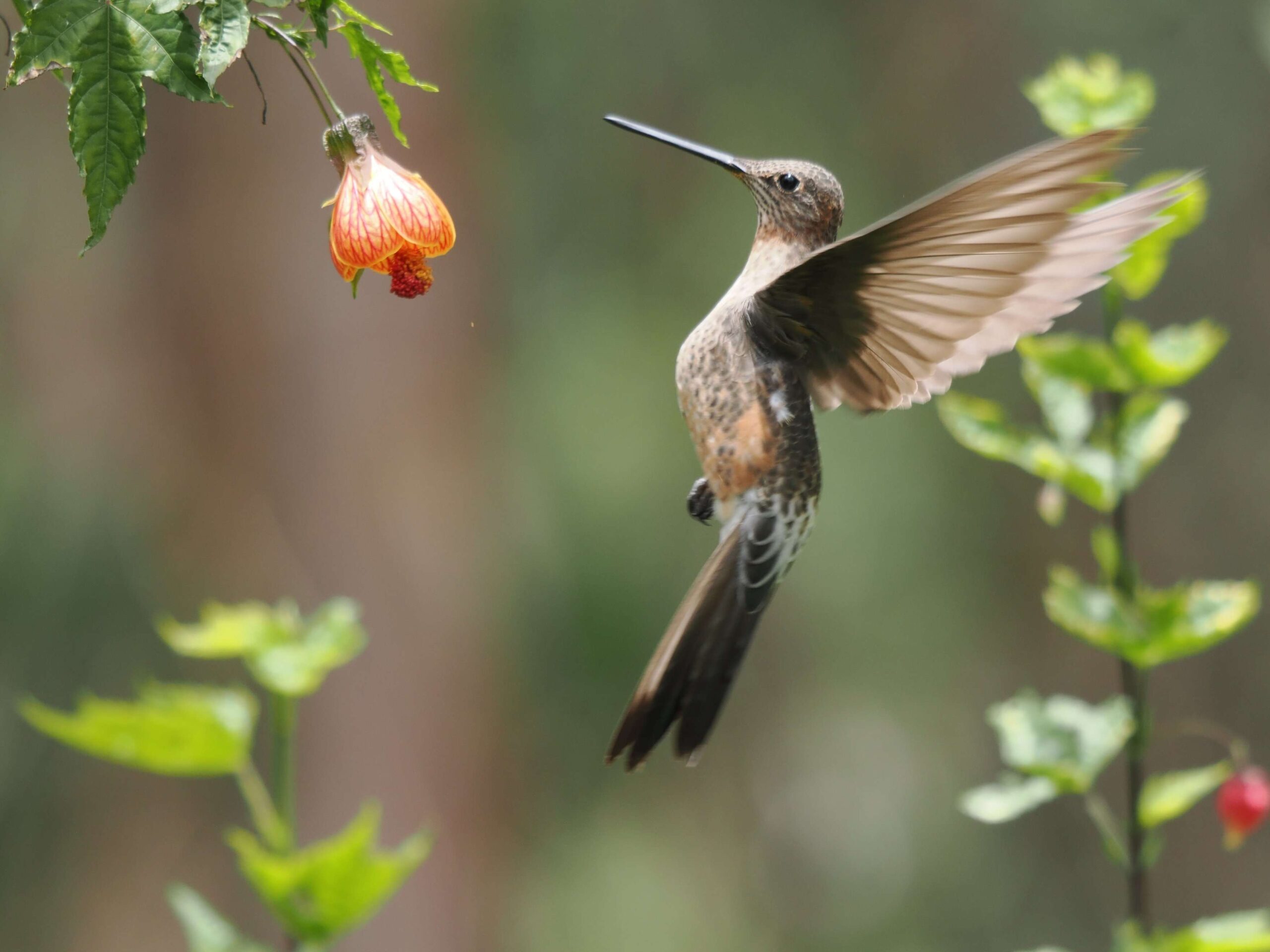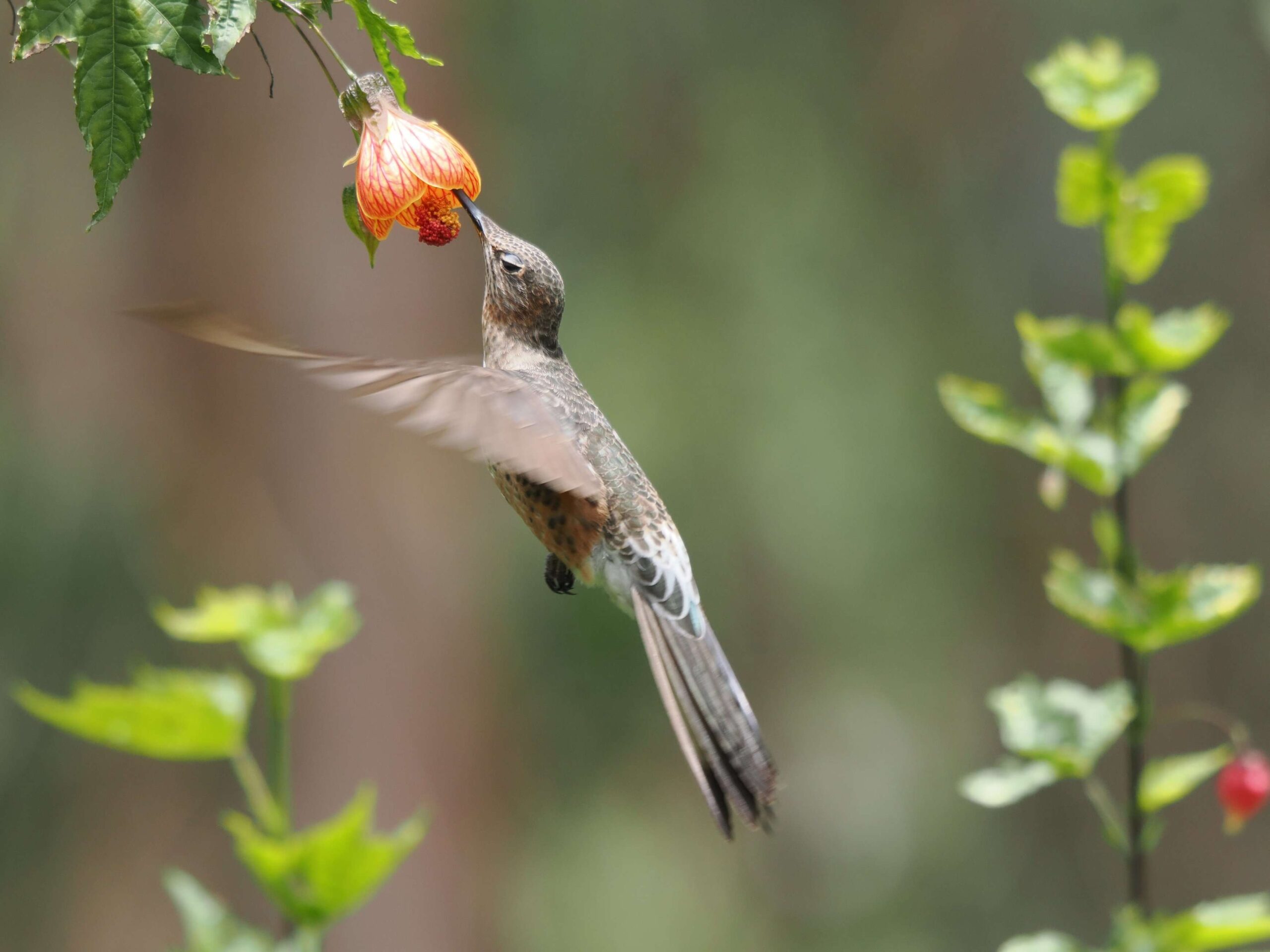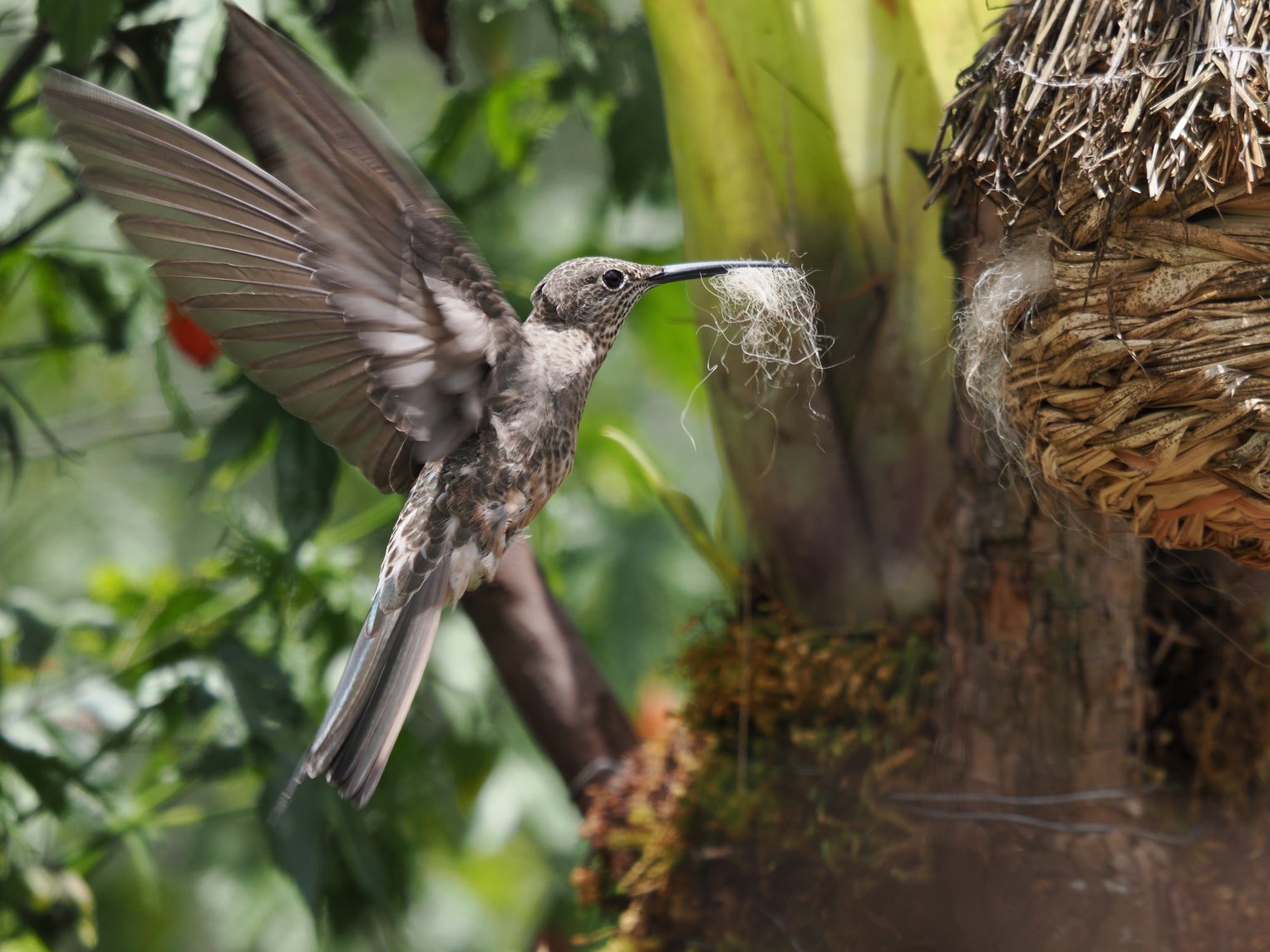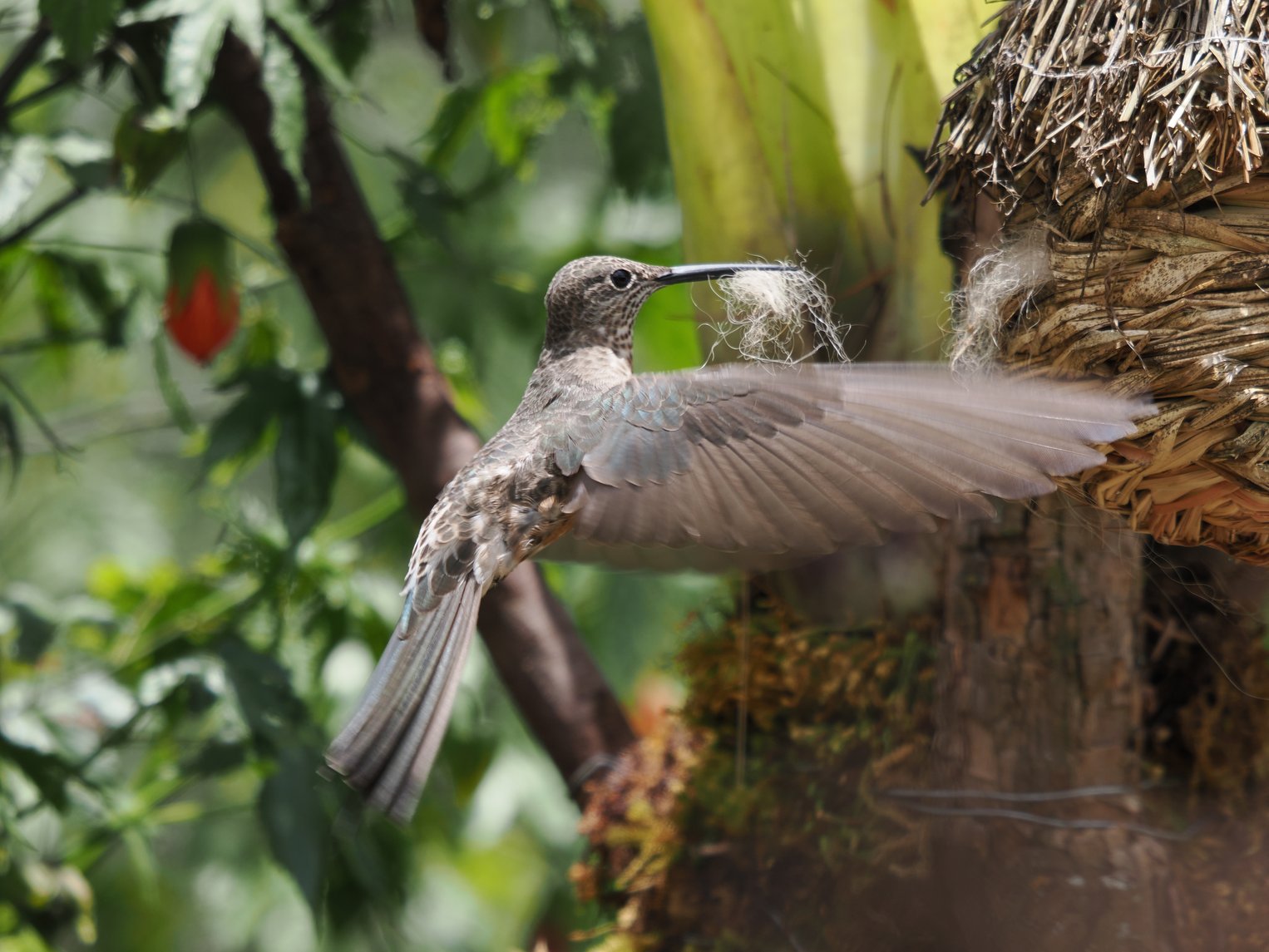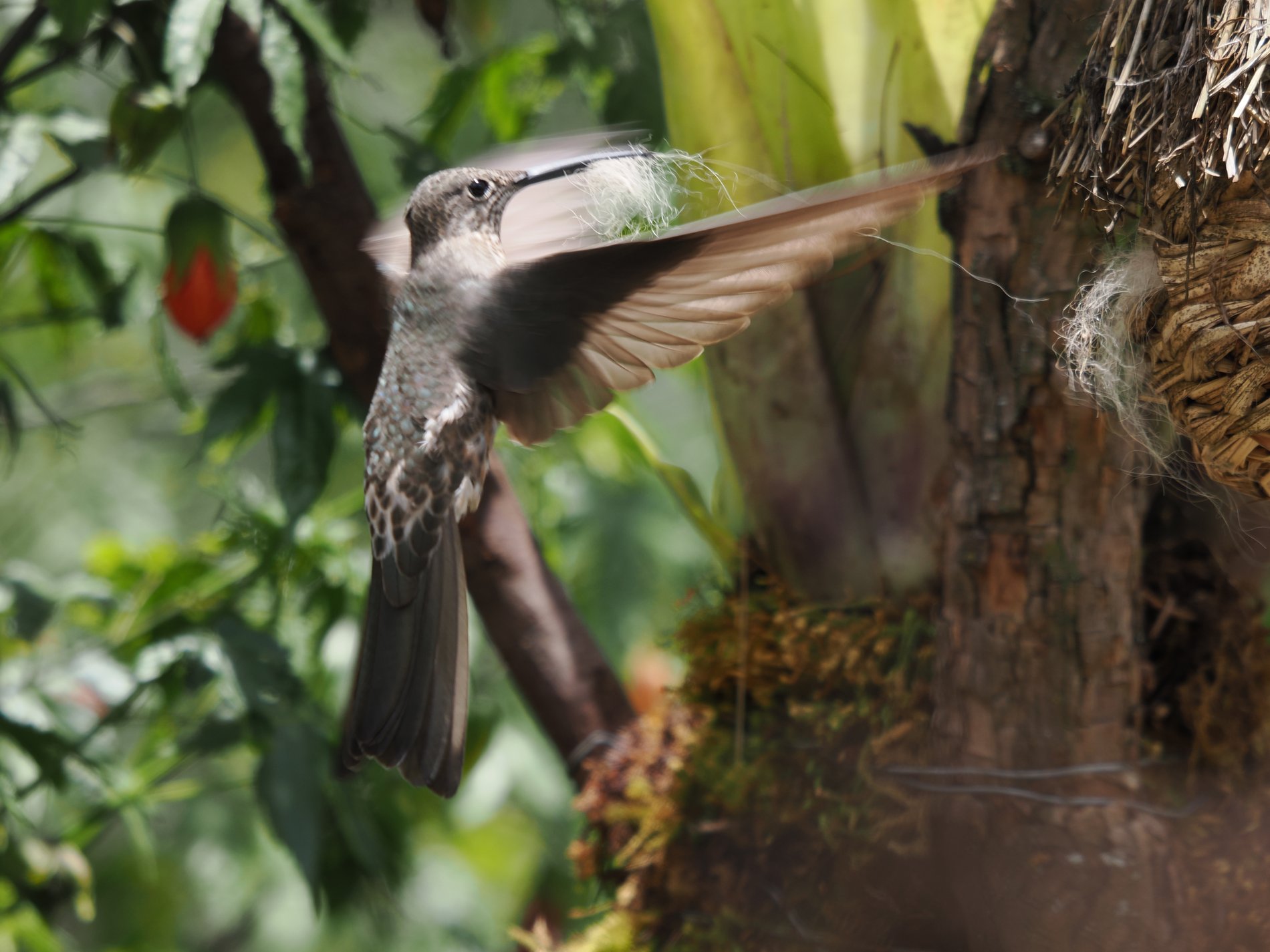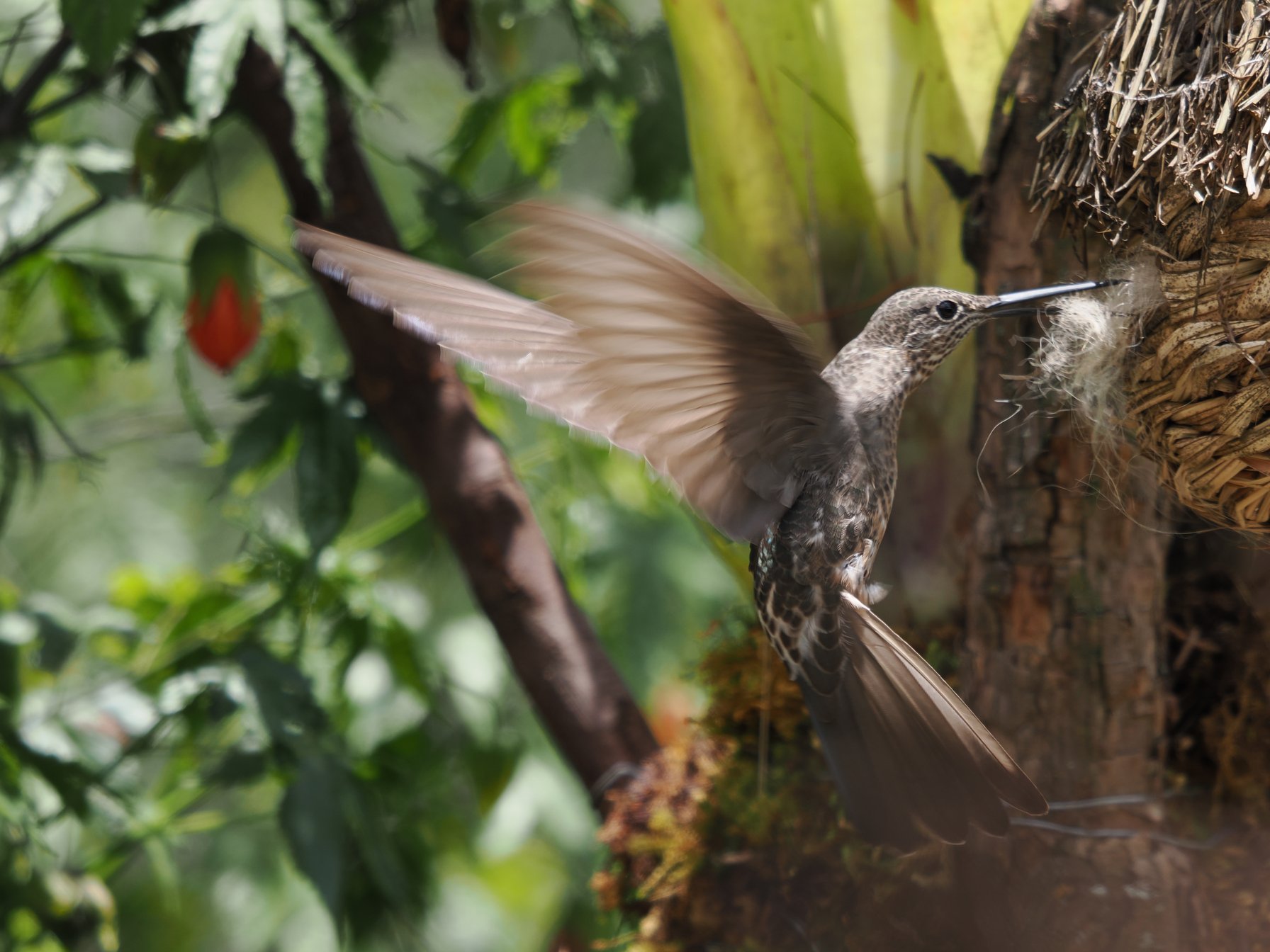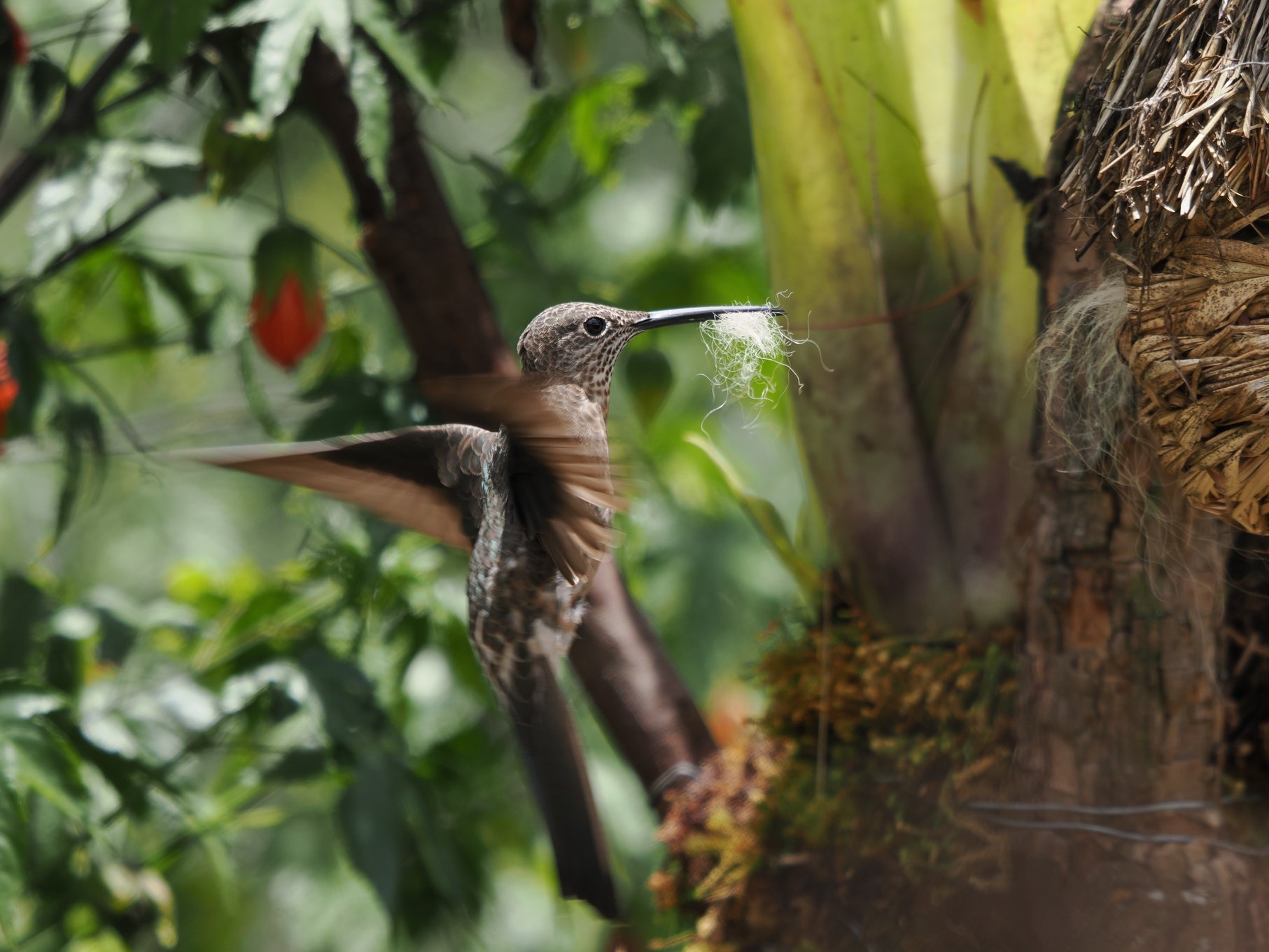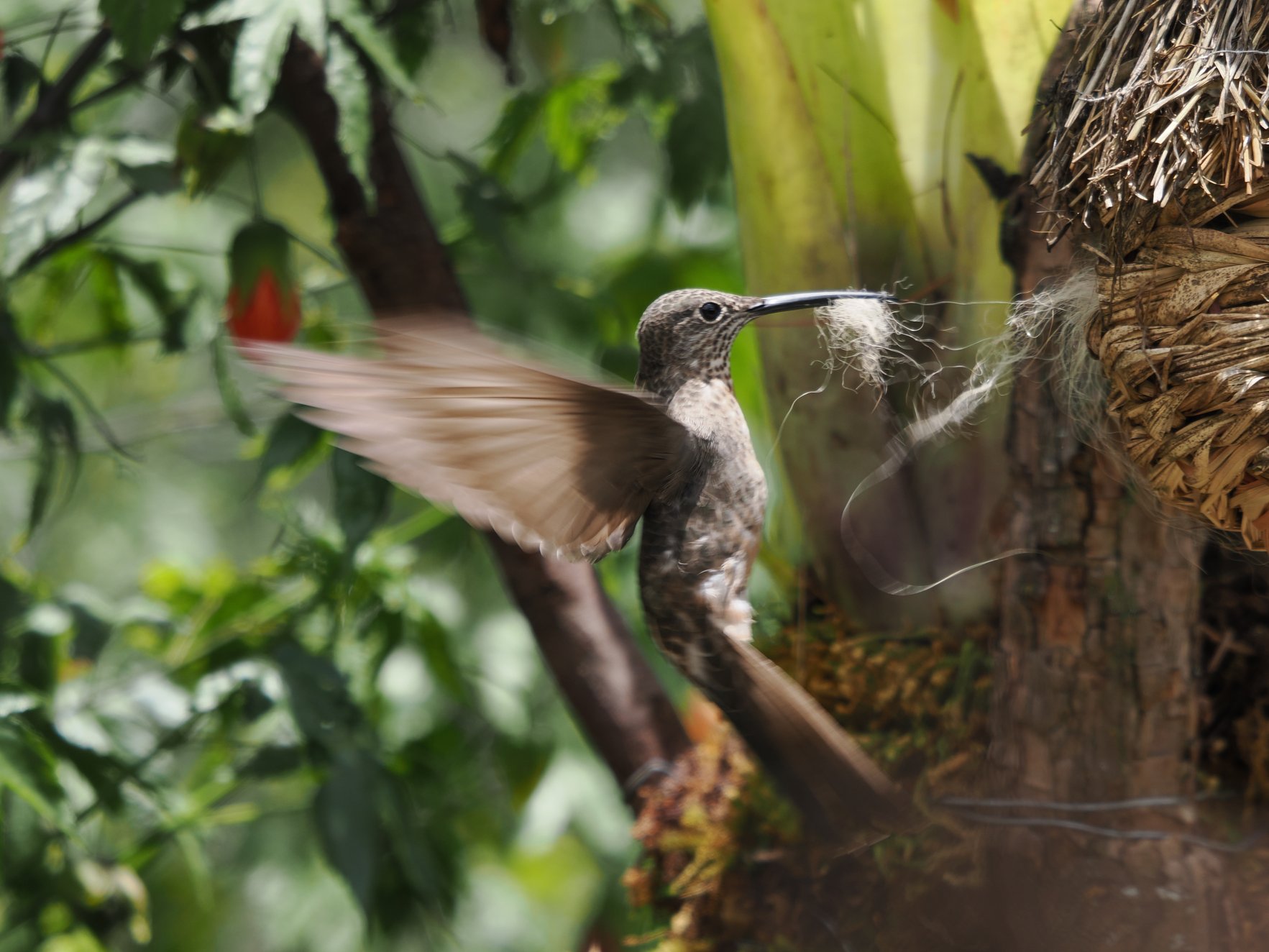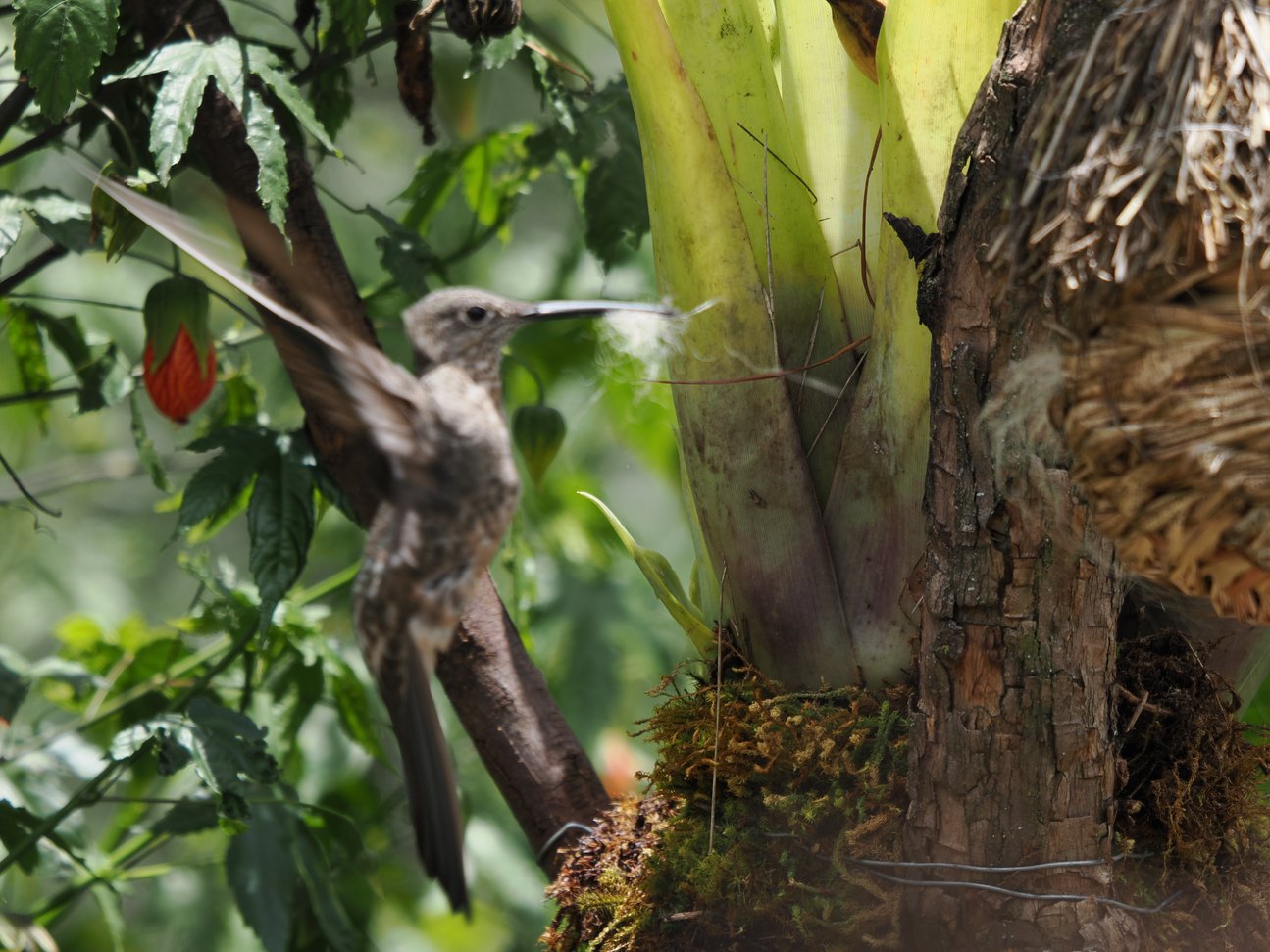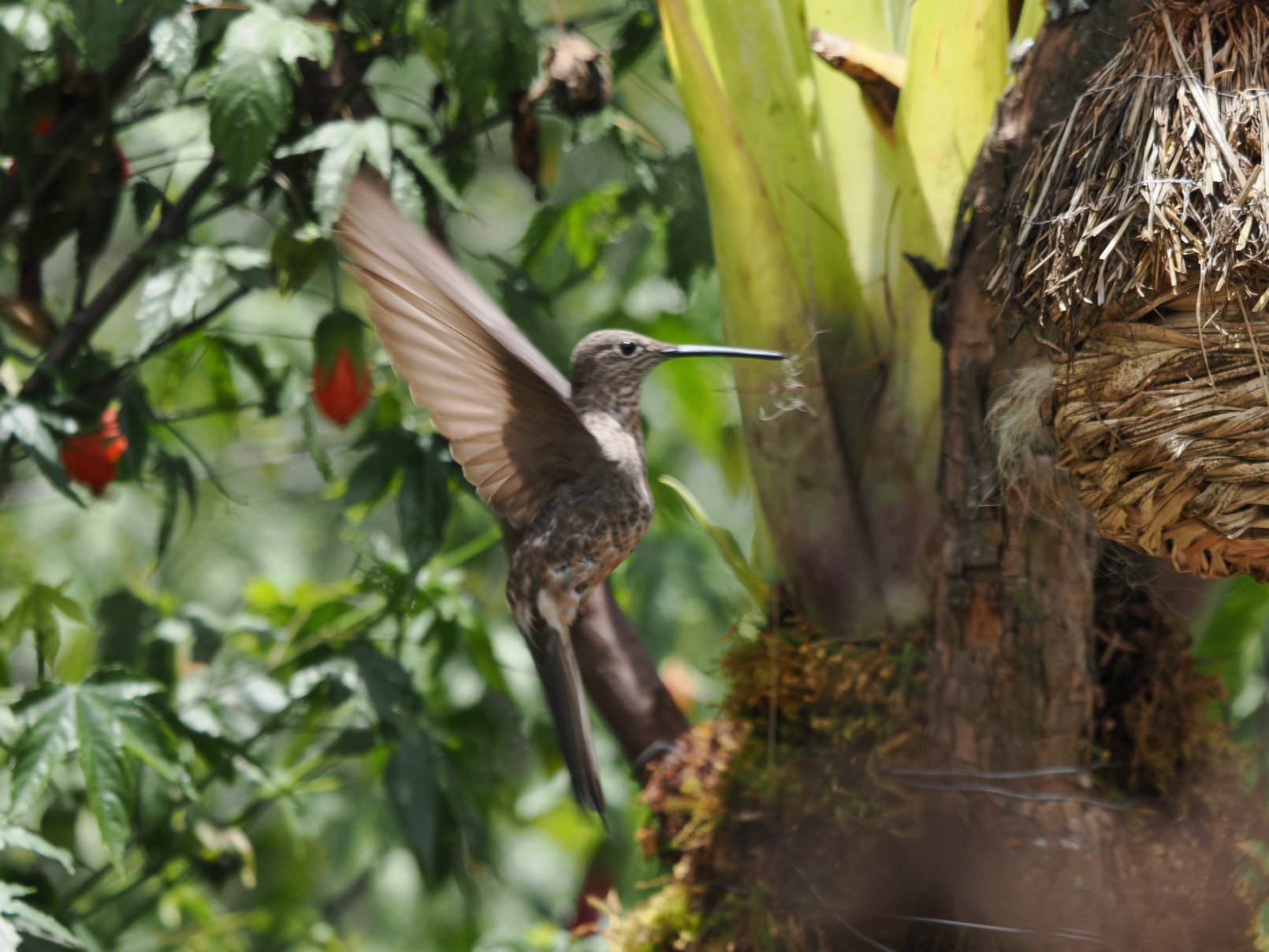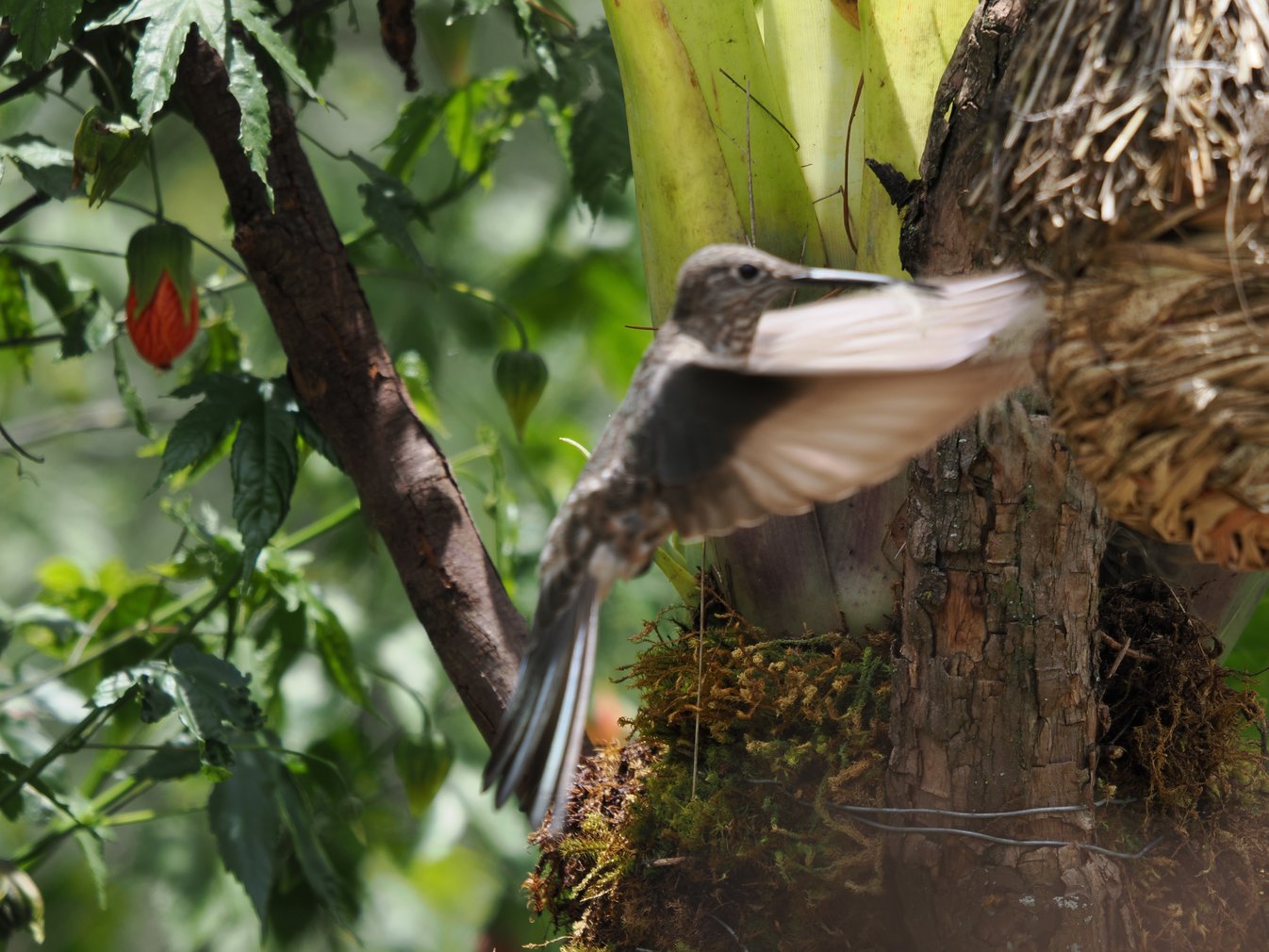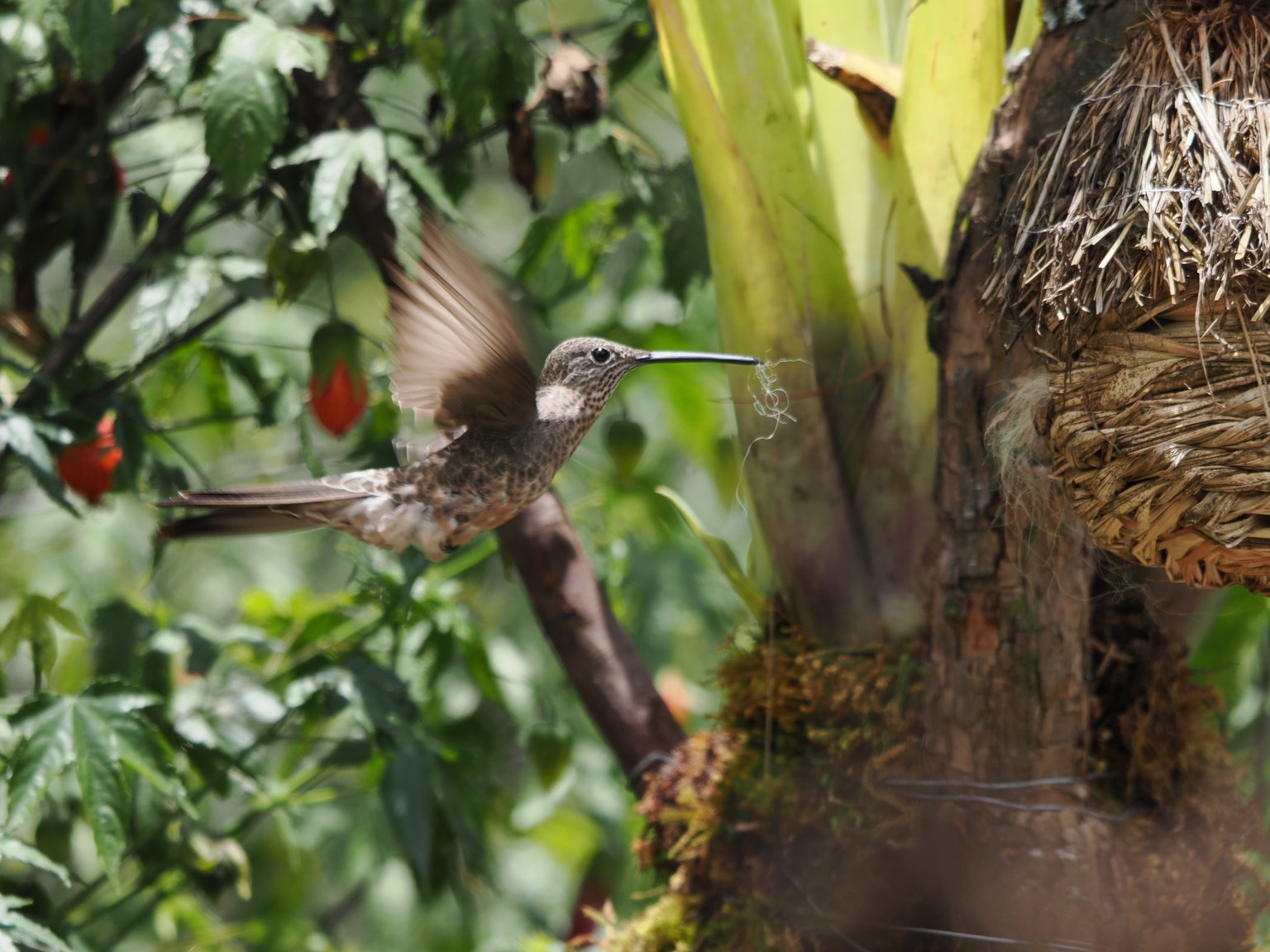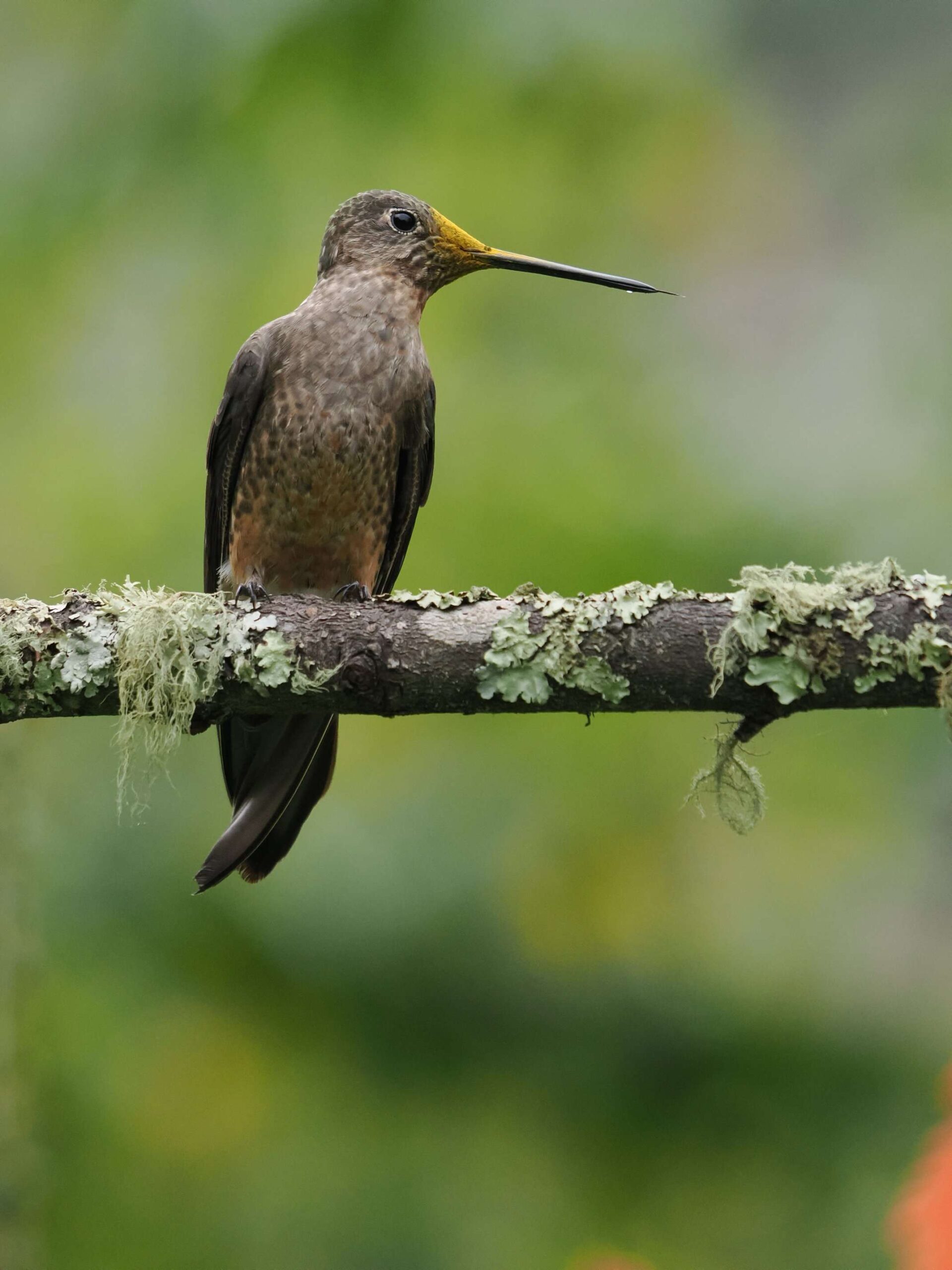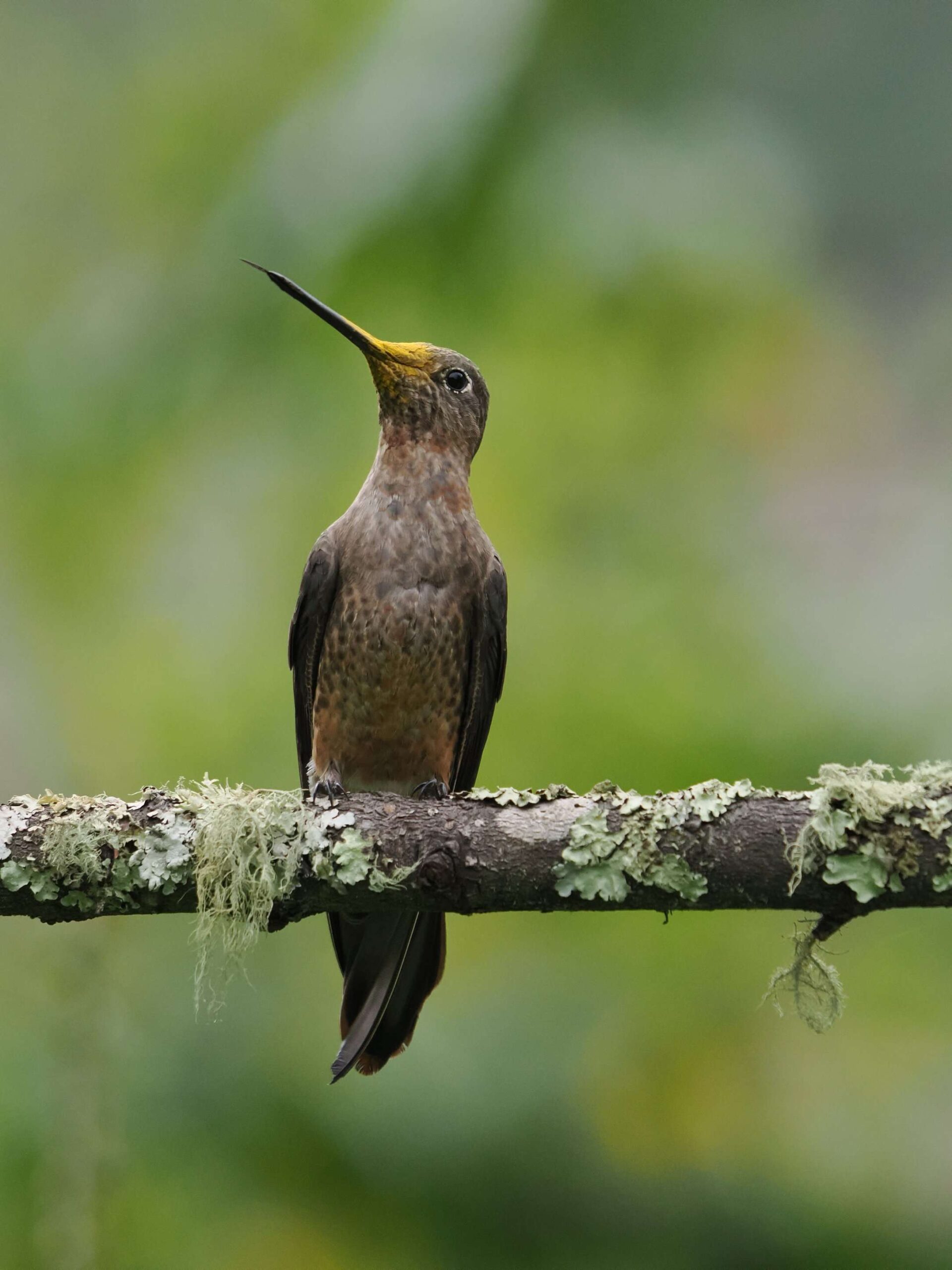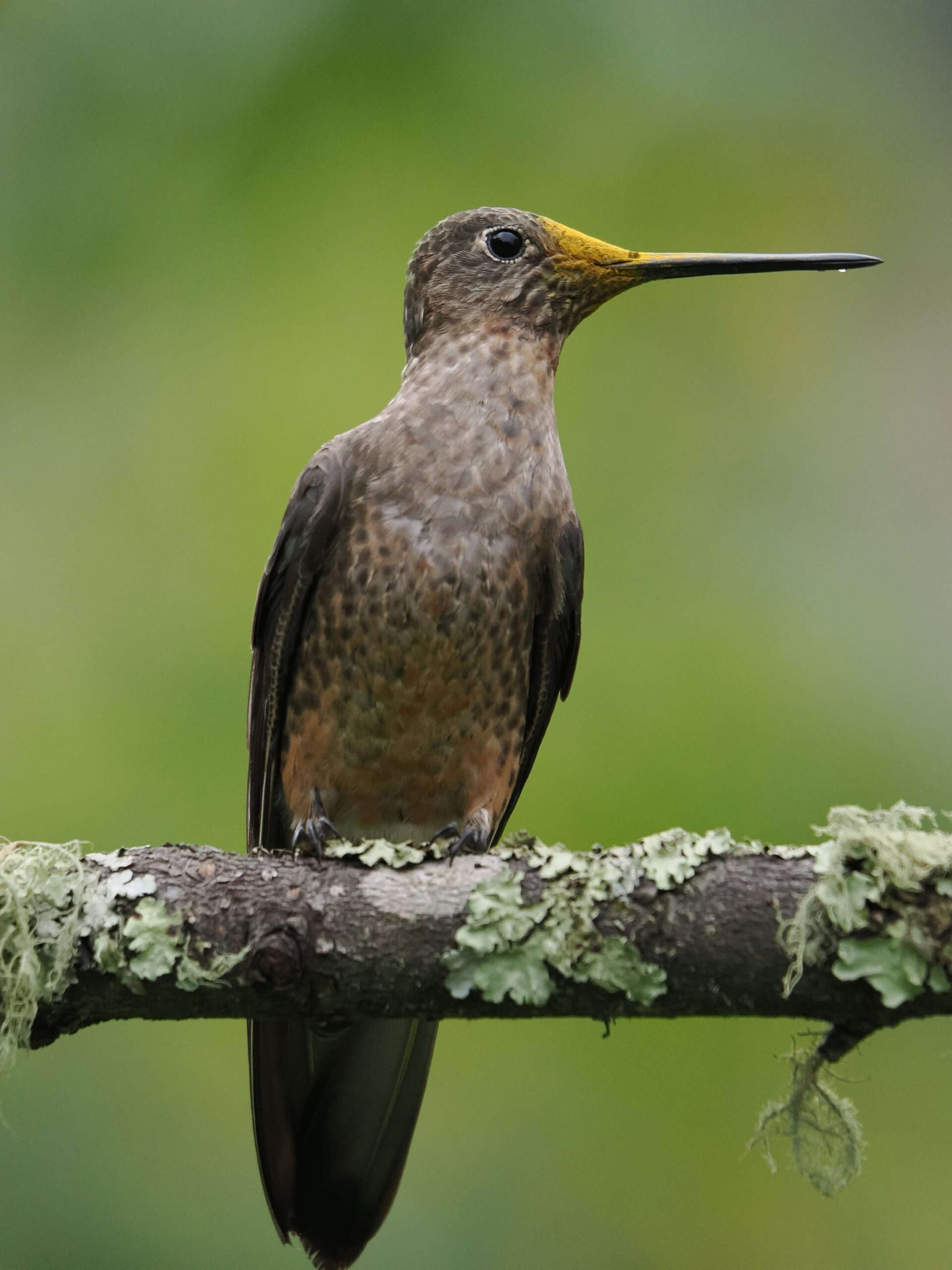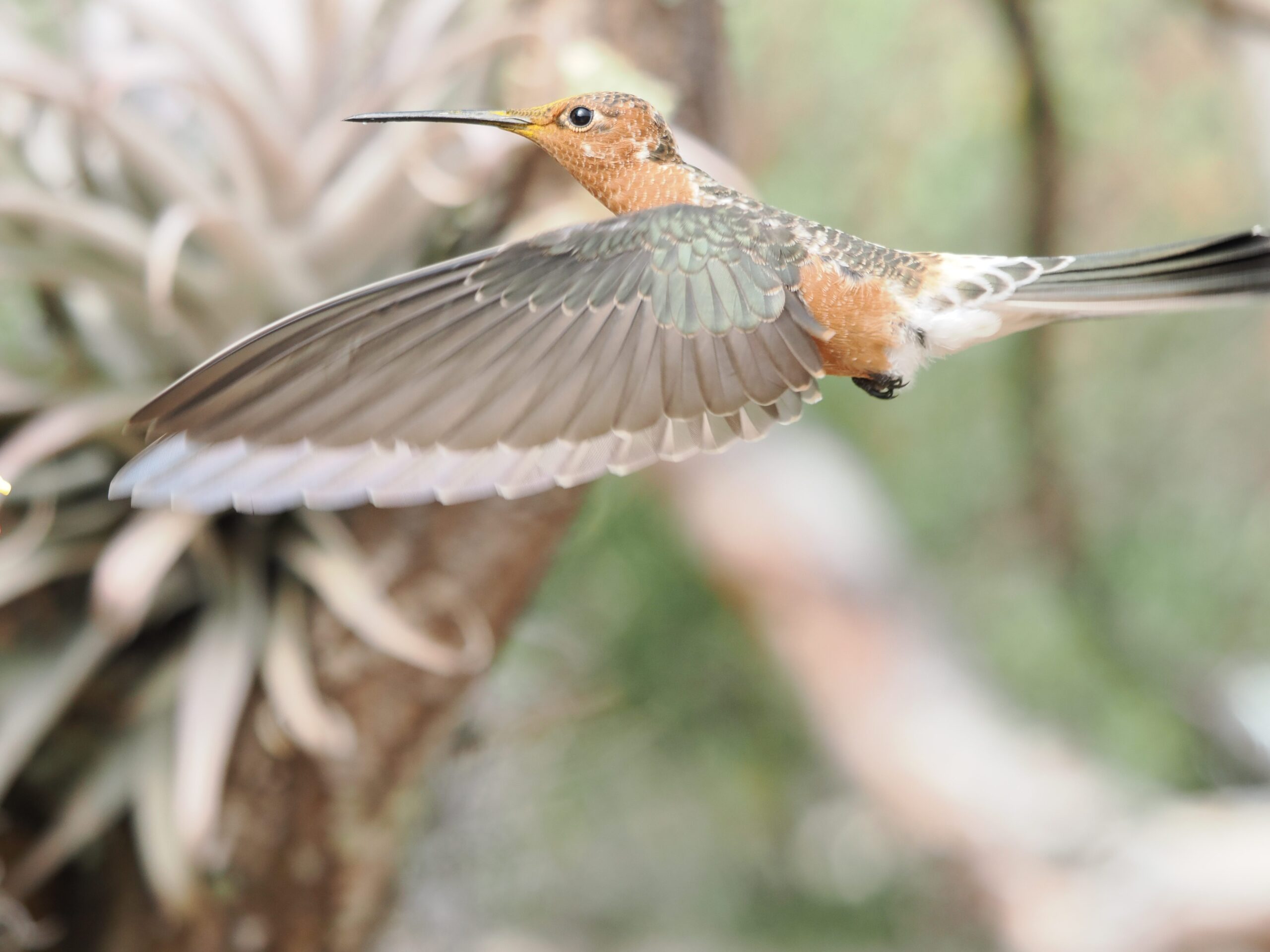
THE TWO GIANTS OF THE ANDEAN FOREST SCIENTIFIC DIFFERENCES BETWEEN THE SOUTHERN GIANT HUMMINGBIRD AND THE NORTHERN GIANT HUMMINGBIRD AT PACHACÚTEC ANDEAN FOREST
Part I: The Discovery of Two Giants Hidden Within a Single Species
At dawn, on the high-Andean slopes of San Jerónimo, Cusco, the forest seems to awaken first with the cold and then with flight. Among kantuta flowers, achupallas, native shrubs, and restored thickets, a hummingbird of unexpected size crosses the air with a deep hum. It does not move like smaller hummingbirds. Its flight is slower, heavier, more direct. It perches on a visible branch, observes the landscape, and then moves again toward another floral patch.
For a long time, any observer would have simply said: “it is a Giant Hummingbird.”
But today, science requires us to look more carefully.
What for more than a century was treated as a single species, the Giant Hummingbird, Patagona gigas, has recently been reinterpreted through genomic, physiological, and movement studies. Research published in 2024 demonstrated that within what was once considered a single species there are two deeply differentiated lineages: the Southern Giant Hummingbird, Patagona gigas, and the Northern Giant Hummingbird, proposed by some authors as Patagona chaski, although other specialists argue that the correct name should be Patagona peruviana because of nomenclatural priority. This taxonomic discussion is still developing, but the central biological fact is already clear: the Andes hold two giants, not one.
At Pachacútec Andean Forest, where Giant Hummingbirds are observed every year around the observatory, this scientific revelation has enormous value. It is not only about identifying a large bird. It is about understanding whether the restored forest is being used by one or both lineages, how they behave, which plants they visit, in which seasons they appear, and what they tell us about the health of the ecosystem.
This article proposes a first scientific and naturalist comparison between the two Giant Hummingbirds, with one central question: what does it mean to observe them at Pachacútec Andean Forest?
The Largest Hummingbird in the World
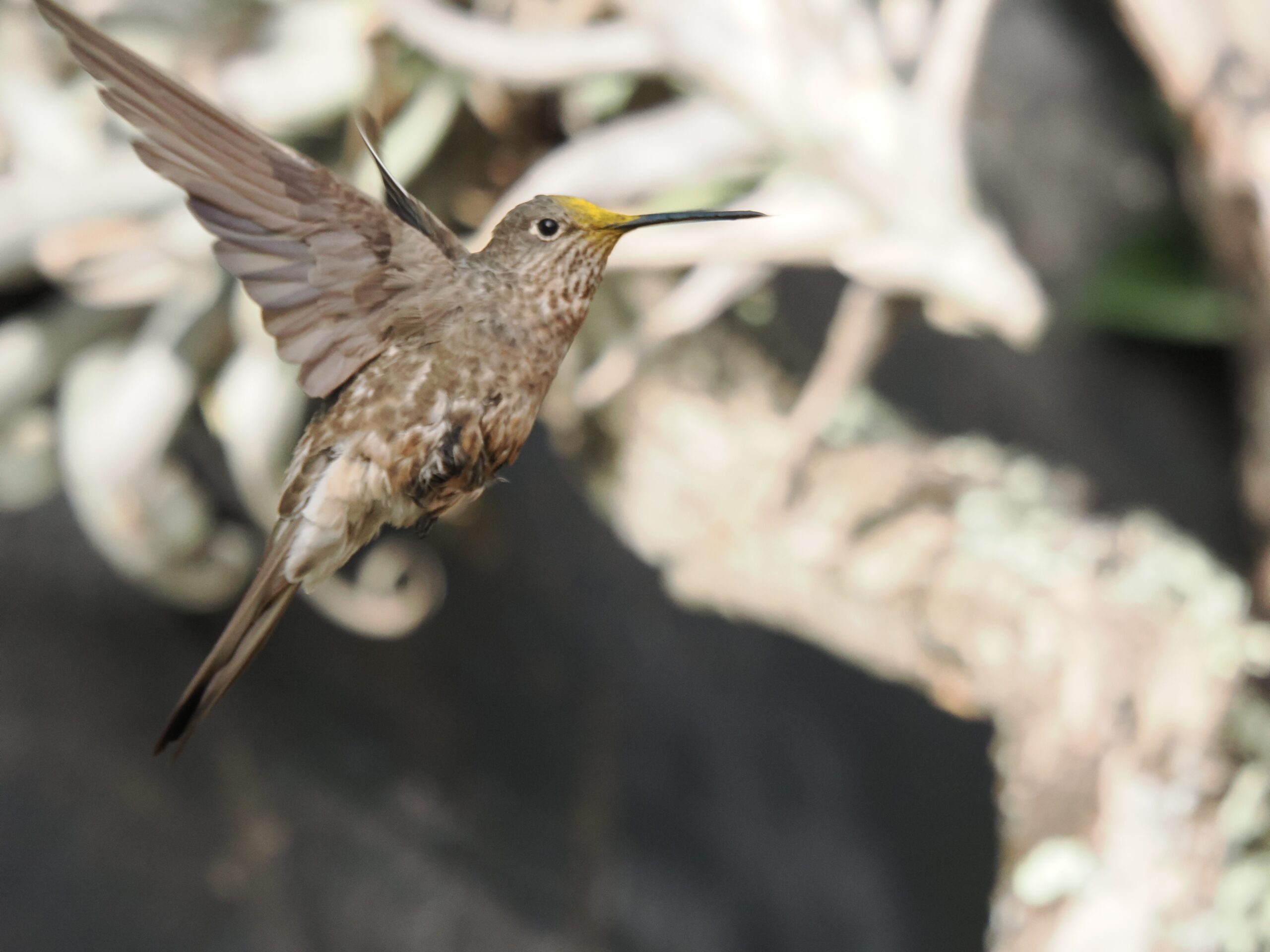
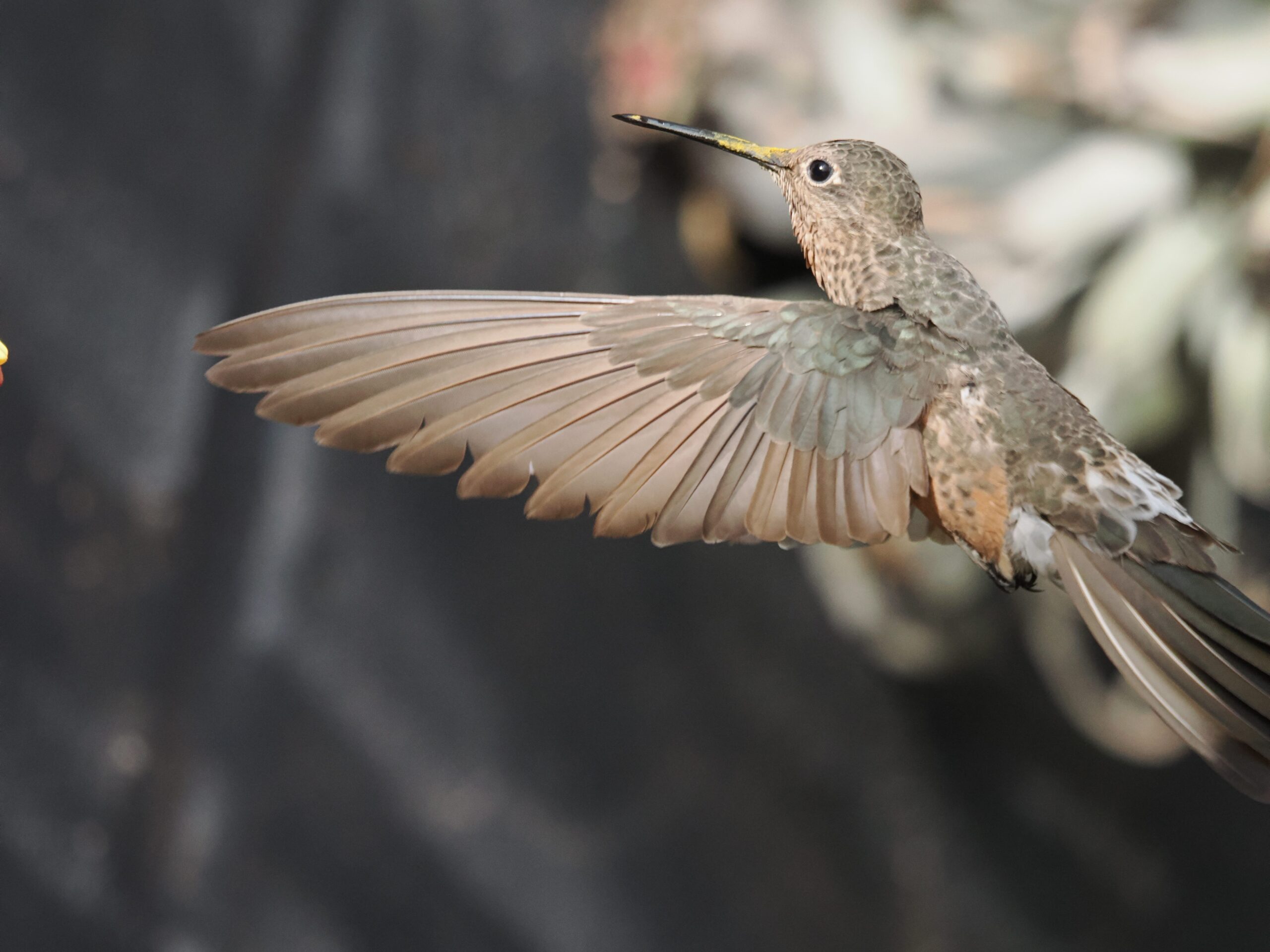
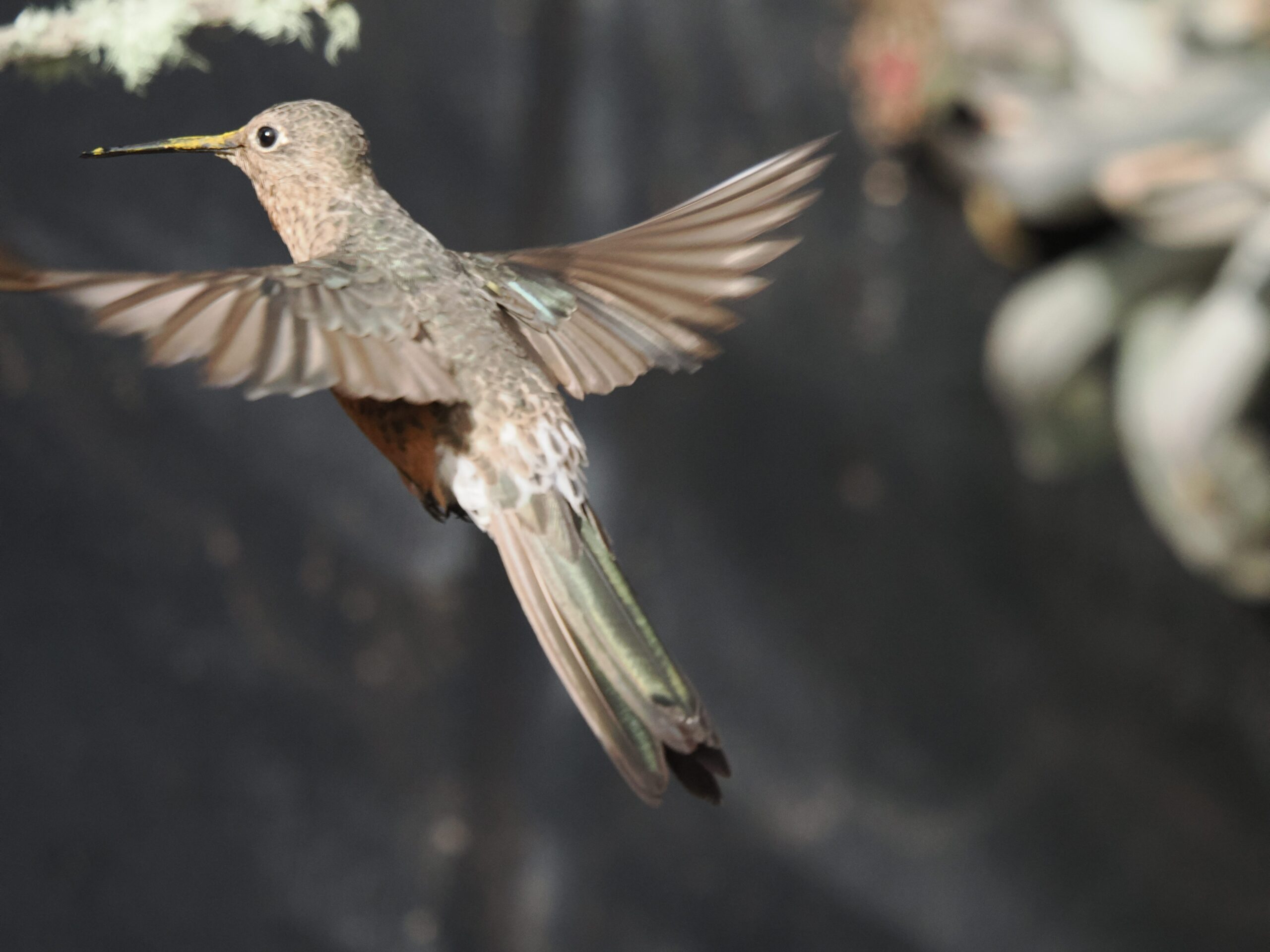
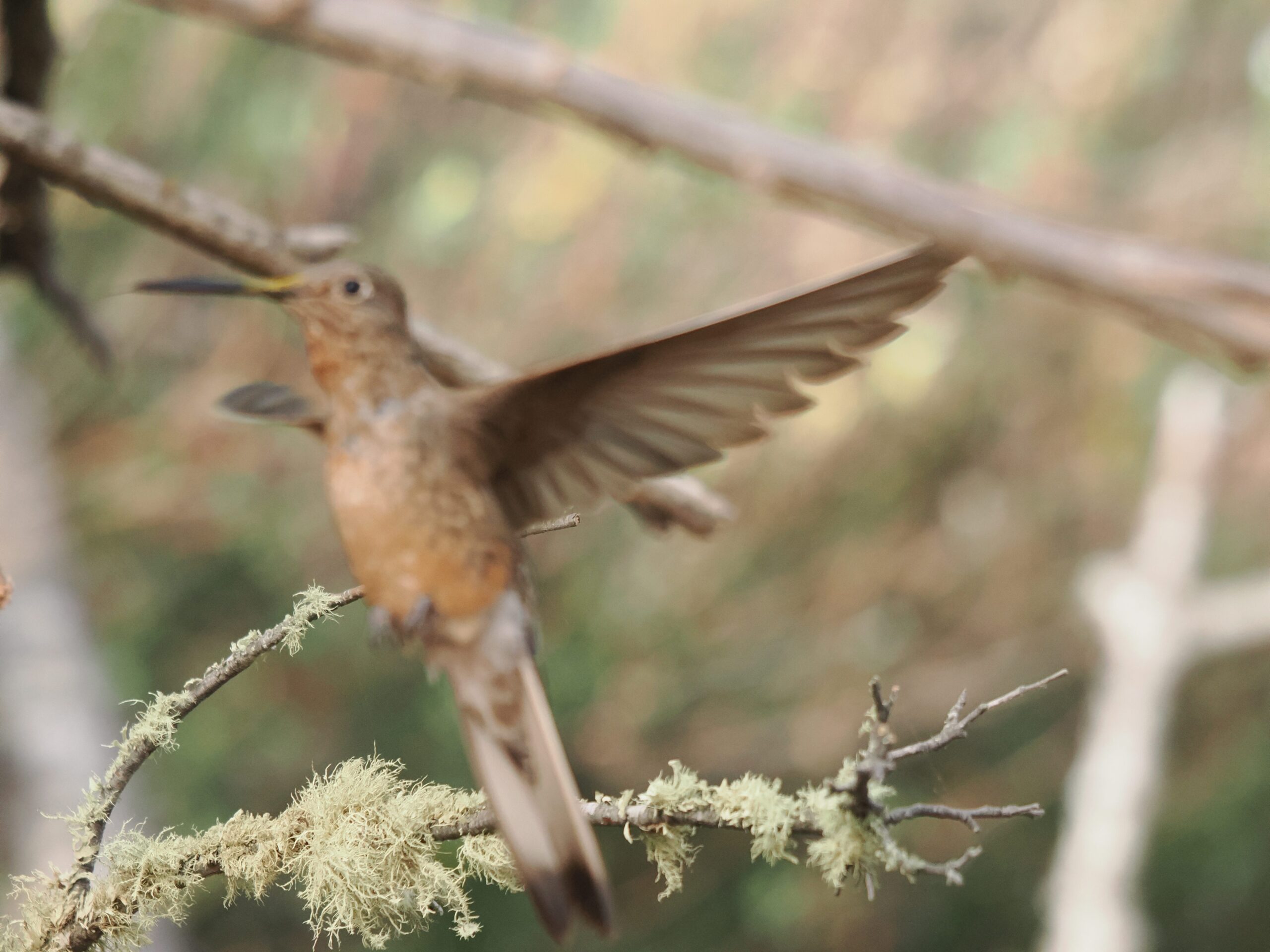
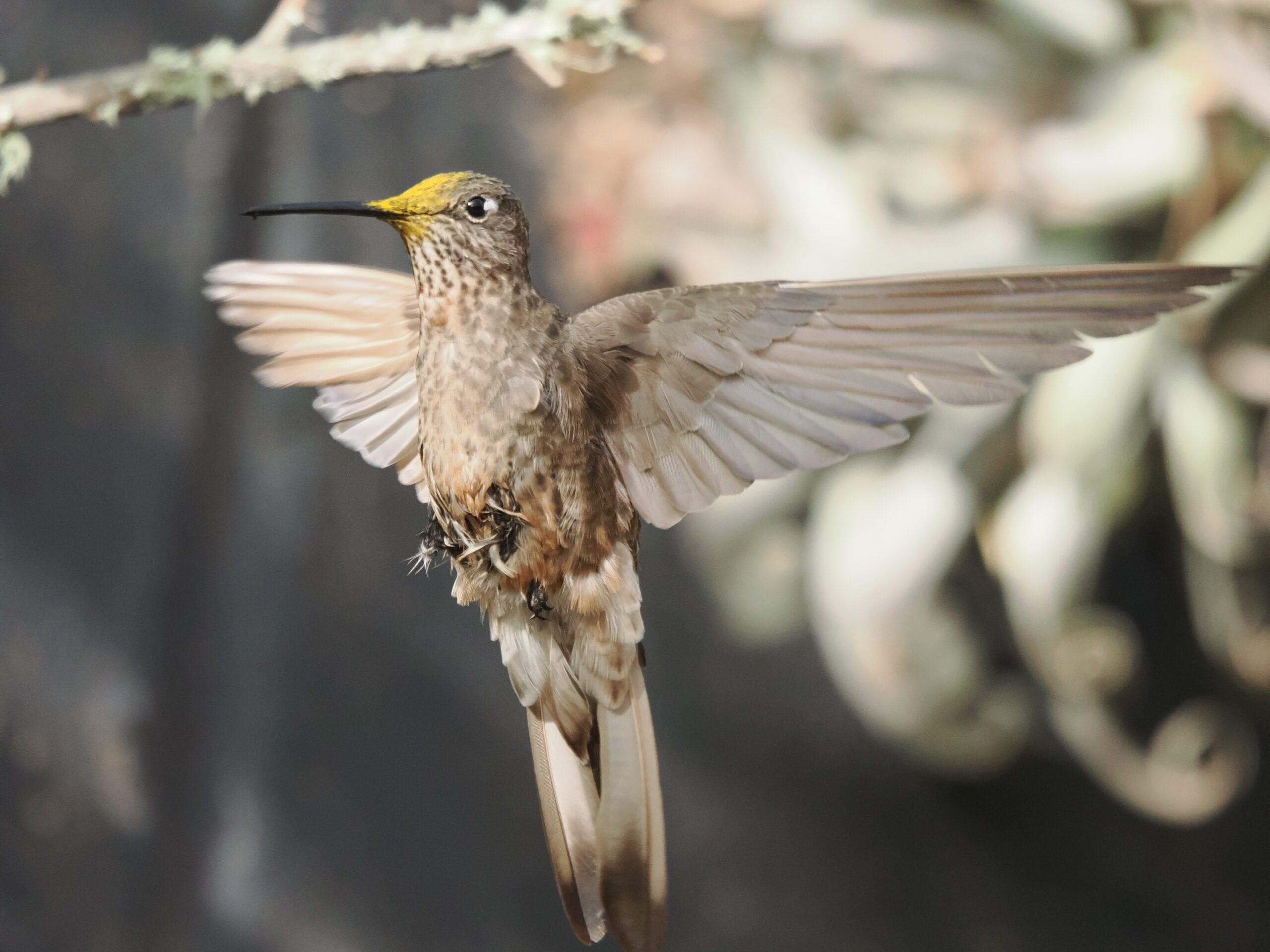
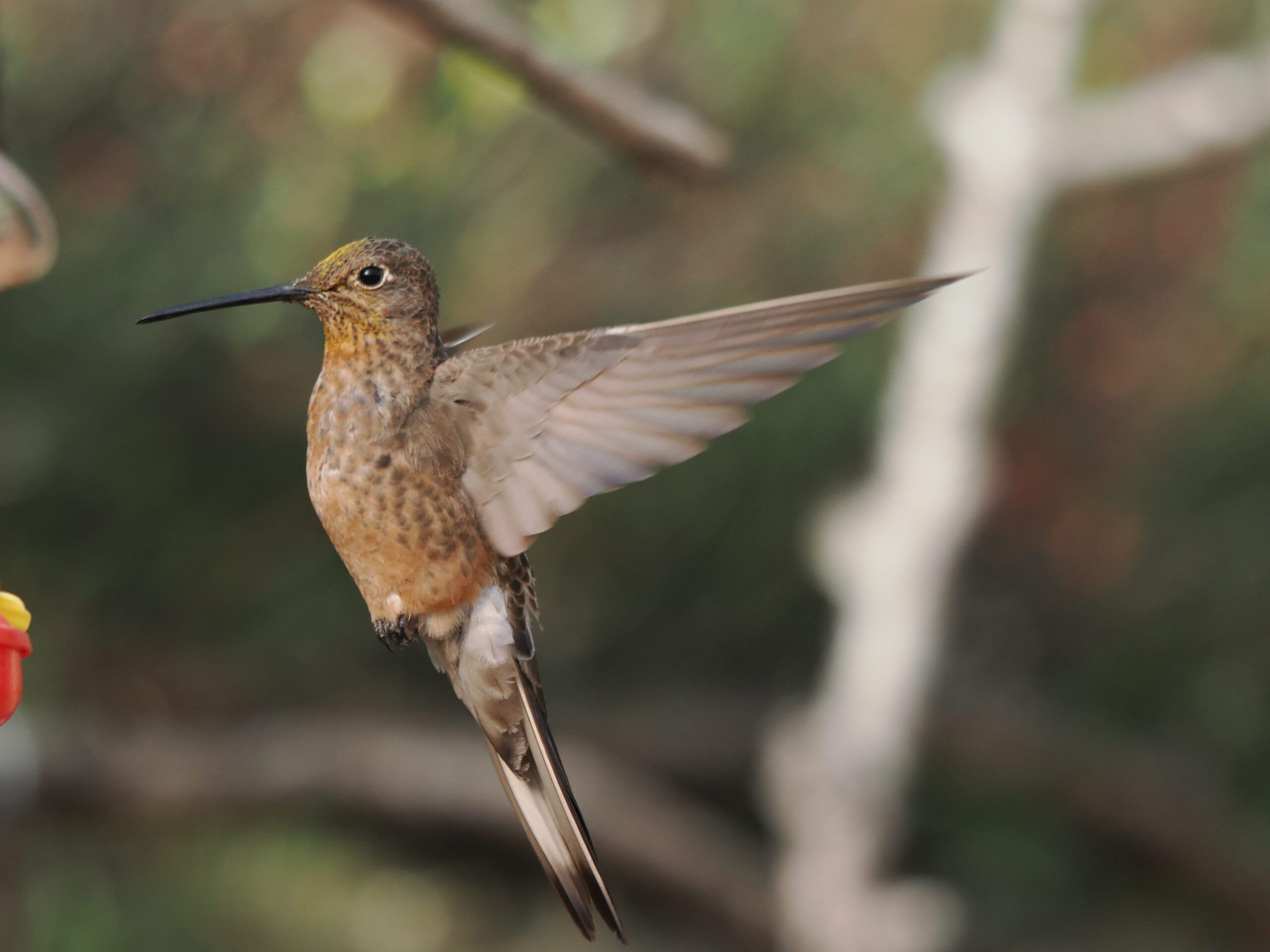
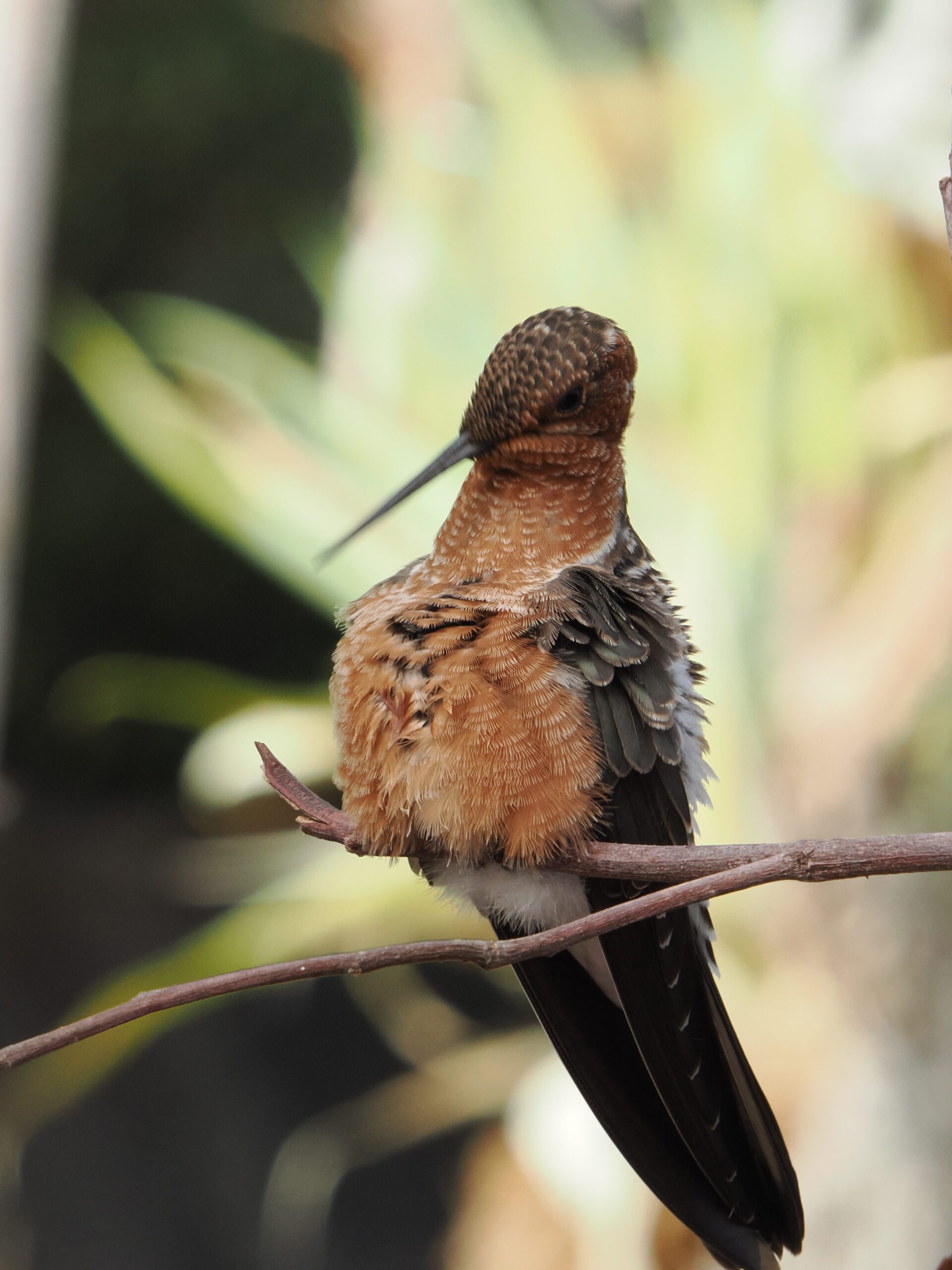
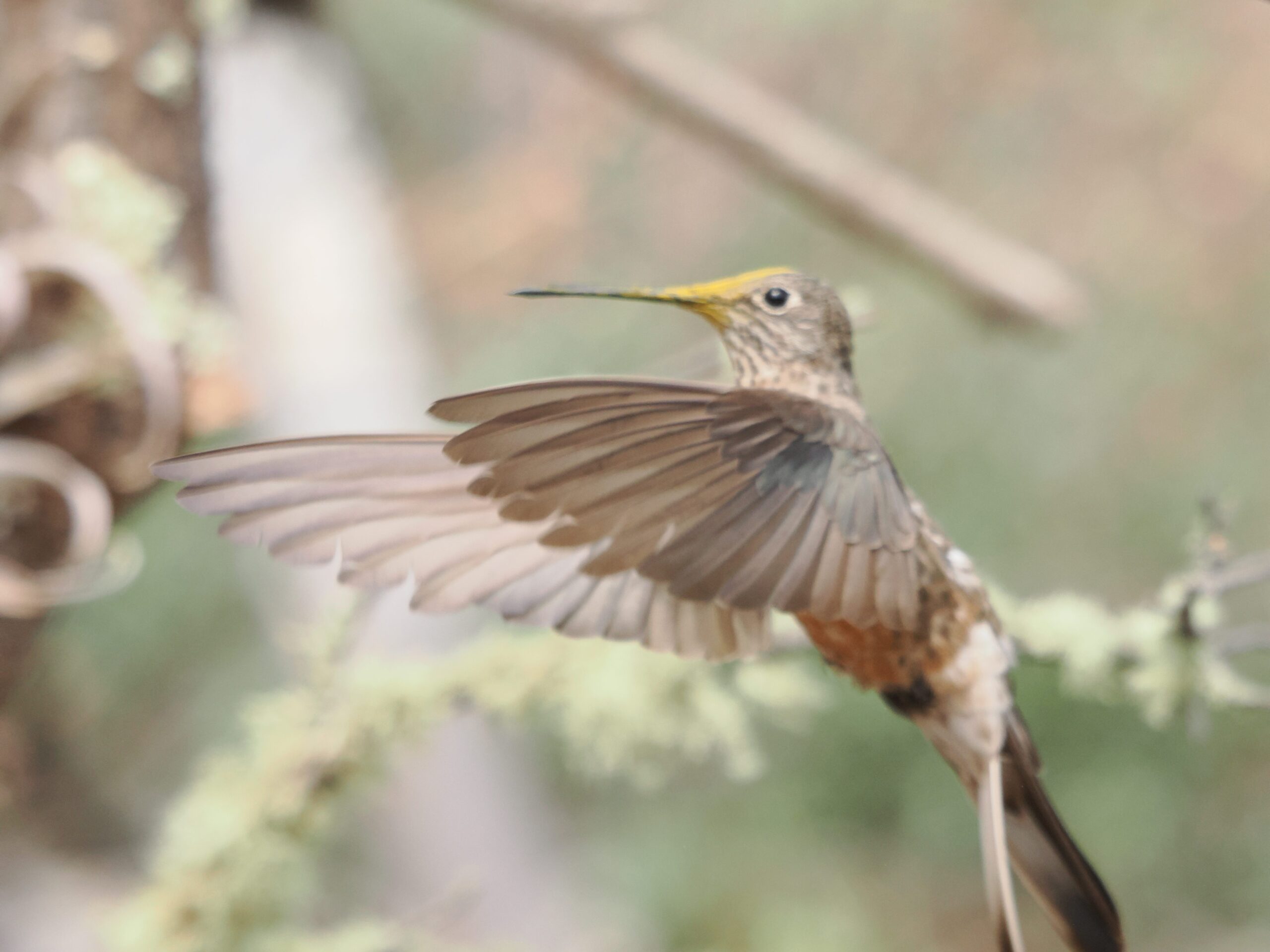
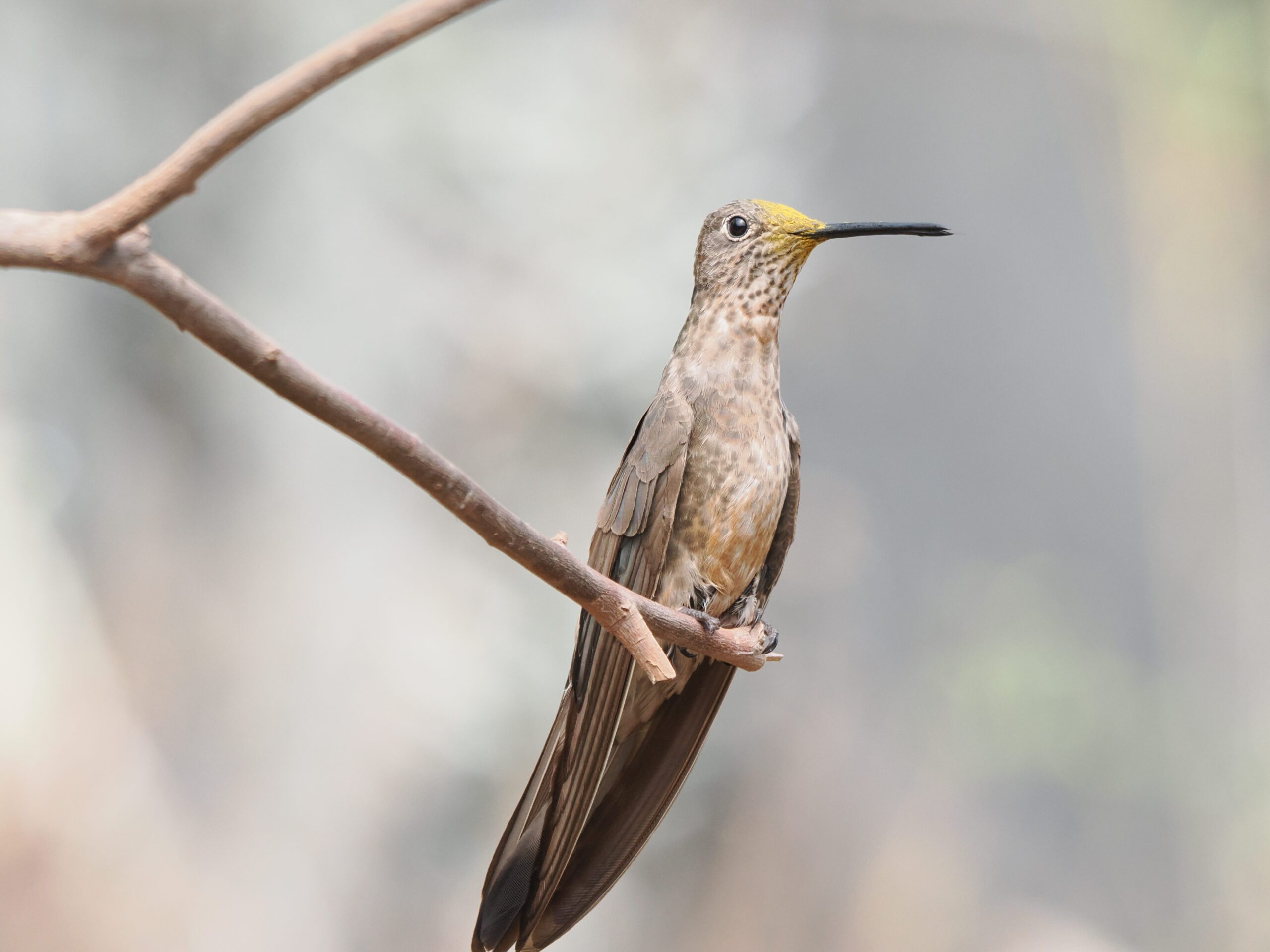
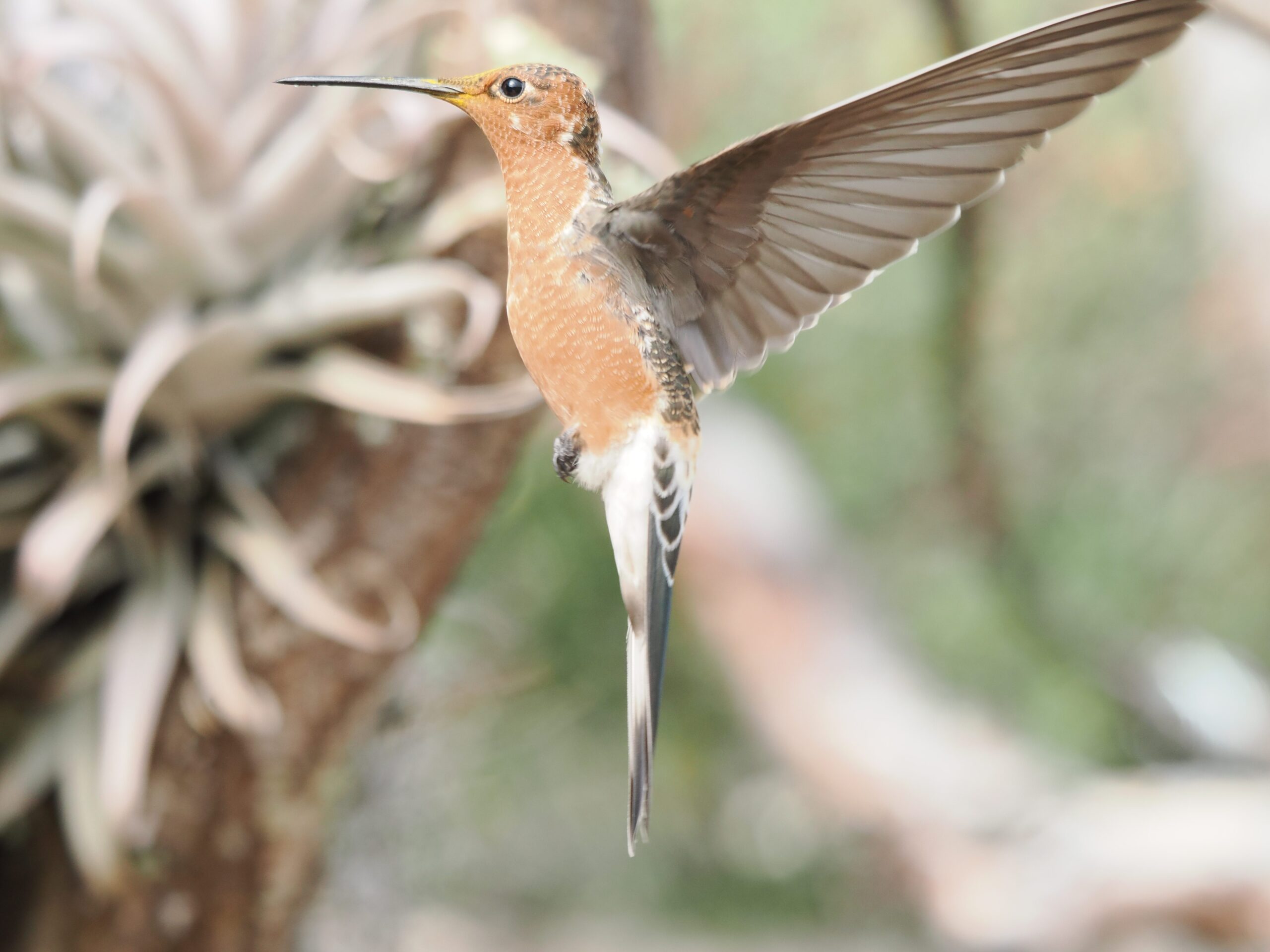
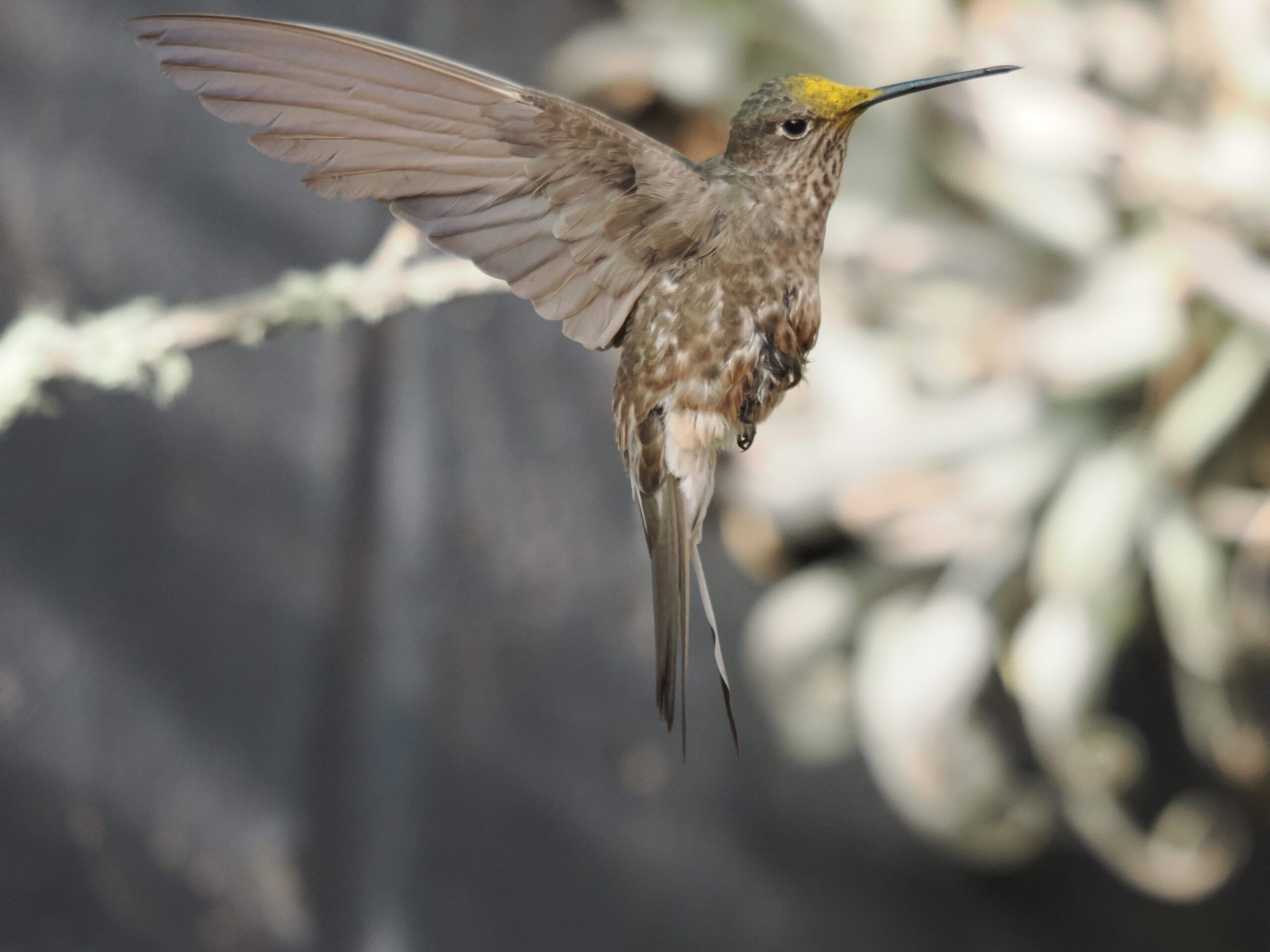
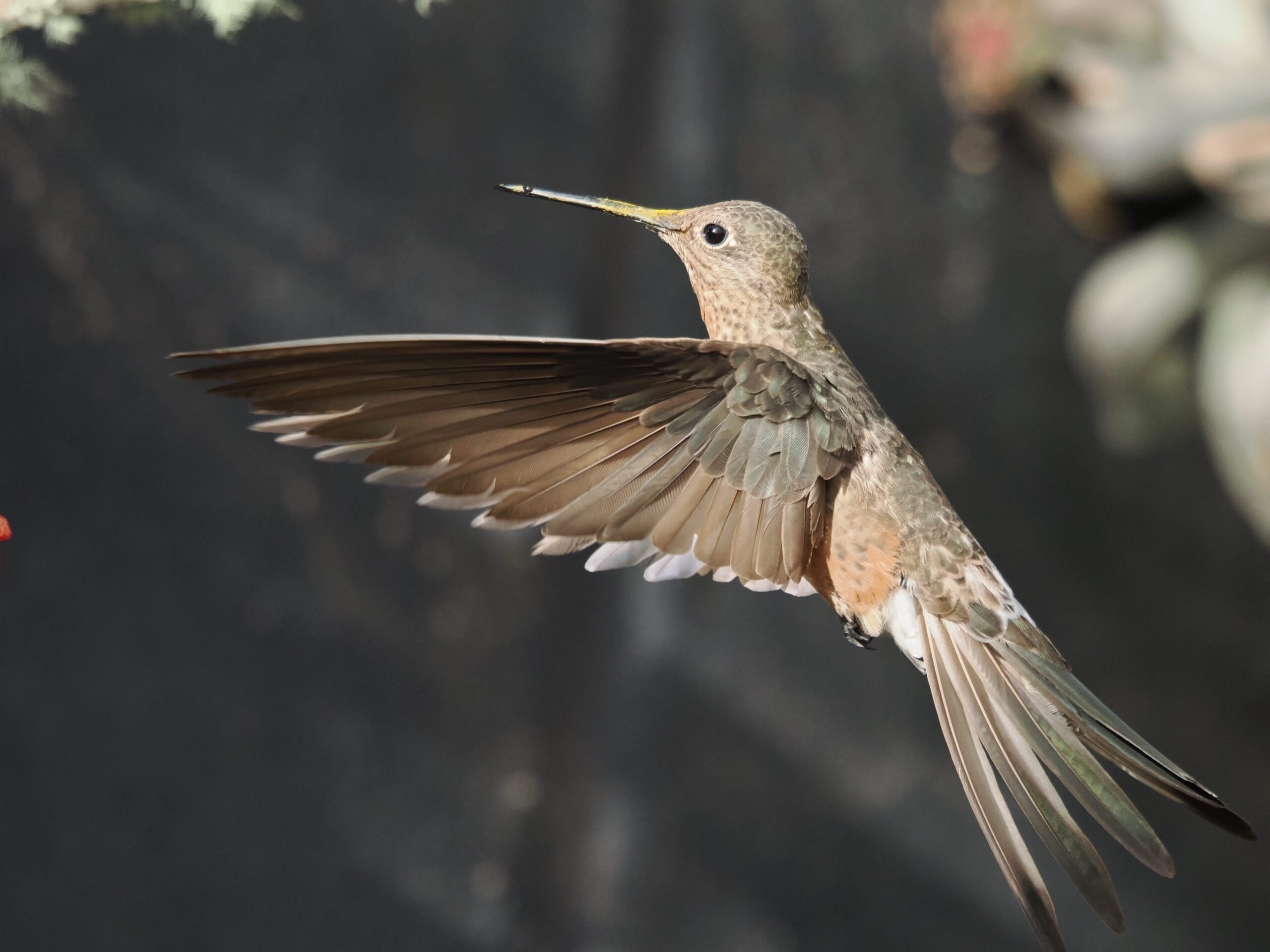
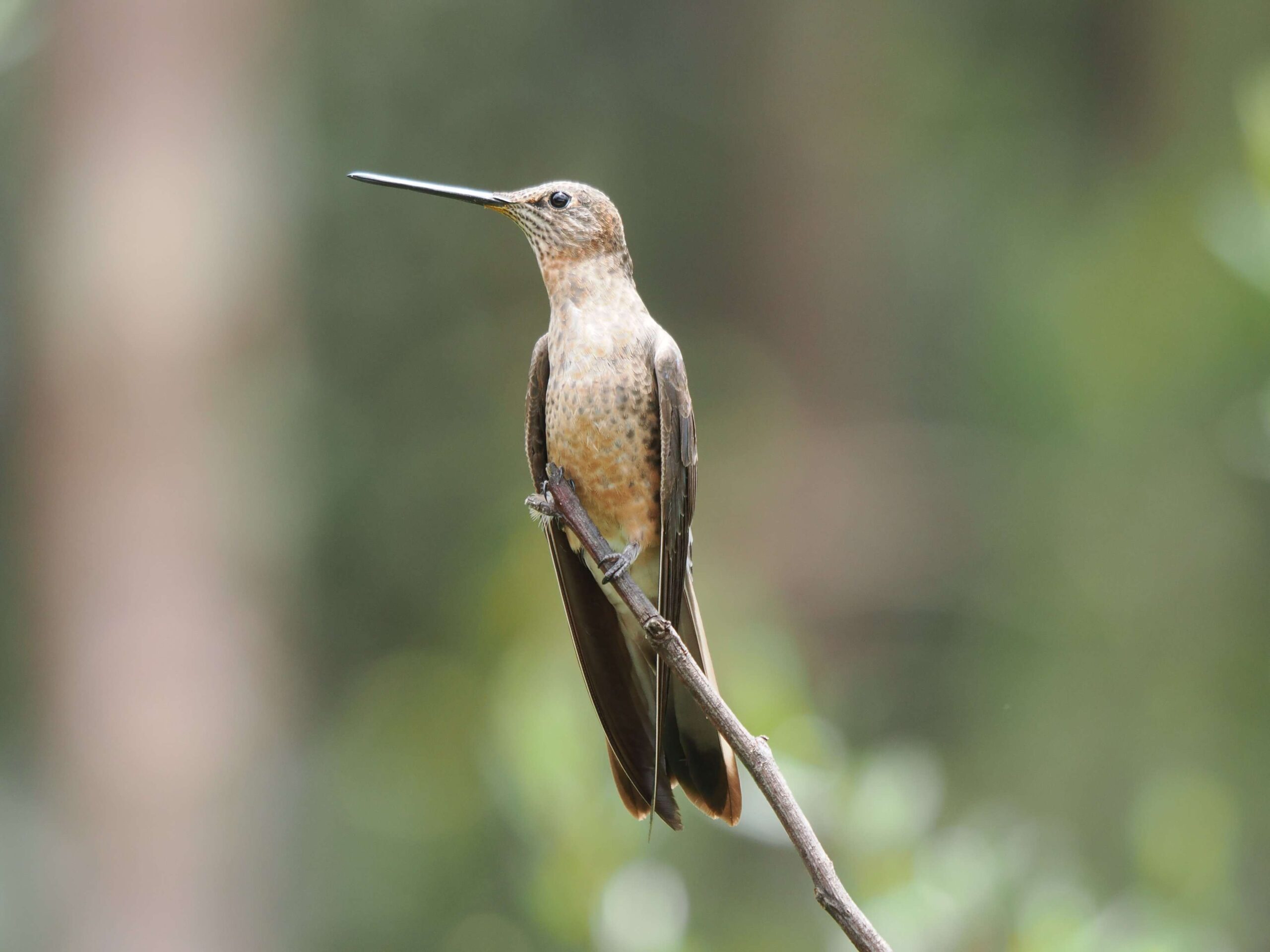
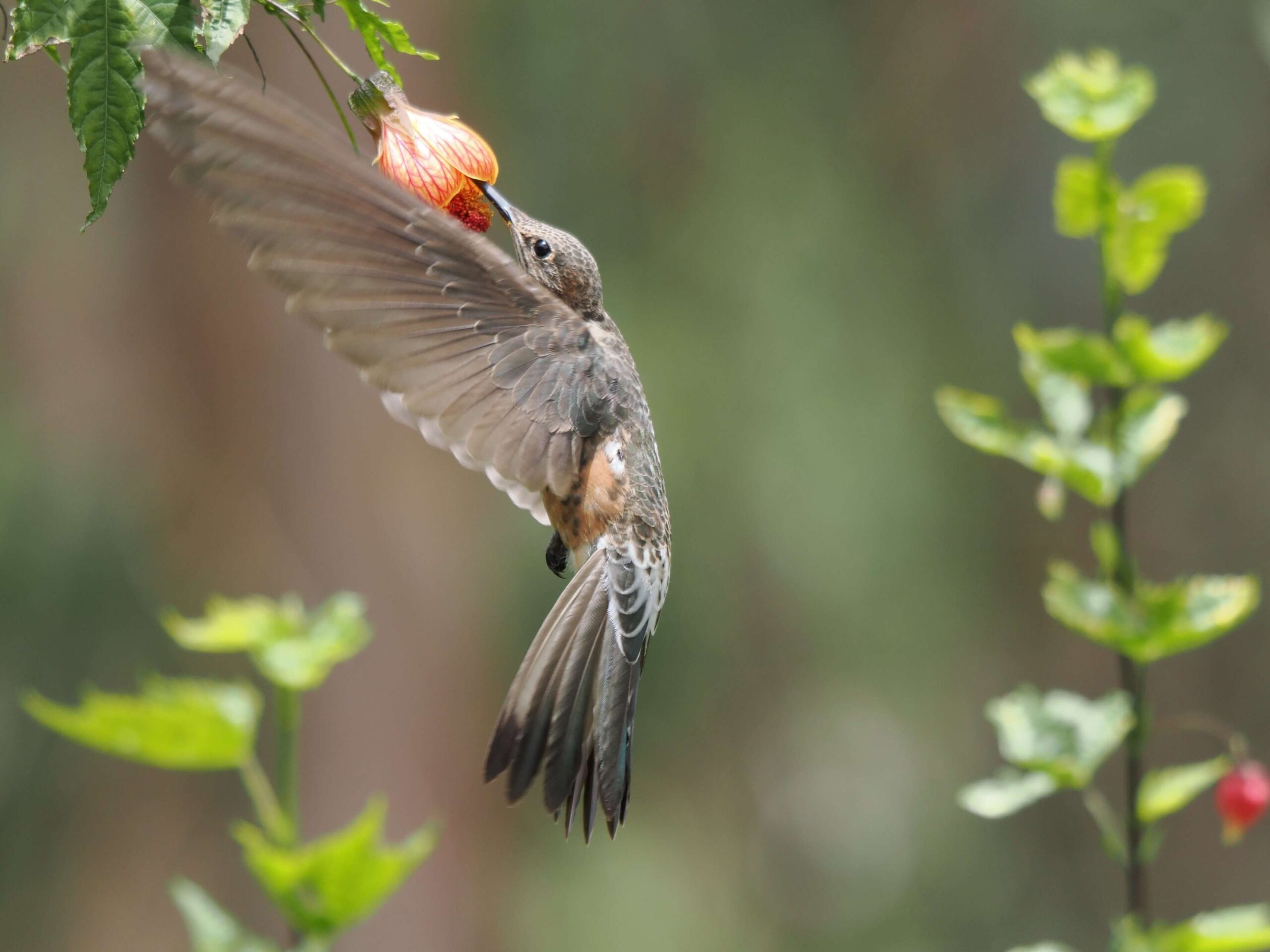
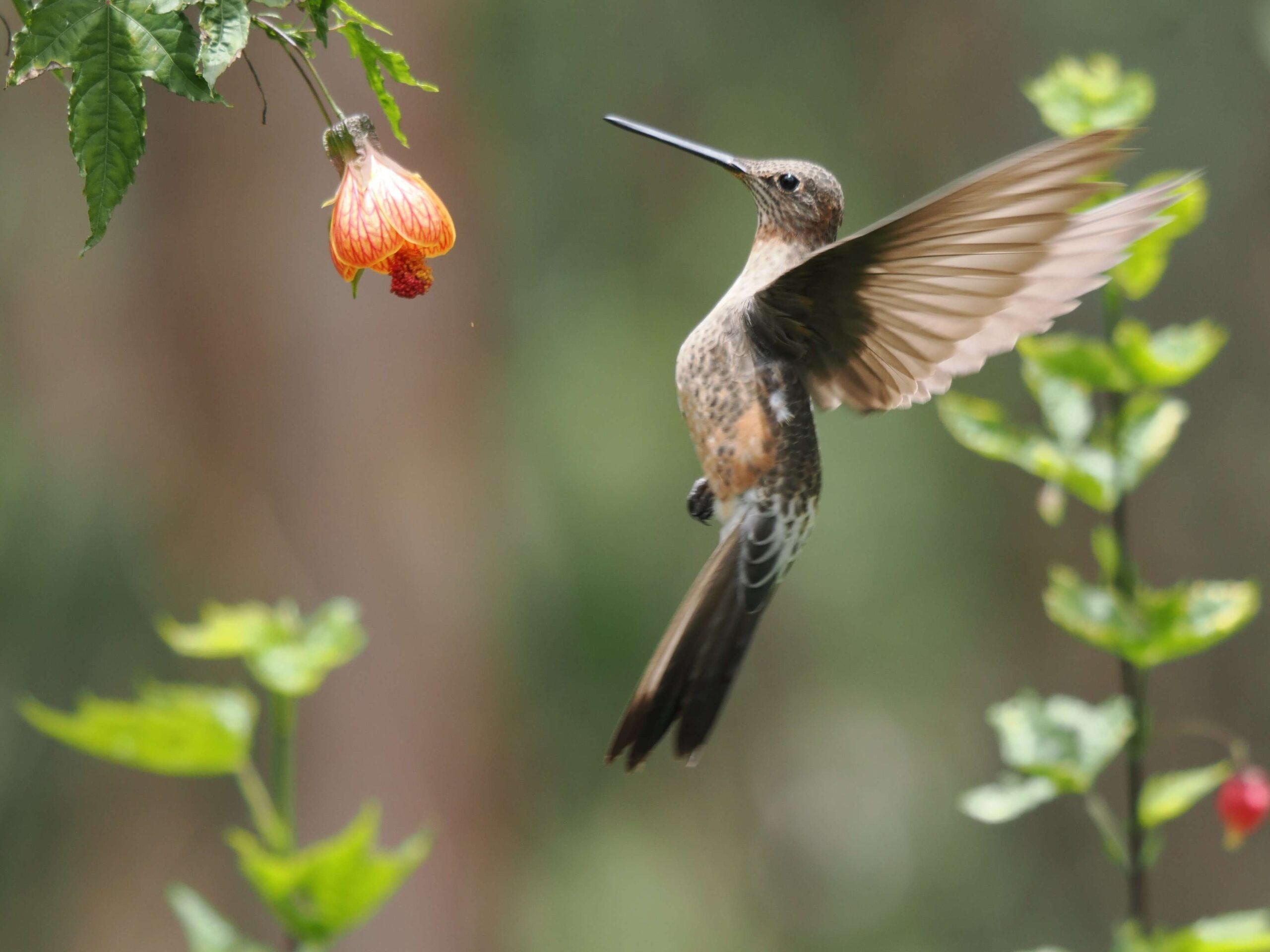
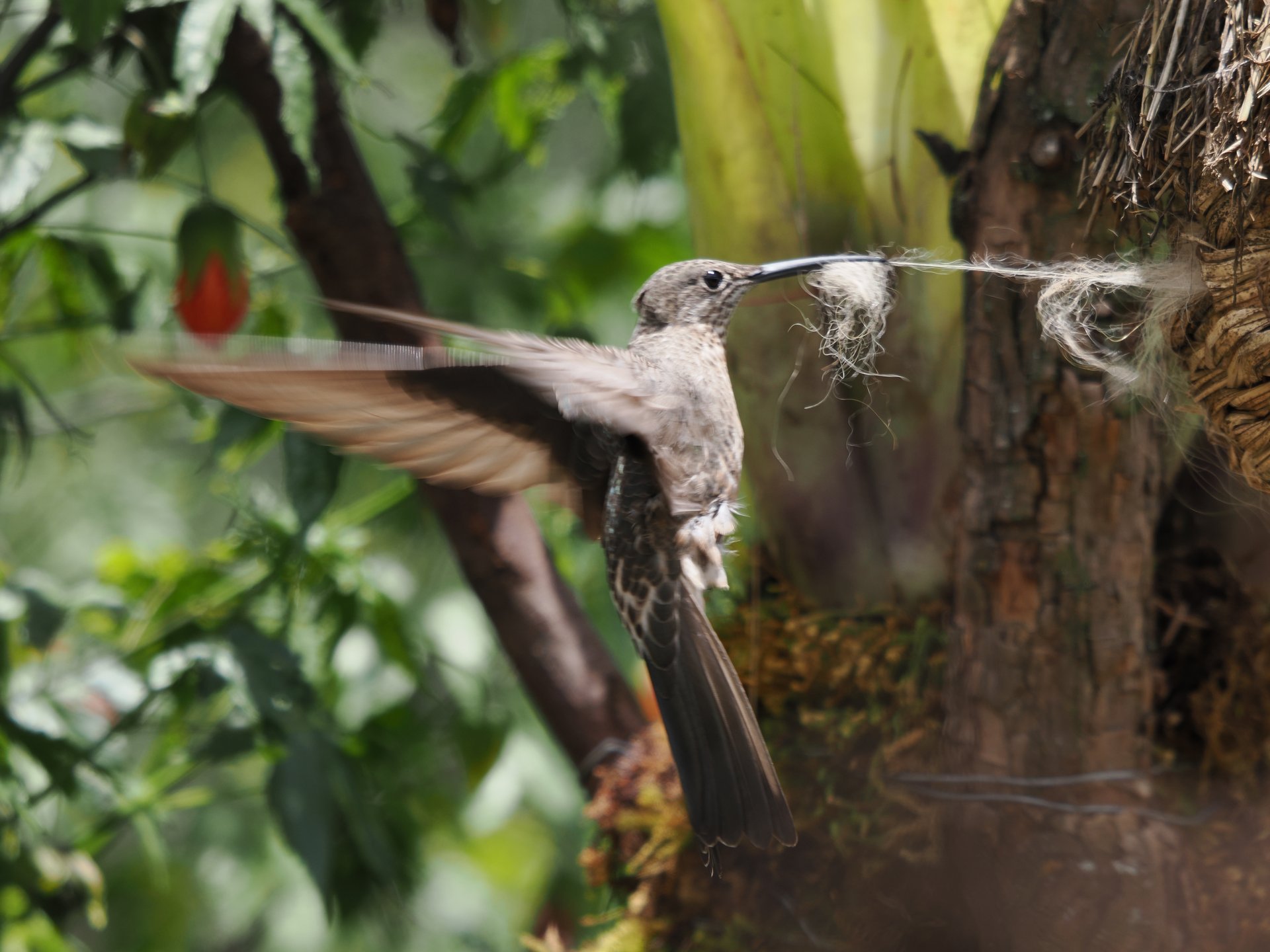
Giant Hummingbirds belong to the genus Patagona, within the family Trochilidae. They are the largest hummingbirds on the planet. While many hummingbird species measure only a few centimeters and weigh about as much as a coin, the giants reach exceptional dimensions for this family. Specialized identification sources describe the Giant Hummingbird as measuring approximately 20 to 23 cm, with grayish-green upperparts, a pale or whitish rump, and underparts with tones ranging from grayish to ferruginous. Its flight shows slower and more powerful wingbeats than those of other hummingbirds, a feature that makes it easier to recognize in the field.
For a visitor to Pachacútec Andean Forest, the first difference between a Giant Hummingbird and any other hummingbird is not in the plumage, but in the scale. The giant does not look like a spark suspended in the air, but rather like a mountain bird that has learned to live as a hummingbird. Its body requires more energy, its flight consumes important resources, and its survival depends on a landscape capable of offering flowers, perches, and corridors.
For this reason, its presence in a restored forest is an ecological signal. A Giant Hummingbird does not remain in a place where there is not enough food. If it returns every year, if it perches, feeds, defends flowers, the forest is offering something real.
One Species That Became Two
For decades, ornithological literature treated the Giant Hummingbird as a single species widely distributed across the Andes. However, that view began to change when researchers placed small tracking devices on individuals in Chile and began studying their elevational movements. The result was surprising: some Giant Hummingbirds carried out extreme elevational migrations, traveling thousands of kilometers and gradually ascending the mountain range, with acclimatization pauses similar to those made by mountaineers adapting to altitude.
The research was not limited to movement. The team combined genetics, morphology, physiology, and museum data. In this way, they discovered that the migratory populations of the south and the high-elevation resident populations of the north were deeply separated. According to the study published in PNAS, this divergence is associated with ecological, genomic, and migratory differences sufficient to recognize two cryptic species. The work proposed the name Patagona chaski for the northern species, evoking the Andean messengers who traveled great distances along highland routes.
But shortly afterward, an important nomenclatural discussion emerged. Other specialists reviewed the taxonomic history and argued that the name peruviana had already been described in the nineteenth century for the northern giant, so the valid name should be Patagona peruviana and not Patagona chaski. The South American Classification Committee also reflects this discussion while evaluating the recognition of Patagona gigas and Patagona peruviana as separate species.
For Pachacútec Andean Forest, the prudent approach is to use a scientifically responsible formulation: Northern Giant Hummingbird, Patagona chaski / Patagona peruviana, until the nomenclature becomes fully stabilized in the reference lists used in Peru.
Main Difference: Migration Versus High-Andean Residency
The most important difference between both giants is not easily seen in a photograph. It is not only in the throat, size, or color. It lies in their history of movement.
The Southern Giant Hummingbird, Patagona gigas, includes populations with extreme elevational movements. In part of its distribution, it breeds in lower areas and later ascends toward high-Andean regions. The study by Williamson and collaborators showed that this migration may include an ascent of approximately 4,100 m in about three weeks, with gradual acclimatization pauses and increased hemoglobin in the blood, as a physiological adaptation to withstand altitude.
The northern giant, in contrast, appears to be associated with high-elevation resident populations in the Andes of Peru and nearby regions. In other words, instead of carrying out long elevational migrations, it lives year-round in high environments, adapted to cold conditions, low oxygen pressure, and seasonal availability of flowers.
This difference transforms the way they are interpreted in the field. If giants are observed at Pachacútec throughout the year, or if individuals are present even at times when the migratory lineage should be elsewhere, they may belong to the northern lineage. If, on the other hand, clear patterns of seasonal arrival and departure are observed, there could be movements compatible with the southern lineage or with local elevational movements.
For now, without genetic analysis or detailed morphological documentation, the responsible approach is to speak of Giant Hummingbirds observed at Pachacútec and to propose the hypothesis that the observatory could be a site of interest for comparing both lineages.
Visible Differences: Difficult, but Possible
One of the great challenges of this story is that the two Giant Hummingbirds are very similar. That is why this is referred to as cryptic speciation: different species that remained hidden because their external appearance is almost the same.
Recent studies indicate that there are subtle differences in size, plumage, and respiratory traits, but they are not easy to assess in the field without high-quality photographs, measurements, direct comparison, and experience. The scientific results themselves indicate that both forms may differ only almost imperceptibly in external appearance.
In practical terms, Pachacútec Andean Forest should carefully record the following traits:
- coloration of the throat and breast;
- intensity of cinnamon or ferruginous tones;
- presence and size of the pale rump patch;
- dorsal coloration;
- pattern of ventral markings;
- relative size;
- behavior;
- date of observation;
- altitude;
- plants visited;
- vocalizations;
- lateral and dorsal photographs.
It is not recommended to state with certainty that an individual belongs to Patagona gigas or Patagona chaski / P. peruviana based only on a quick observation. Identification must be cautious.
Pachacútec Andean Forest as a Scientific Setting
Pachacútec Andean Forest is not only a tourist observatory. It is an ecological restoration space located in a key landscape of Cusco, where the recovery of nectar-producing plants, Andean shrubs, achupallas, kantutas, Buddleja, queñuas, and thickets has begun to rebuild a network of resources for birds.
If Giant Hummingbirds are observed there every year, this turns the place into a scientific opportunity. The forest can provide data on seasonal presence, flower use, territorial behavior, interaction with other hummingbirds, and possible coexistence of lineages.
At a time when science has just revealed that the largest hummingbird in the world concealed two evolutionary stories, every Andean observatory can become a valuable information point.
Pachacútec has one advantage: it observes the same place continuously. That continuity is scientific gold. Many major studies begin with something apparently simple: observing well, recording well, and comparing year after year.
An Initial Comparison for Pachacútec
Below is a preliminary and responsible comparison between both giants:
Characteristic | Southern Giant Hummingbird | Northern Giant Hummingbird |
Scientific name | Patagona gigas | Patagona chaski / Patagona peruviana |
Taxonomic status | Recognized as the southern lineage | Name under discussion: chaski proposed, peruviana defended by priority |
Main strategy | Elevationally migratory in part of its distribution | High-Andean resident |
General distribution | Southern Peru, Bolivia, Chile, Argentina | Northern and central Andes, including Peru |
Visible difference | Very subtle | Very subtle |
Field identification | Difficult without good documentation | Difficult without good documentation |
Relevance at Pachacútec | Possible seasonal visitor or landscape user | Possible high-elevation resident if records are constant |
What to investigate | Arrival dates, departure dates, plants used | Annual permanence, reproduction, patch fidelity |
This table does not close the discussion. It opens it.
Why It Matters to Differentiate Them
Some may ask: if they look so similar, why does it matter to distinguish them?
It matters for several reasons.
First, because each species may have different ecological needs. A migratory species depends on broad corridors, routes of passage, breeding areas, and non-breeding areas. A high-Andean resident species depends on the stability of local habitat throughout the year.
Second, because climate change may affect them differently. Migratory species may suffer mismatches between flowering calendars and routes. Resident species may face reduced resources at high elevation, droughts, or changes in floral phenology.
Third, because conservation must be based on real biological identity. Protecting “a Giant Hummingbird” is not the same as protecting two species with evolutionary histories separated by millions of years.
Fourth, because Pachacútec Andean Forest can become a reference site for recording these differences in Cusco.
The Giant Hummingbird has always been an impressive presence in the Andes. But now we know that its greatness was even greater than it seemed. Beneath discreet plumage and heavy flight were hidden two lineages, two strategies, and two ways of living the mountain.
At Pachacútec Andean Forest, every sighting of these giants must be seen with new eyes. It is no longer enough to say, “we saw a Giant Hummingbird.” Now the scientific question is deeper:
Which giant did we see? In what season? On which flower? At what altitude? With what behavior?
The restoration of the Andean forest has brought back flowers and routes. Science has revealed two species where we once saw one. And Pachacútec, by observing them year after year, can help unite both stories: the story of the returning forest and the story of the giants that still cross the Andes.
THE TWO GIANTS OF THE ANDEAN FOREST
Scientific Differences Between the Southern Giant Hummingbird and the Northern Giant Hummingbird at Pachacútec Andean Forest
How to Differentiate the Two Giants in the Field
In the Andean forest, not all differences are visible at first glance. Sometimes evolution works silently, hidden under almost identical plumages. This is what happens with Giant Hummingbirds. For decades, observers, photographers, and ornithologists saw only one giant. Today we know that behind that name there were at least two stories: one migratory and another high-elevation resident.
For Pachacútec Andean Forest, this difference opens an extraordinary scientific opportunity. If Giant Hummingbirds are observed every year at the observatory, the challenge is not only to photograph them. The challenge is to learn how to read them: when they arrive, which flowers they use, how they behave, whether they remain all year, whether they change with the season, and whether there are signs that allow us to distinguish the southern giant from the northern giant.
- The Main Difficulty: They Look Too Similar
The separation between the Southern Giant Hummingbird and the Northern Giant Hummingbird is based mainly on genetic, physiological, migratory, and detailed morphological evidence. It is not an easy separation to recognize with a quick glance. That is why it is considered a cryptic difference: two evolutionarily distinct species that, to the human eye, still look almost the same.
The study by Williamson and collaborators demonstrated that there are two lineages with separate histories: the migratory southern giant, which retains the name Patagona gigas, and the high-Andean resident northern giant, proposed as Patagona chaski. However, the nomenclature remains under review, since other authors argue that the valid name for the northern giant should be Patagona peruviana, described much earlier.
This means that, for now, at Pachacútec it is best to use a responsible identification: Giant Hummingbird observed, and when there is enough evidence, attempt to separate between Patagona gigas and Patagona chaski / Patagona peruviana.
- Ecological Difference: Migrant Versus Resident
The strongest difference between both giants is not color, but the way they live the mountain.
The Southern Giant Hummingbird, Patagona gigas, carries out extreme elevational movements in part of its range. Some individuals migrate long distances, crossing altitudinal gradients and making acclimatization pauses before reaching high zones. This pattern was one of the keys to understanding that not all Giant Hummingbirds belonged to the same lineage.
The Northern Giant Hummingbird, called Patagona chaski by some authors and Patagona peruviana by others, appears to be more closely linked to high-Andean residency. That is, it lives in high zones year-round and is adapted to conditions of lower oxygen, cold, and strong temperature changes. The discussion about the correct name remains open, but the biological concept is clear: the northern giant represents a more high-elevation resident strategy.
For Pachacútec, this raises a central question:
Are the Giant Hummingbirds we observe throughout the year high-Andean residents, seasonal visitors, or a combination of both?
That question is not answered with a single photograph. It is answered through monitoring.
- Habitat: Where to Look for Each Giant
Both giants use open and semi-open mountain landscapes, but they may differ in how they use the territory.
The traditionally described Giant Hummingbird uses shrublands, gardens, dry valleys, shrubby ravines, and open Andean habitats. It is common to see it perched on visible shrubs, wires, high branches, or roadsides. Its flight seems slow for a hummingbird, but it is strong and direct.
At Pachacútec Andean Forest, the best places to document them would be:
- slopes with kantuta;
- areas with achupallas and Puya;
- Buddleja patches;
- edges of high-Andean shrubland;
- open areas with visible perches;
- restored areas with nectar-producing flowers;
- routes between the observatory and higher sectors of the micro-watershed.
If an individual is observed using the same territory for several weeks or months, it could be a local resident. If it appears only during certain flowerings or seasons, it may be following seasonal resources.
- Flowers: The Key to Understanding Them
Giant Hummingbirds cannot be understood from the bird alone. They must be understood from the flowers.
At Pachacútec, the plants that should be monitored as a priority are:
- kantuta;
- Puya / achupallas;
- Buddleja;
- Nicotiana glauca;
- native nectar-producing shrubs;
- columnar cacti, if they exist in the surroundings;
- flowers of high-Andean shrubland.
The question should not only be “which hummingbird did we see?” but:
On which flower was it?
That information may be more useful than a general description of the plumage. If an individual always appears when achupallas are flowering, that indicates a seasonal relationship. If it uses kantuta within the observatory, that demonstrates that restoration is offering a direct resource. If it moves among distant patches, it may be using Pachacútec as part of a floral corridor.
- Behavior: An Important Clue
Although the two giants are similar, their behavior can provide clues. It does not allow definitive identification, but it helps formulate hypotheses.
Possible signs of a high-Andean resident:
- presence for several months;
- repeated use of the same patches;
- prolonged territorial defense;
- fixed perches;
- possible local reproductive behavior;
- absence of major seasonal changes.
Possible signs of a migratory or seasonal visitor:
- appearance during a specific season;
- intense use of flowers for a few days or weeks;
- disappearance after flowering;
- frequent movement between sectors;
- greater presence during the transition between rains and dry season.
These signs must be recorded carefully, because in mountain birds there are also local movements that do not necessarily mean long migration.
- Field Comparison for Pachacútec
Observation criterion | Patagona gigas | Patagona chaski / P. peruviana |
Known strategy | Elevationally migratory in part of its range | High-Andean resident |
Expected permanence | May vary by season | More constant in high zones |
Visual identification | Very difficult | Very difficult |
Key behavior | Use of routes and seasonal flowerings | Regular defense or use of territory |
Best evidence | Dates, movements, photos, patterns | Annual presence, possible reproduction |
Risk of error | High without data | High without data |
What to record | Arrivals, departures, plants used | Patch fidelity, nests, territories |
- The Name Problem: chaski or peruviana
In 2024, Williamson and colleagues proposed the name Patagona chaski for the northern giant. The name “chaski” carries strong cultural meaning, recalling the Andean messengers who traveled great distances. However, Areta and collaborators argued that the name Patagona peruviana had already been described in 1893 for the same taxon, and therefore would have nomenclatural priority. The South American Classification Committee has an active proposal to recognize Patagona gigas and Patagona peruviana as separate species.
For Pachacútec publications, I recommend writing it this way:
Northern Giant Hummingbird, Patagona chaski / Patagona peruviana, name under taxonomic discussion.
This preserves the communicative strength of “chaski,” while maintaining scientific seriousness.
- The New Frontier: Vocalizations
A very recent scientific line suggests that vocalizations could help distinguish the giants. A study published in 2026 reported vocal differences between Patagona lineages, with recordings from Peru, Bolivia, and Chile. Although this information still needs to be incorporated carefully into field practice, it opens a very interesting possibility: at Pachacútec, the giants should not only be photographed; they should also be recorded.
This can be very useful for the observatory. With a recorder or a good-quality cellphone, a sound archive can begin:
- date;
- time;
- place;
- altitude;
- behavior;
- nearby plant;
- audio;
- associated photograph.
Over time, Pachacútec could compare these vocalizations with scientific databases and contribute to resolving identifications.
- How to Document Them Scientifically at Pachacútec
To better differentiate the two giants, the observatory should implement a specific field form:
Basic Data
- Date.
- Time.
- Observer.
- Forest sector.
- Altitude.
- Weather.
Bird Data
- Number of individuals.
- Behavior: feeding, perched, chasing, singing, direct flight, territorial defense.
- Time spent in the area.
- Interaction with other hummingbirds.
Plant Data
- Species visited.
- Approximate number of flowers.
- Whether the patch was defended.
- Whether the bird changed plants.
Evidence
- Lateral photo.
- Dorsal photo.
- Frontal photo.
- Video of flight.
- Audio if vocalizing.
- eBird record.
eBird can be a useful tool because it documents observations with date, location, and evidence, contributing data for research and conservation at a global scale.
- Why Pachacútec Can Contribute to Science
Pachacútec Andean Forest has an advantage that many large projects do not have: constant observation of the same place.
That allows patterns to be detected. An outside visitor may see a giant one morning and continue traveling. But a local observatory can notice whether it returns every April, changes flowers, disappears in June, stays all year, or increases during certain rains.
That local memory is potential science.
If recorded with method, Pachacútec can provide information on:
- use of restored habitat;
- key plants for Giant Hummingbirds;
- annual or seasonal presence;
- possible coexistence of both lineages;
- response to climate change;
- importance of the Wanakauri micro-watershed as an altitude corridor.
- Initial Hypothesis for Pachacútec
With the available information, a working hypothesis can be proposed:
Pachacútec Andean Forest functions as a high-Andean floral node used by Giant Hummingbirds, possibly with the presence of resident and/or seasonal individuals, whose identification as Patagona gigas or Patagona chaski / Patagona peruviana requires photographic, acoustic, phenological, and eventually genetic monitoring.
This hypothesis is serious, cautious, and scientifically valuable. It does not claim more than is known, but it opens a research path.
The two giants of the Andean forest cannot be easily differentiated with a quick glance. Their difference is written in genetics, blood, altitude, movement, and perhaps also voice.
For Pachacútec Andean Forest, the challenge is to learn to observe them with scientific discipline. Every flower visited, every perch used, every appearance date, and every sound recorded can help understand which giant is using the restored forest.
Restoration has brought back flowers.
The flowers have brought hummingbirds.
Now science must learn to distinguish their stories.
Because in the Andes, even the largest of the hummingbirds may still hold secrets.
HOW SCIENTISTS COULD HELP THE TWO GIANTS OF THE ANDEAN FOREST
Scientific Differences Between the Southern Giant Hummingbird and the Northern Giant Hummingbird at Pachacútec Andean Forest
Part III: Pachacútec as a Natural Laboratory for Studying the Two Giants
In the Andes, not all mountains hold ruins. Some hold invisible routes. Nectar corridors. Altitudinal steps. Resting stops. Vigilance perches. Flowers that open during a precise week and, without knowing it, sustain the flight of a hummingbird that has learned to survive among cold, wind, and scarcity.
That is what makes Pachacútec Andean Forest so important.
At first glance, the observatory could be described as a bird refuge, a hummingbird garden, or an ecological restoration project in San Jerónimo, Cusco. But if we observe it from the natural history of the giants of the genus Patagona, Pachacútec is something more: a natural high-elevation laboratory, a space where the restored forest can help answer one of the most fascinating questions left by recent Andean ornithology:
How do the Southern Giant Hummingbird (Patagona gigas) and the Northern Giant Hummingbird (Patagona chaski / Patagona peruviana) coexist, distribute themselves, or differ in the Cusco landscape?
Answering that question is not an academic luxury. It has consequences for conservation, environmental education, nature tourism, and the way the Andean forest itself is understood.
- The Scientific Value of Seeing Giants in a Restored Forest
Observing Giant Hummingbirds in a restored Andean forest does not only mean adding an attractive species to a bird list. It means confirming that the landscape has recovered functions.
The giants are not easy birds from an energetic point of view. Their size forces them to consume large amounts of nectar. Their flight, heavier than that of other hummingbirds, requires sufficient and relatively connected floral patches. Their permanence depends on perches, refuge, flower availability, and a certain stability of the territory.
For this reason, when a giant uses a restored forest, the ecological message is strong: the forest is offering real resources.
At Pachacútec Andean Forest, this idea is central. Restoration has not been limited to planting for aesthetic purposes. Work has been carried out with the logic of rebuilding an ecological matrix: nectar-producing flowers, Andean shrubs, structural plants, vegetated ravines, perches, cover, and continuity. The objective is not only for visitors to see birds, but for birds to find conditions to live, move, feed, and eventually reproduce.
From this perspective, the annual observation of Giant Hummingbirds turns Pachacútec into a privileged point for studying the relationship between restoration and habitat use by hummingbirds with high energy demands.
- A Strong Hypothesis: Pachacútec as a High-Elevation Floral Node
Based on the available information and recurrent observations at the observatory, a robust ecological hypothesis can be proposed:
Pachacútec Andean Forest functions as a high-Andean floral node used by Giant Hummingbirds within a resource corridor that connects ravines, slopes, shrublands, and restored patches of the Wanakauri micro-watershed.
This hypothesis implies several things.
First, the observatory should not be understood as an isolated site, but as part of a larger landscape. The giant does not “belong” to a garden; it belongs to a network of flowers distributed across elevation.
Second, Pachacútec’s restoration may have increased the quality of the local habitat, making the site more visible and useful to the giants.
Third, the presence of Patagona gigas and/or Patagona chaski / peruviana may be related to the phenology of certain forest plants, especially those that offer nectar at critical times of the year.
Fourth, if the two lineages use the Cusco environment in different ways—one more resident and the other more seasonal—the observatory could record signs of that difference.
- Which Plant Species Should Be Studied First?
If Pachacútec wants to understand the giants, it must first study the flowers. A hummingbird cannot be interpreted only from its plumage. It must be interpreted from the energy it needs.
In the context of the restored Andean forest, the priority plants for giant monitoring should be:
- a) Kantuta (Cantua buxifolia)
The sacred flower of the Andes, with tubular corollas and intense colors, is a natural candidate for monitoring. Its floral form, visibility, and ecological value make it a key plant for medium and large hummingbirds.
- b) Achupallas and Other Puya
Puyas are spectacular floral structures of the high-Andean landscape. For a Giant Hummingbird, they may represent important resources and visible perches. In addition, their distribution on open slopes makes them strategic within the mosaic of the observatory and its surroundings.
- c) Buddleja
Buddleja species do not only offer flowers; they also create vegetation structure, partial shade, refuge, and perches. They are part of the architecture of the restored forest.
- d) Nicotiana glauca and Other Nicotiana Species
In several Andean systems, Nicotiana species may be valuable resources for hummingbirds. If the giants use them at Pachacútec, it would be important to record this in detail.
- e) Other Native Nectar-Producing Plants of the Andean Forest
Pachacútec has worked with multiple nectar-producing species. All should be included in a phenological list with flowering dates, duration, abundance, and observed visits.
In practice, the observatory needs an annual floral calendar. That calendar is the basis for interpreting the giants.
- How Can We Know Whether Pachacútec Hosts Both Giants?
This is the most delicate and most interesting question.
With current evidence, claiming that both giants are confirmed at Pachacútec would require very solid documentation. The scientifically correct approach is to say that the observatory records Giant Hummingbirds and that, given the new taxonomic division of the genus Patagona, there is interest in investigating whether the observed individuals correspond to one or both lineages.
To approach that answer, Pachacútec should work on five fronts:
- Seasonal Monitoring
Record every giant observation throughout the year:
- date;
- time;
- weather;
- altitude;
- forest sector;
- plant visited;
- behavior;
- number of individuals.
The goal is to detect whether there is continuous presence or clear peaks of appearance.
- Comparative Photographic Archive
A beautiful photograph is not enough. Images with scientific value are needed:
- left lateral view;
- right lateral view;
- dorsal view;
- frontal view;
- detail of throat and breast;
- rump if possible;
- perch and floral context.
- Vocalization Recording
Recent literature suggests that there may be acoustic differences between Patagona lineages. If Pachacútec records songs or calls, those recordings could be compared with sound libraries and future publications.
- Floral Phenology
Every observation of a giant must be associated with flowering status. This will make it possible to know whether it appears linked to certain plants or moments of the year.
- Collaboration with Researchers
If the observatory manages to gather a good set of photos, dates, audio recordings, and floral data, it could collaborate with ornithologists, universities, or hummingbird specialists to evaluate the material.
- Behavior as an Interpretation Tool
Although identification between the giants cannot be based only on behavior, behavior can help build hypotheses.
If Pachacútec Records Individuals During Almost the Entire Year
That could suggest the presence of a more high-elevation resident giant, compatible with the northern lineage.
If Presence Increases Only During Certain Periods
That could indicate seasonal use of the forest, compatible with elevational or floral movements of the southern giant, or with regional movements.
If the Same Forest Sector Is Defended for Weeks
That would suggest territorial fidelity and prolonged local use.
If an Individual Appears Only When Certain Plants Are Flowering
That would point to a strong relationship with resource pulses.
If Giants Repeatedly Use High and Open Perches
Those perches should be mapped, because they may form part of their territorial vigilance strategy.
In other words: behavior does not replace genetics, but it can guide the right question.
- Giants, Restoration, and Competition with Other Hummingbirds
One of the most interesting scenes at Pachacútec is the coexistence between Giant Hummingbirds and other forest hummingbirds. Species involved include:
- Sparkling Violetear (Colibri coruscans);
- Green-tailed Trainbearer;
- Black-tailed Trainbearer;
- Tyrian Metaltail;
- White-bellied Woodstar;
- other high-Andean hummingbirds of the area.
Floral restoration changes the dynamics among these species. When there are more flowers and more available patches, extreme competitive pressure over a single resource decreases. This does not eliminate chases, but it can favor coexistence.
For the giants, this is important because it allows them to exploit forest sectors without depending on a single intensely disputed patch. A diverse forest does not only feed more; it also distributes space better.
Pachacútec could document:
- which species chase the giants;
- whether the giants displace other hummingbirds;
- in which flowers the greatest competition occurs;
- whether there are seasonal differences in aggression.
This information would help understand how the forest’s pollinator community is organized.
- Climate Change: Why This Comparison Matters So Much
The difference between a migratory giant and a resident giant is not a minor detail. Under climate change scenarios, that difference may define different vulnerabilities.
Risks for a Migratory Giant
- mismatch between flowering and arrival;
- loss of altitudinal corridors;
- sudden temperature changes along the route;
- reduced availability of acclimatization sites.
Risks for a Resident Giant
- sustained reduction of flowers at high elevation;
- prolonged droughts;
- fires;
- local habitat fragmentation;
- loss of key plants within its annual territory.
For this reason, distinguishing the giants is not merely a taxonomic curiosity. It is a conservation necessity. Each lineage may require different strategies.
And here Pachacútec becomes relevant again: a restored high-elevation forest can function as a climate refuge, a feeding patch, or a station within a broader network of resources.
- Pachacútec as a School of Citizen Science
One of the greatest strengths of the observatory is that it does not only receive ornithologists. It also receives students, volunteers, photographers, tourists, and people interested in learning. This allows the observation of the giants to become a guided citizen science experience.
A well-oriented visitor can contribute a great deal if they learn to record:
- observation time;
- flower visited;
- behavior;
- useful photograph;
- duration of the sighting.
Volunteers can help fill out field forms. Students can collaborate with flowering calendars. Photographers can generate high-quality comparative material. Guides can identify patterns between seasons.
In this way, the forest becomes a classroom, and science stops being something distant and becomes a daily practice.
- What a Future Scientific Article from Pachacútec Should Say
If the observatory gathers two or three years of systematic data, it could prepare a scientific or technical article with a structure like this:
Tentative Title
Use of a Restored Andean Forest by Giant Hummingbirds of the Genus Patagona in the Wanakauri Micro-Watershed, Cusco, Peru
Questions
- Is there annual or seasonal presence of Giant Hummingbirds at Pachacútec Andean Forest?
- Which plants do they visit most frequently?
- What territorial behavior patterns do they show?
- Do the records suggest the presence of one or two lineages?
- How is their presence related to the floral phenology of the restored forest?
Expected Results
- presence calendar;
- list of plants visited;
- maps of sectors used;
- vocalization records;
- photographic comparison;
- discussion of possible taxonomic identity.
That article would not have to resolve the entire history of the genus Patagona. It would be enough to demonstrate that a restored forest in Cusco is generating new information about Giant Hummingbirds.
- Proposed Field Protocol for Pachacútec
Giant Hummingbird Field Form – Pachacútec Andean Forest
General Data
- Date
- Time
- Observer’s name
- Observatory sector
- Altitude
- Weather
Bird Data
- Number of individuals
- Visible perch: yes / no
- Behavior: feeding / perched / chasing / being chased / singing / passing flight
- Time spent in the area
Floral Data
- Plant visited
- Approximate number of open flowers
- Type of use: feeding / defense / passing through
Interactions
- Species present
- Aggression received or performed
- Shared use of the floral patch
Evidence
- Lateral photograph
- Dorsal photograph
- Audio
- Short video
- eBird / field notebook
This protocol, applied consistently, would have more scientific value than it may seem.
- The Deepest Difference Between the Two Giants
After reviewing genetics, morphology, migration, behavior, and ecology, the deepest difference between the two giants is not only in a name or a plumage detail.
The real difference is this:
- one represents the mountain traveled;
- the other represents the mountain inhabited.
The southern giant embodies movement, acclimatization, route, vertical journey.
The northern giant embodies permanence, adaptation to altitude, residence in a world of thin air and severe seasons.
Both are Andean. Both are extraordinary. But they do not tell exactly the same story.
- What This Means for Pachacútec Andean Forest
If Pachacútec confirms in the future that its landscape is used by both giants, the observatory would have exceptional value. It would mean that the restored forest does not only support common hummingbirds or occasional visitors, but participates in the ecology of two major lineages of the genus Patagona.
Even if it is eventually shown that only one of the giants regularly uses the observatory, the result would still be valuable. It would allow us to better understand how a species with high energy demands responds to ecological restoration in the Andean forest.
In both cases, the message is powerful:
Restoring Andean flowers does not only beautify the landscape; it rebuilds routes of life.
- General Conclusion of the Article
For decades, the Giant Hummingbird was a singular but apparently simple bird: one large hummingbird distributed across the Andes. Recent science showed that this story was incomplete. Behind the same name were hidden two giants: one more closely linked to elevational migration and another more associated with high-Andean residency. Two lineages, two strategies, two ways of living the mountain.
At Pachacútec Andean Forest, this revelation transforms everyday observation into a scientific opportunity. Every giant seen on a kantuta, every perch occupied on a slope, every visit to an achupalla, every seasonal disappearance, and every annual return can contribute pieces to a larger puzzle.
The restored forest of Cusco is not only bringing back flowers and refuge. It is creating conditions for new questions to emerge.
Who exactly are the giants that use Pachacútec?
One? Two? Residents? Visitors?
Which plants sustain them?
Which seasons call them?
Which invisible routes bring them to this forest?
Answering these questions will take time. But the foundation already exists: observation, restoration, and memory of the territory.
And perhaps that is the most beautiful lesson of this story. Sometimes, restoring a forest does not only bring birds back. It also brings back mysteries. And with them, the possibility that a place like Pachacútec Andean Forest may be not only a refuge for hummingbirds, but a point from which the Andes begin to explain themselves again.
Suggested Scientific References for the Complete Article
APA 7
- Williamson, J. L., Bozinovic, F., Ricote, N., et al. (2024). Extreme elevational migration spurred cryptic speciation in giant hummingbirds. Proceedings of the National Academy of Sciences, 121(21), e2313599121.
This is the central work demonstrating that the former Patagona gigas includes two lineages and analyzing migration, genetics, and physiology. - Areta, J. I., et al. (2024). The world’s largest hummingbird was described 131 years ago. Bulletin of the British Ornithologists’ Club, 144(3), 328–332.
This discusses nomenclatural priority and proposes that the northern giant should be called Patagona peruviana. - Velásquez-Noriega, P., Williamson, J. L., & collaborators. (2023/2024). Giant Hummingbird (Patagona gigas). Birds of the World. Cornell Lab of Ornithology.
This compiles distribution, ecology, behavior, and background information on the group. - Pulido Capurro, V. (2018). Estacionalidad de aves altoandinas en la cuenca del Titicaca. Revista de Investigaciones Altoandinas, 20(4), 461–476.
Useful for contextualizing seasonal movements of high-Andean birds and changes associated with resources. - Jobling, J. A. (2010). Helm Dictionary of Scientific Bird Names. Bloomsbury.
Useful for explaining the origin of names such as Patagona, gigas, and chaski.
Other Useful Sources for Discussion and Contrast
- South American Classification Committee, proposal on recognizing Patagona gigas and Patagona peruviana.
- eBird / Cornell for current distribution and comparative records.
- Audubon and National Geographic in Spanish as outreach support, not as the main basis of the scientific argument.
Suggested Editorial Closing for Publication
At Pachacútec Andean Forest, the flight of a Giant Hummingbird can no longer be read as before. We now know that beneath that enormous body and discreet plumage, two distinct evolutionary stories may be hidden: that of the vertical traveler of the Andes and that of the high-elevation resident that has made the cold its home. Distinguishing them is not only a matter of name. It is understanding what forest they need, which flowers sustain them, and what future awaits them in a changing mountain range. There, among kantutas, achupallas, and restored shrublands, science and conservation meet again in the deep hum of an impossible hummingbird.