Añade aquí tu texto de cabecera
SPARKLING VIOLETEAR
Colibri coruscans: The Hummingbird That Rules the Andean Forest
Territory, Altitude, and Pollination at Pachacútec Andean Forest, Cusco
In the Andean forest, there are birds that pass like a shadow, silent and brief. And there are others that do not ask permission. They arrive with a metallic hum, perch on a high branch, watch over a patch of flowers as if they owned the valley, and when another hummingbird approaches, they drive it away with fierce speed. Among the hummingbirds of the Andes, few embody that mixture of brilliance, aggression, and presence better than the Sparkling Violetear, Colibri coruscans.
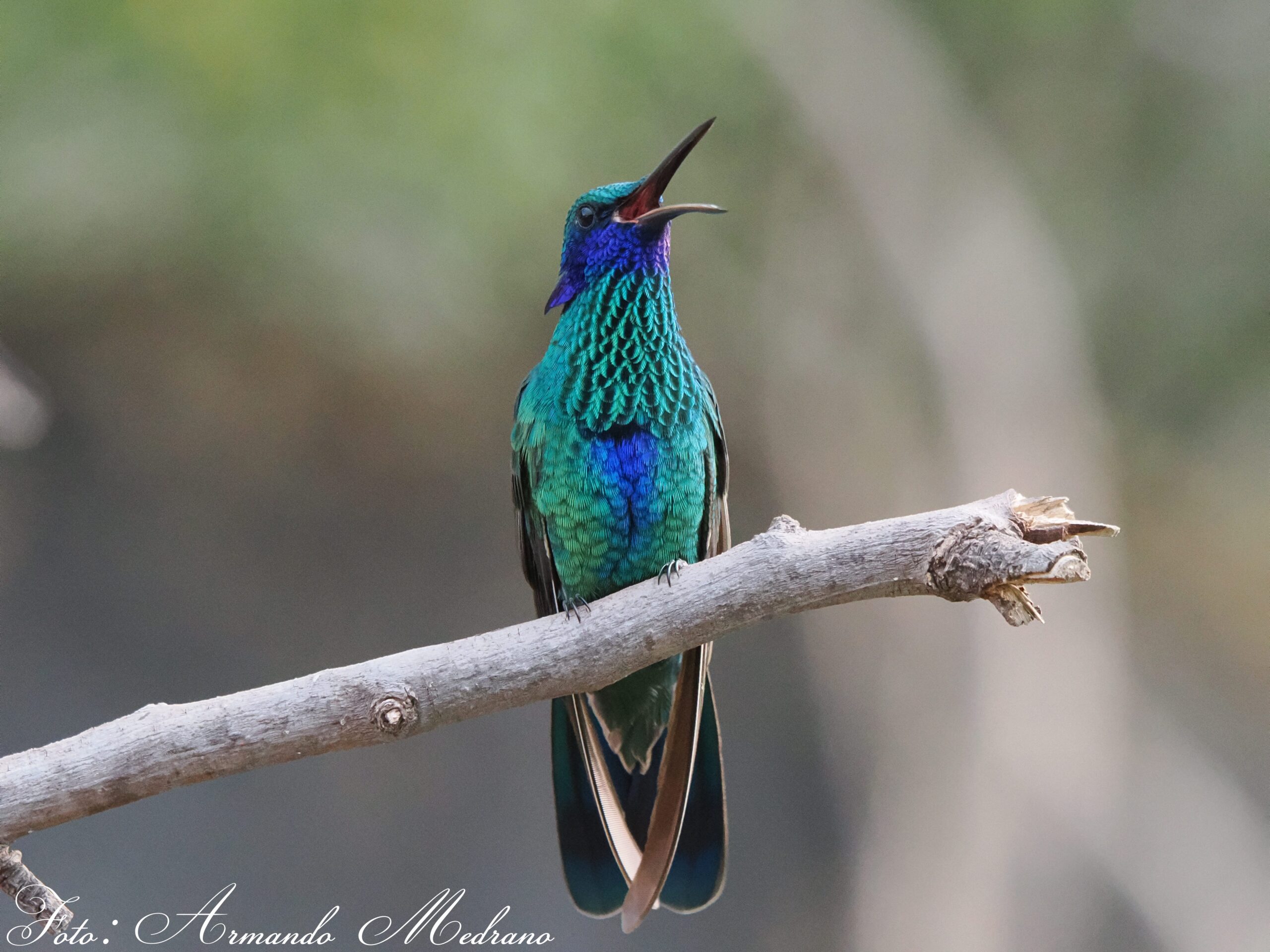
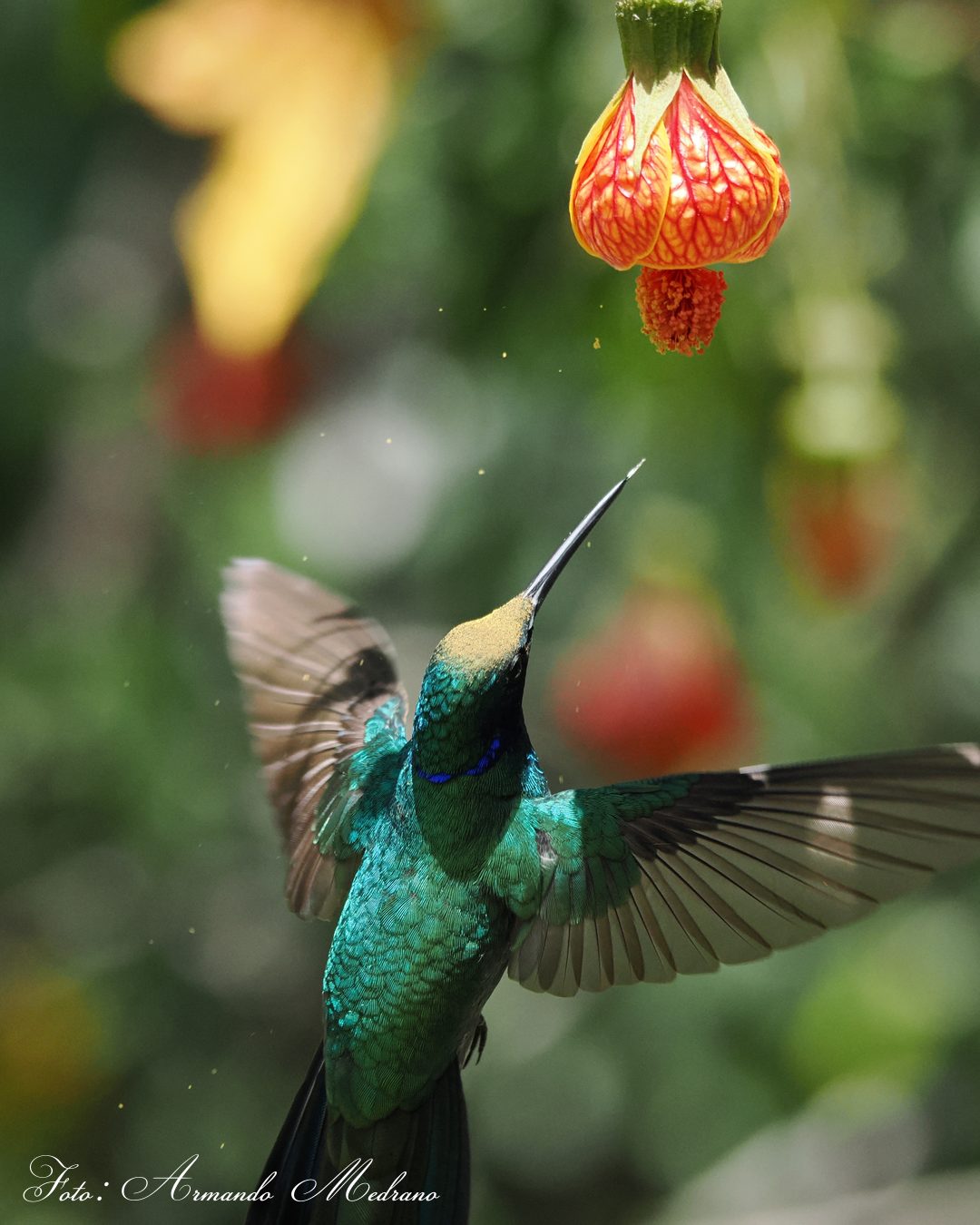
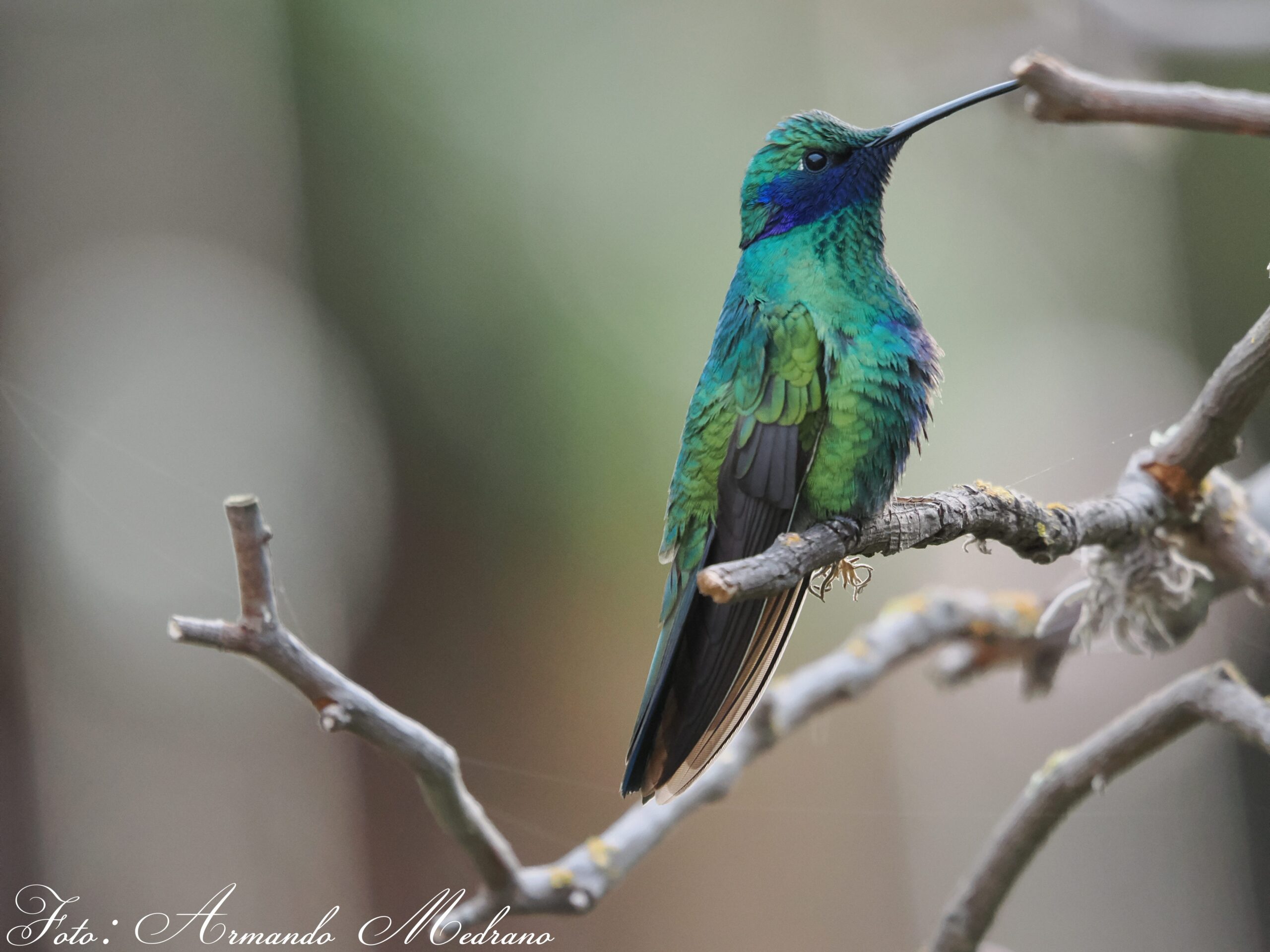
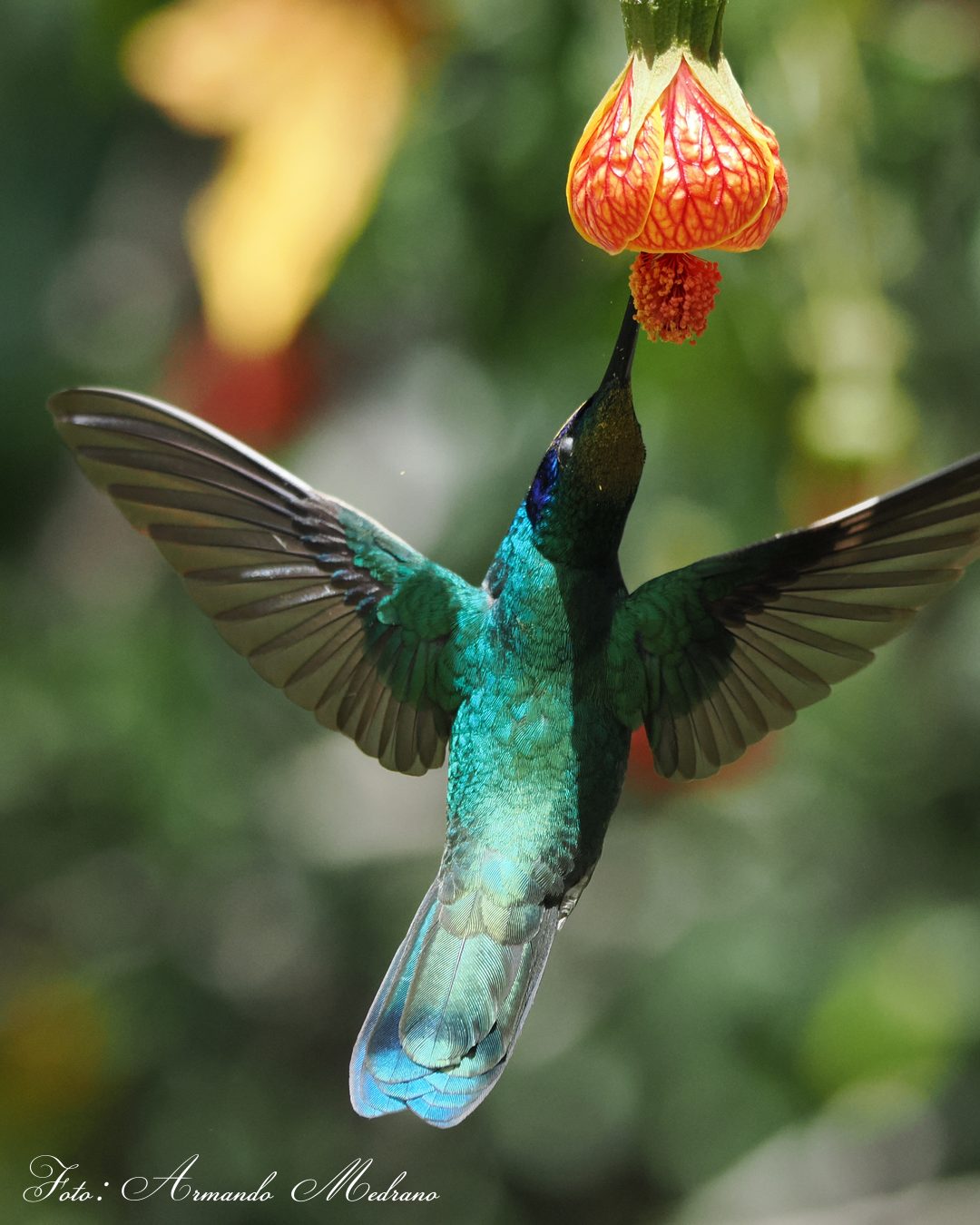
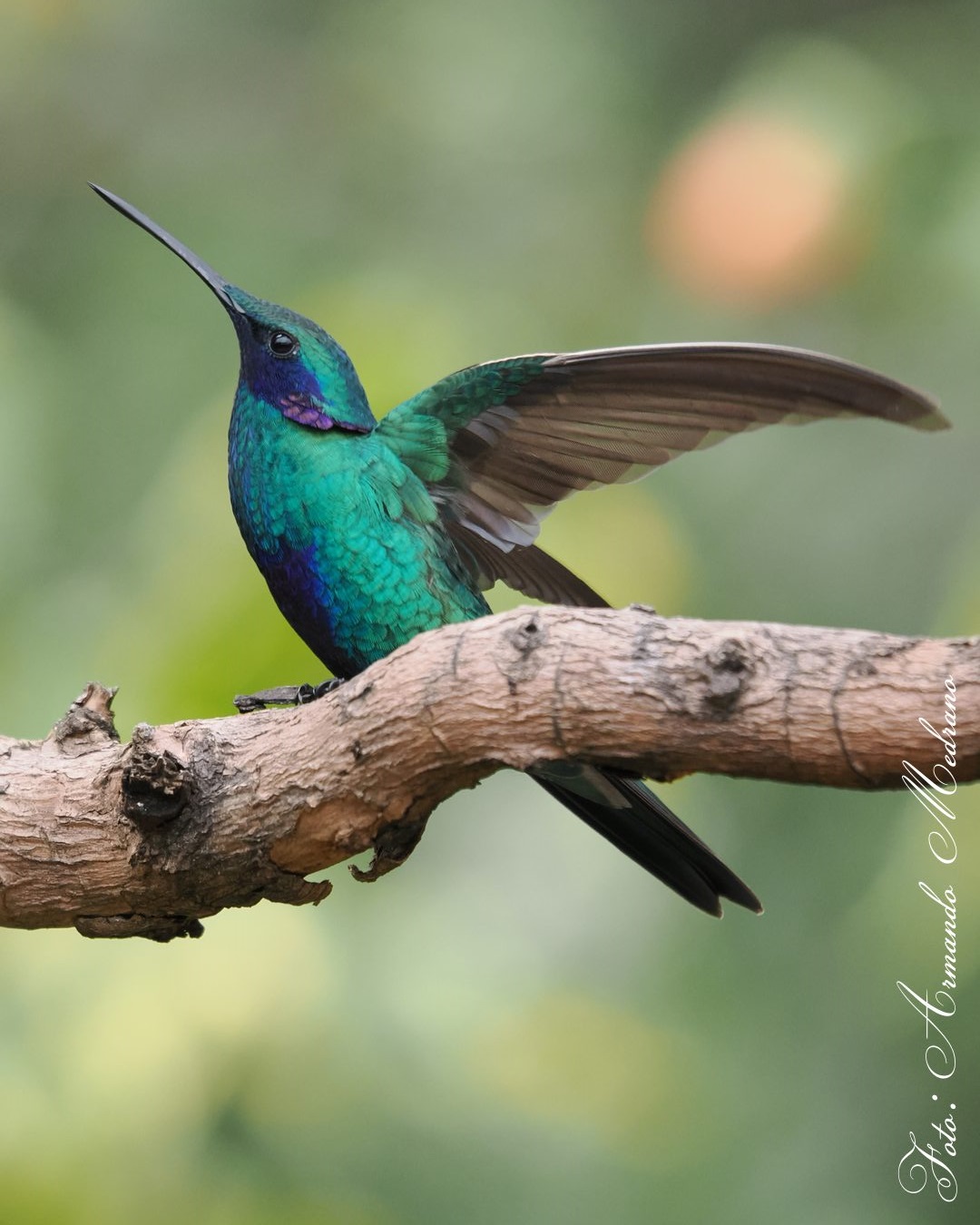
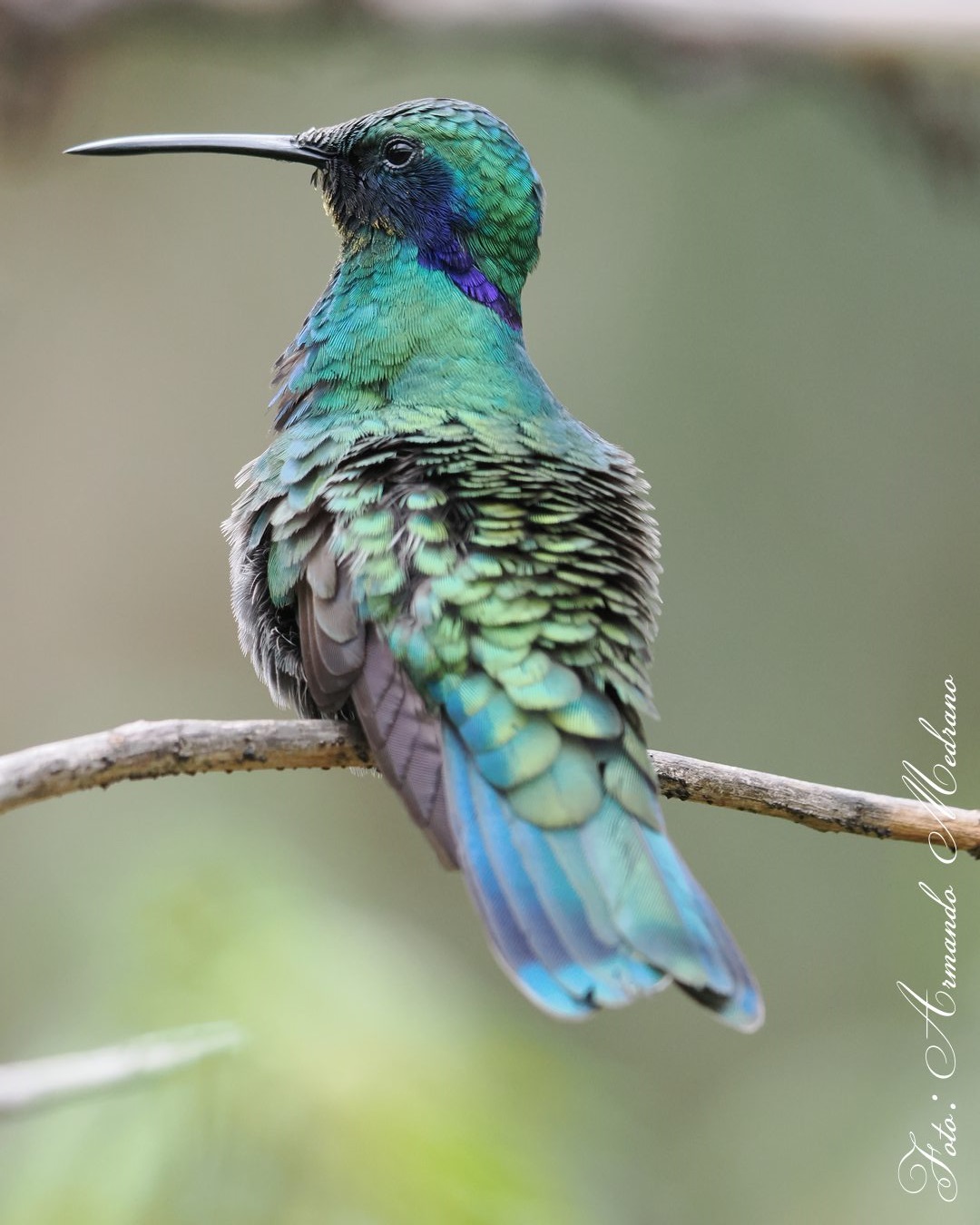
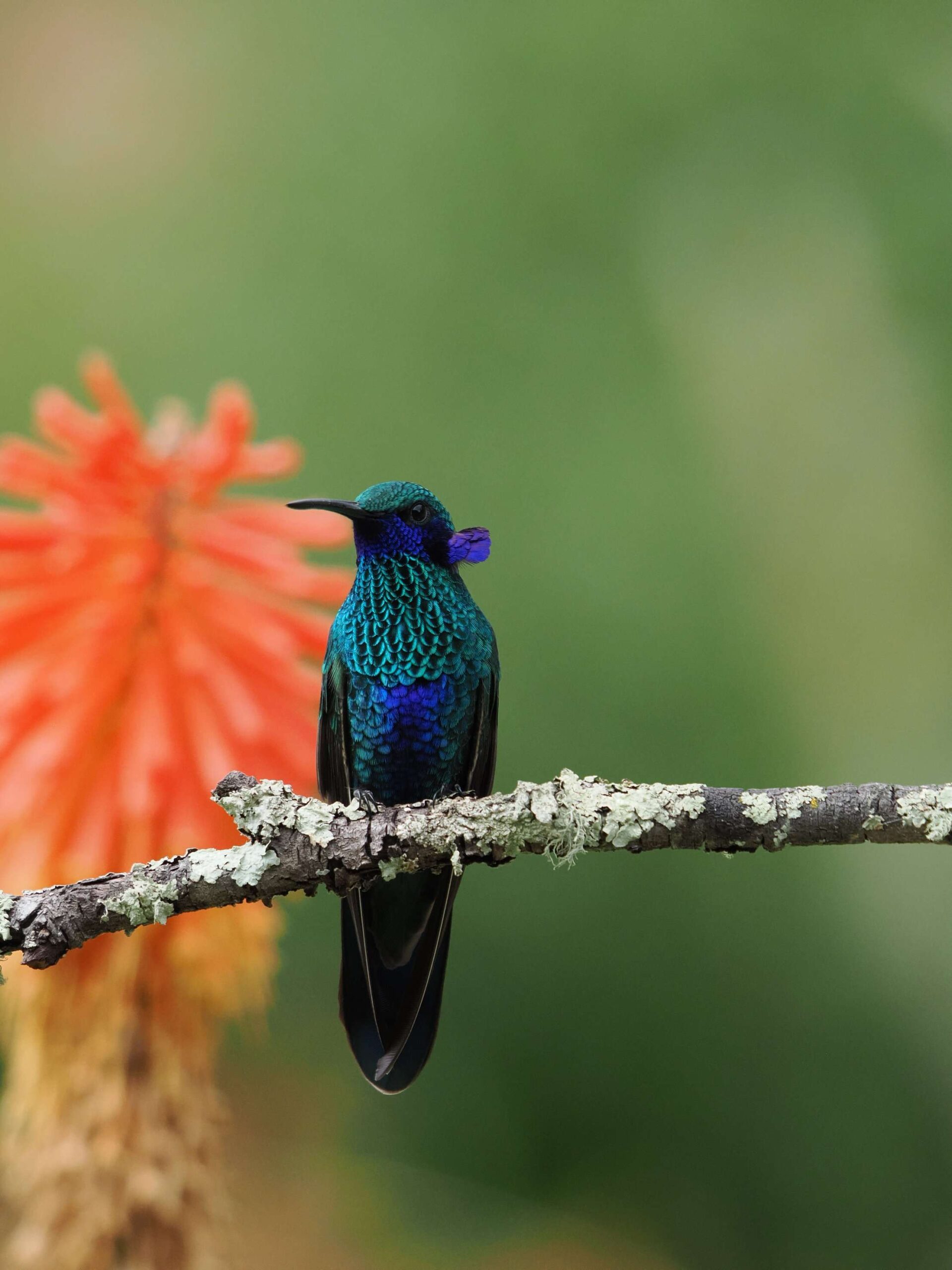
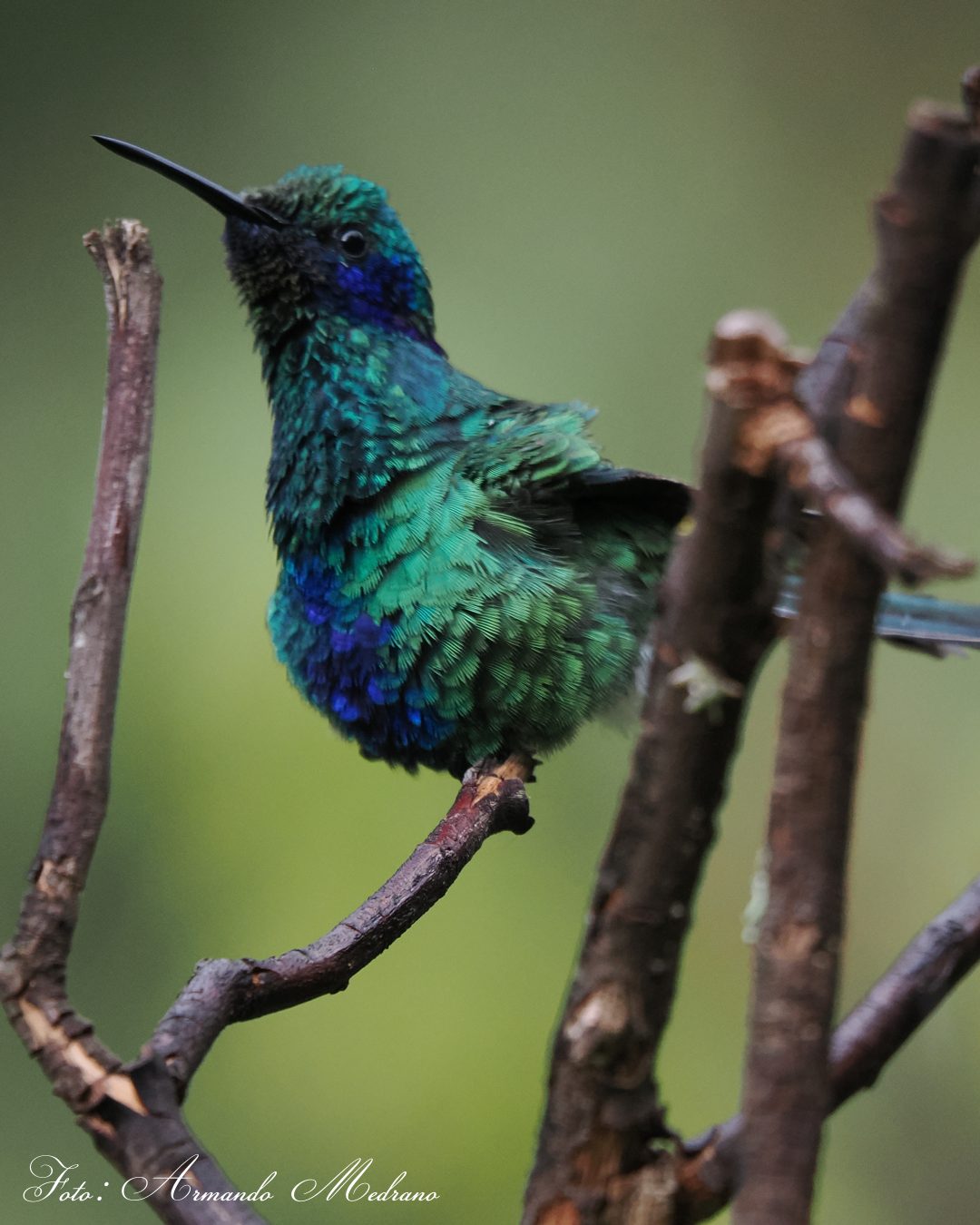
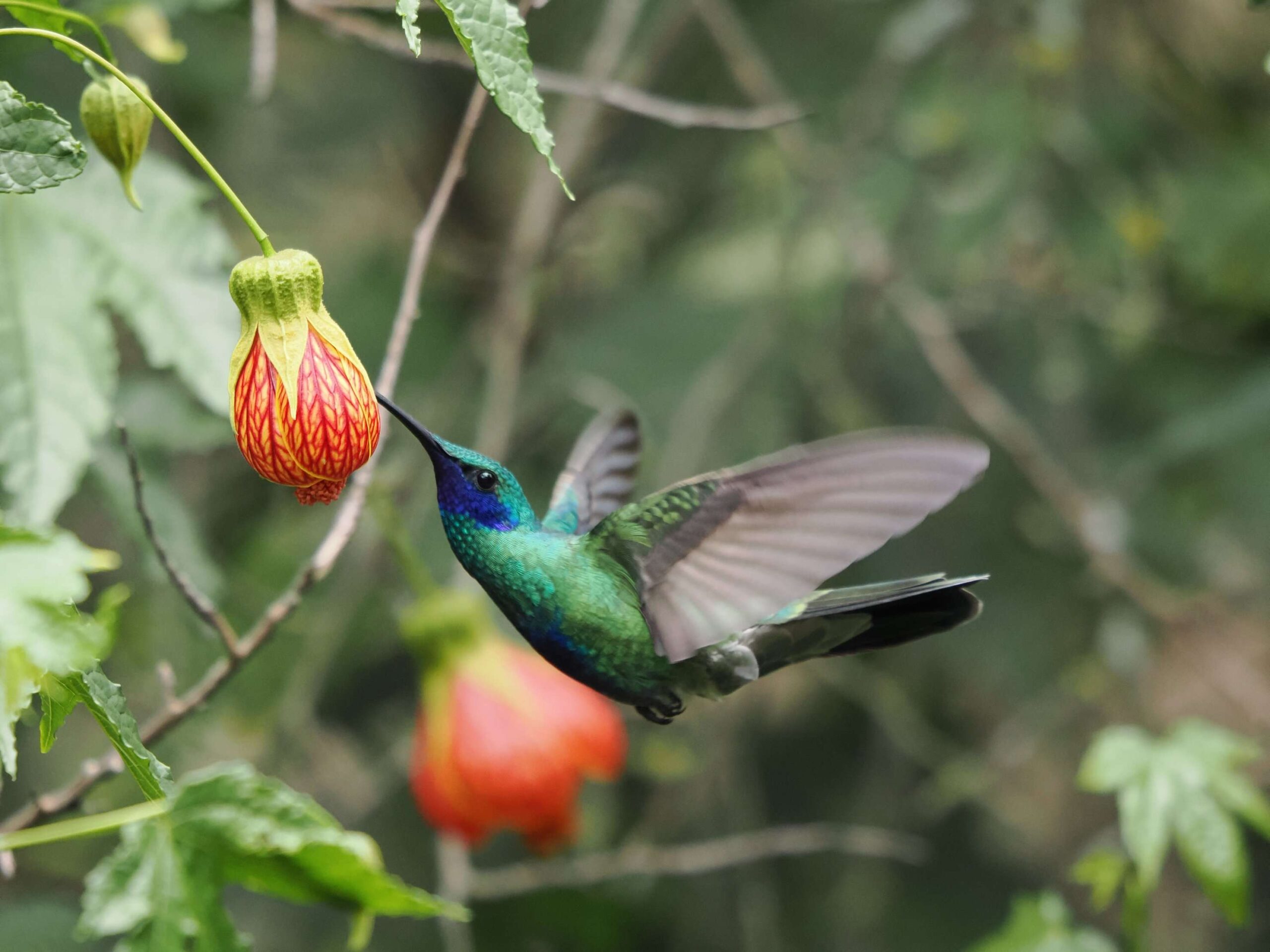
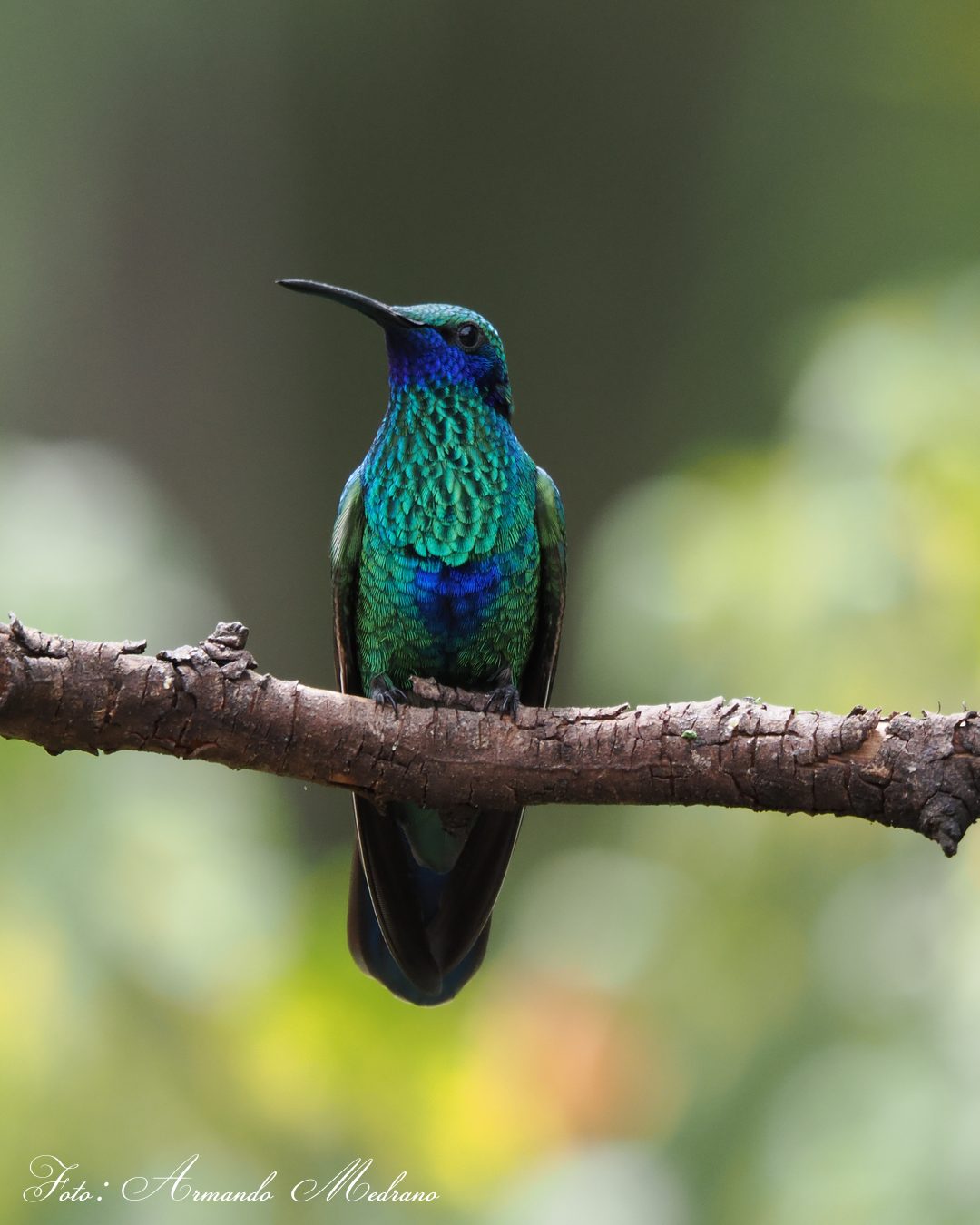
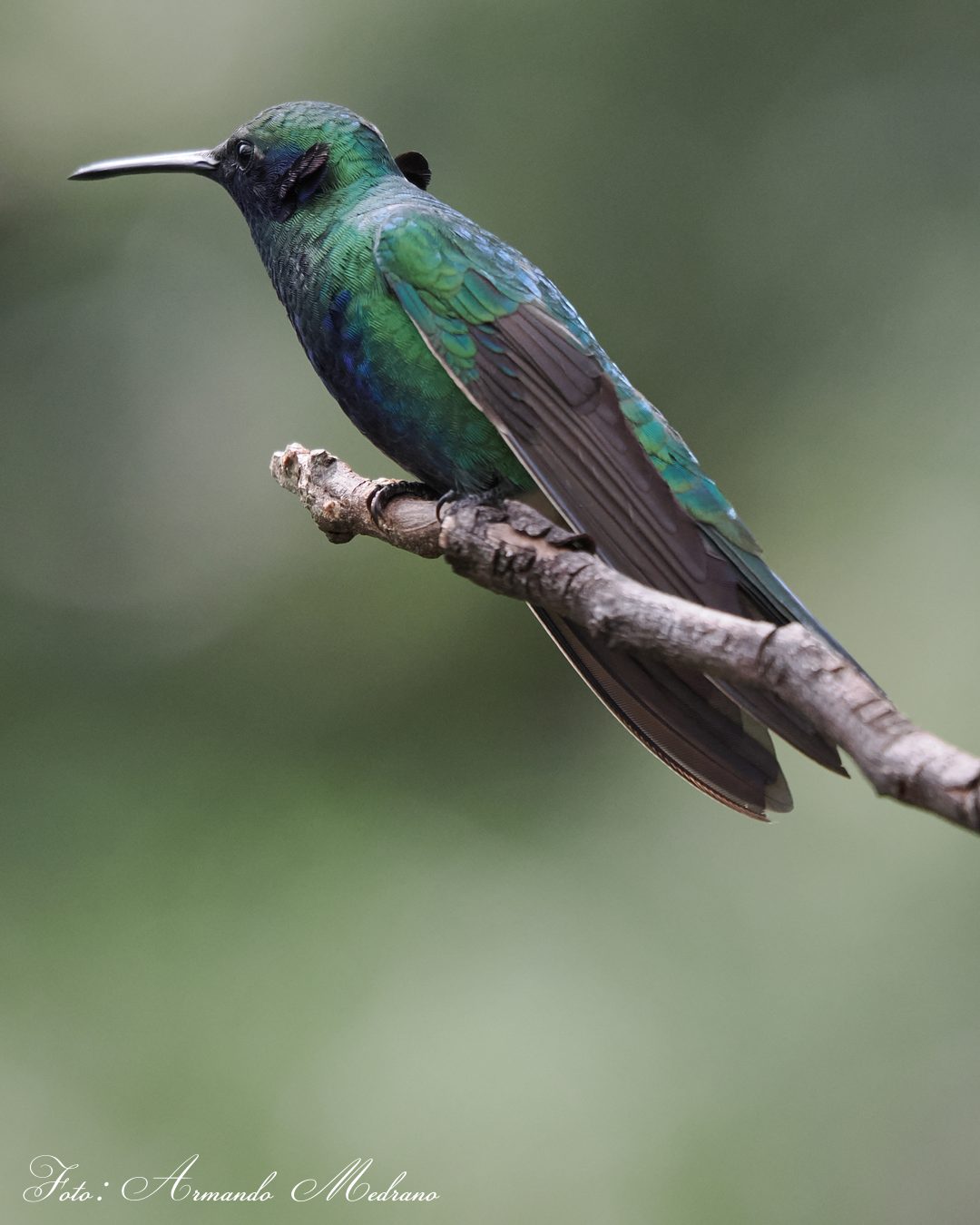
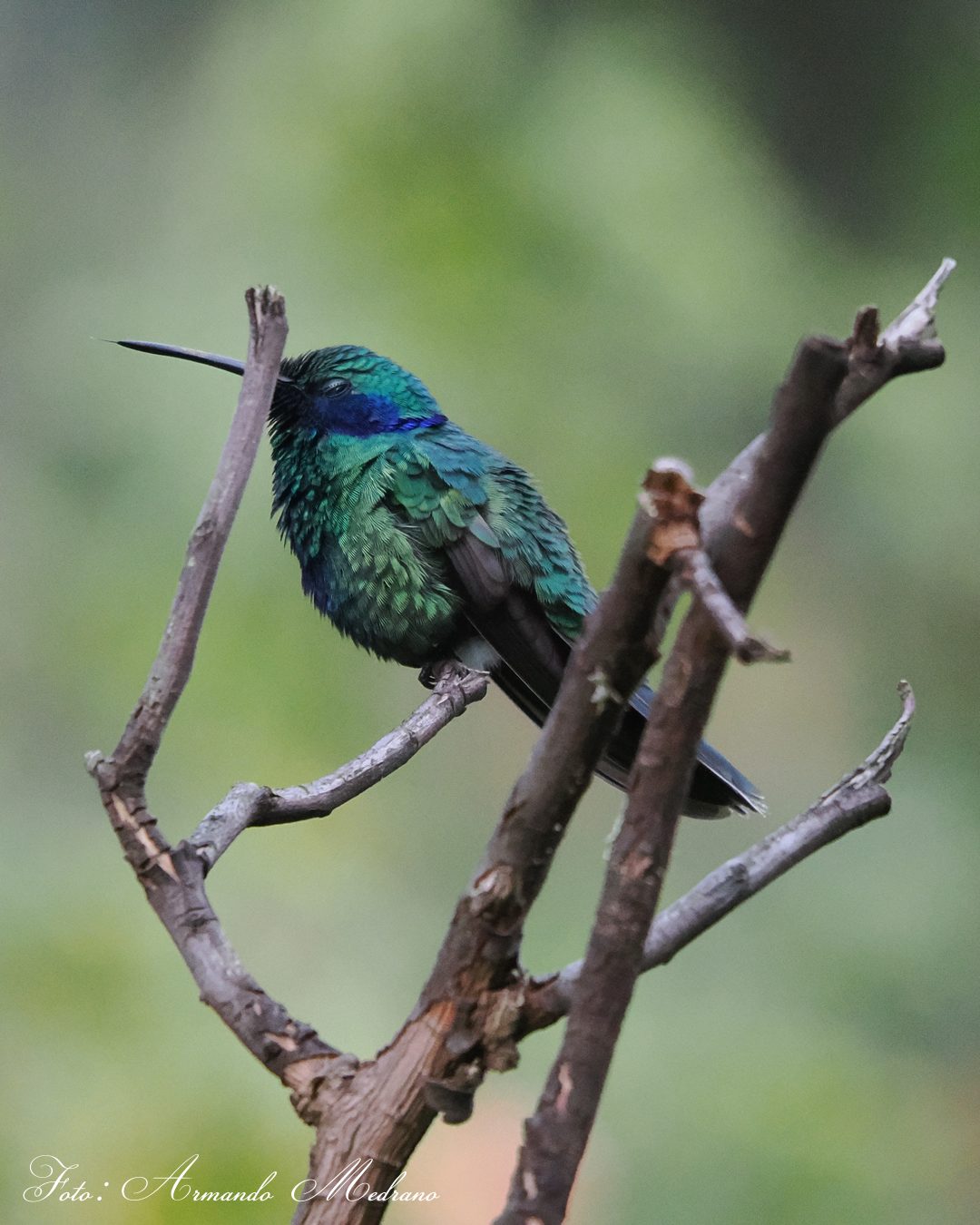
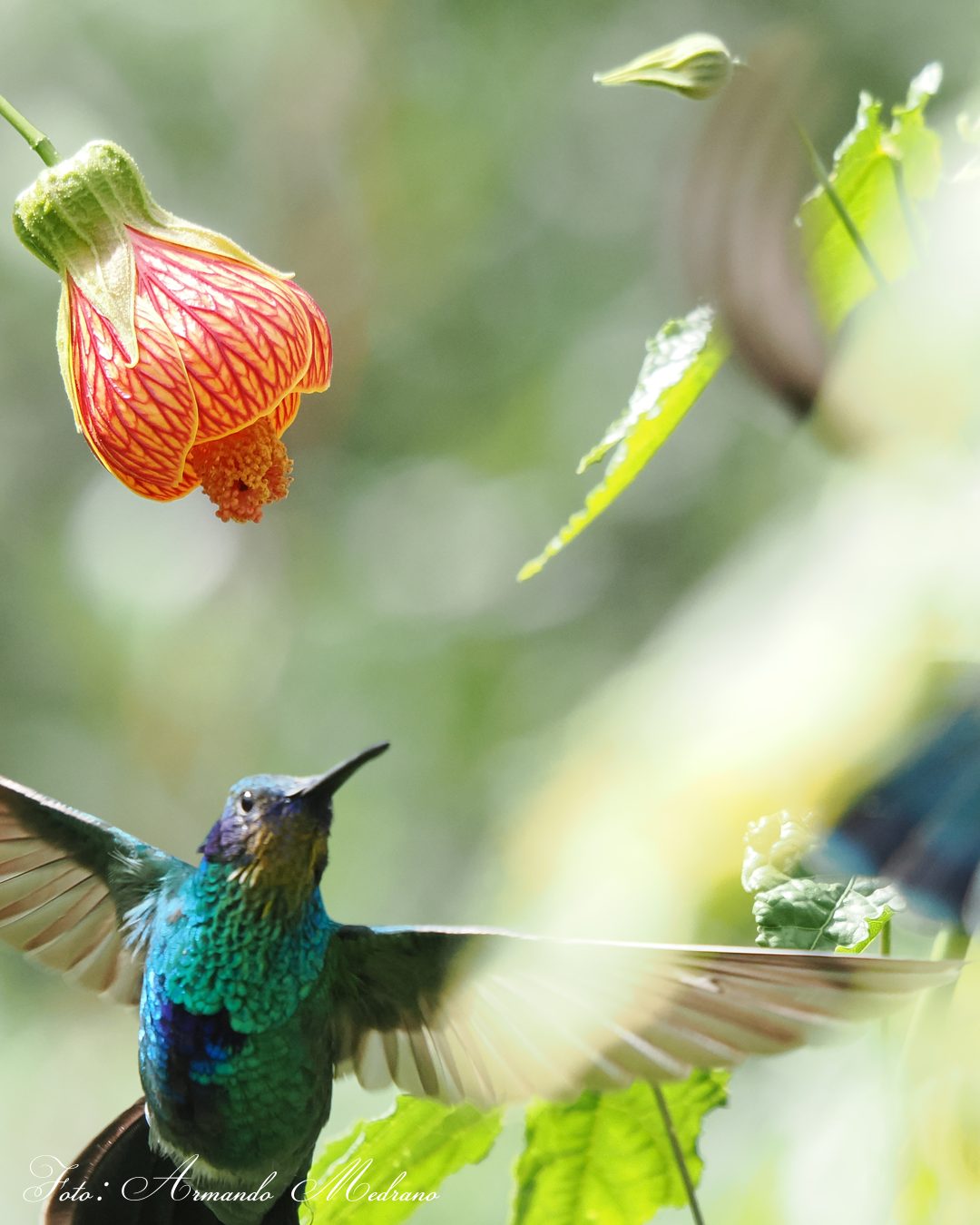
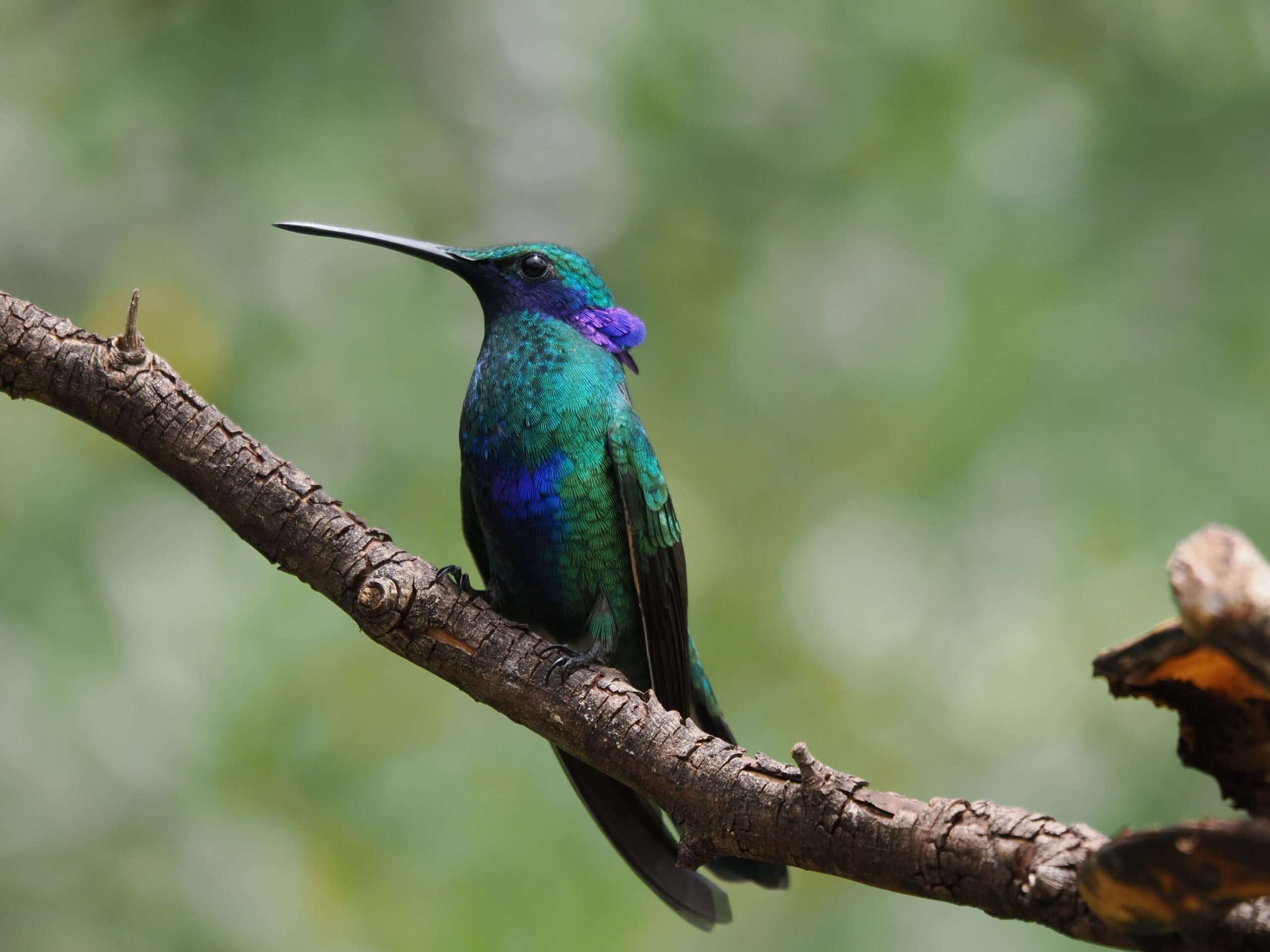
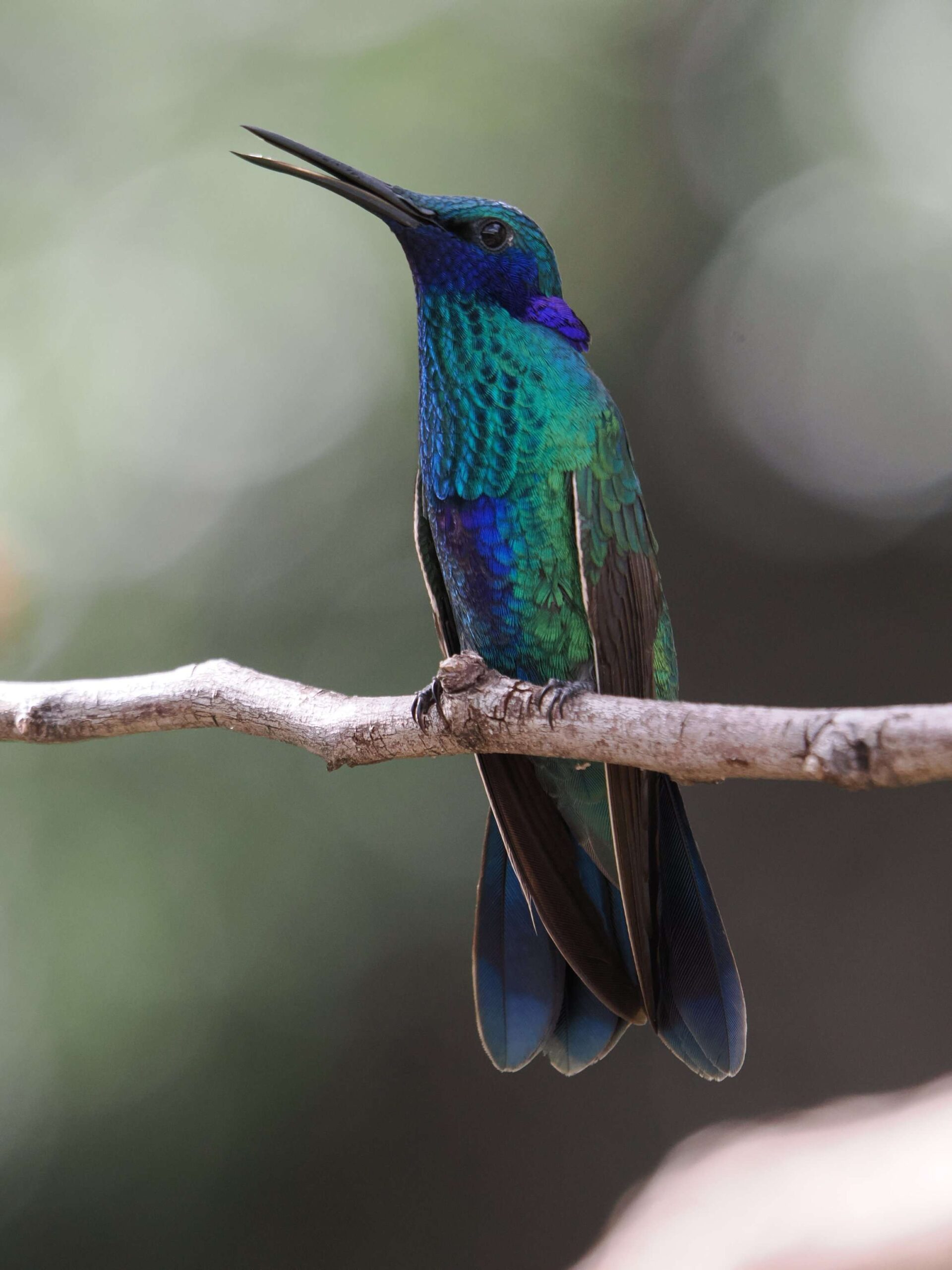
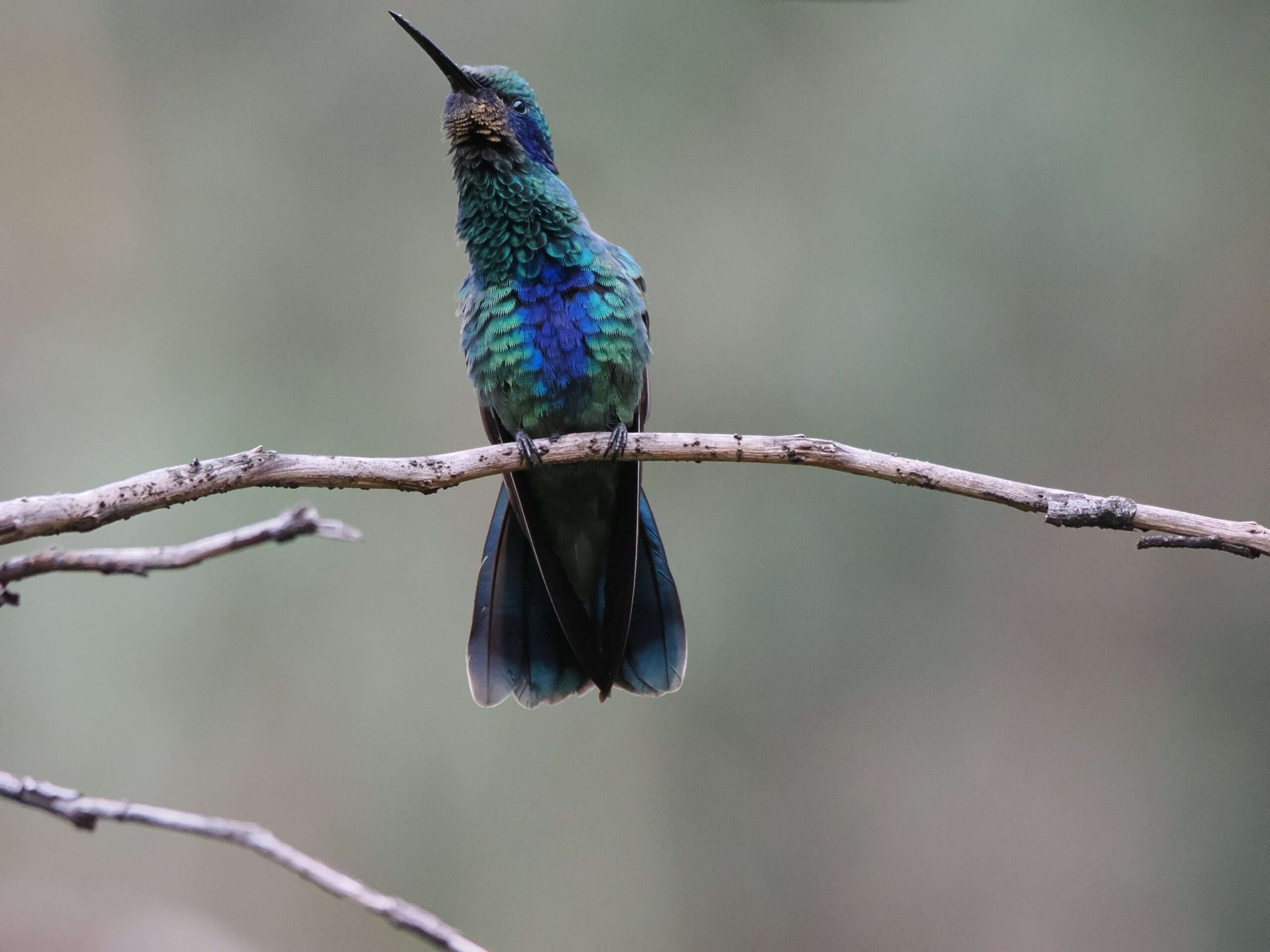
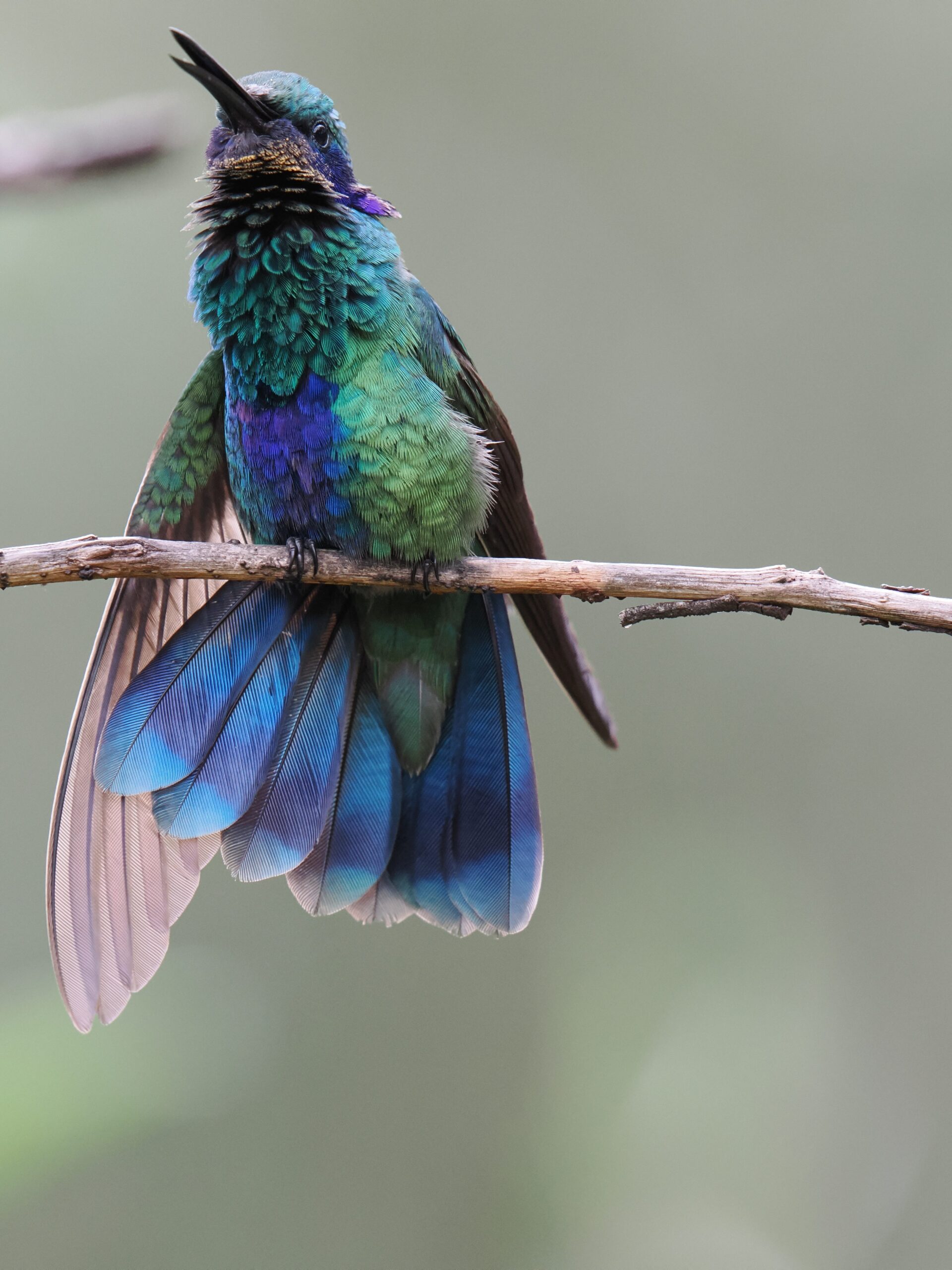
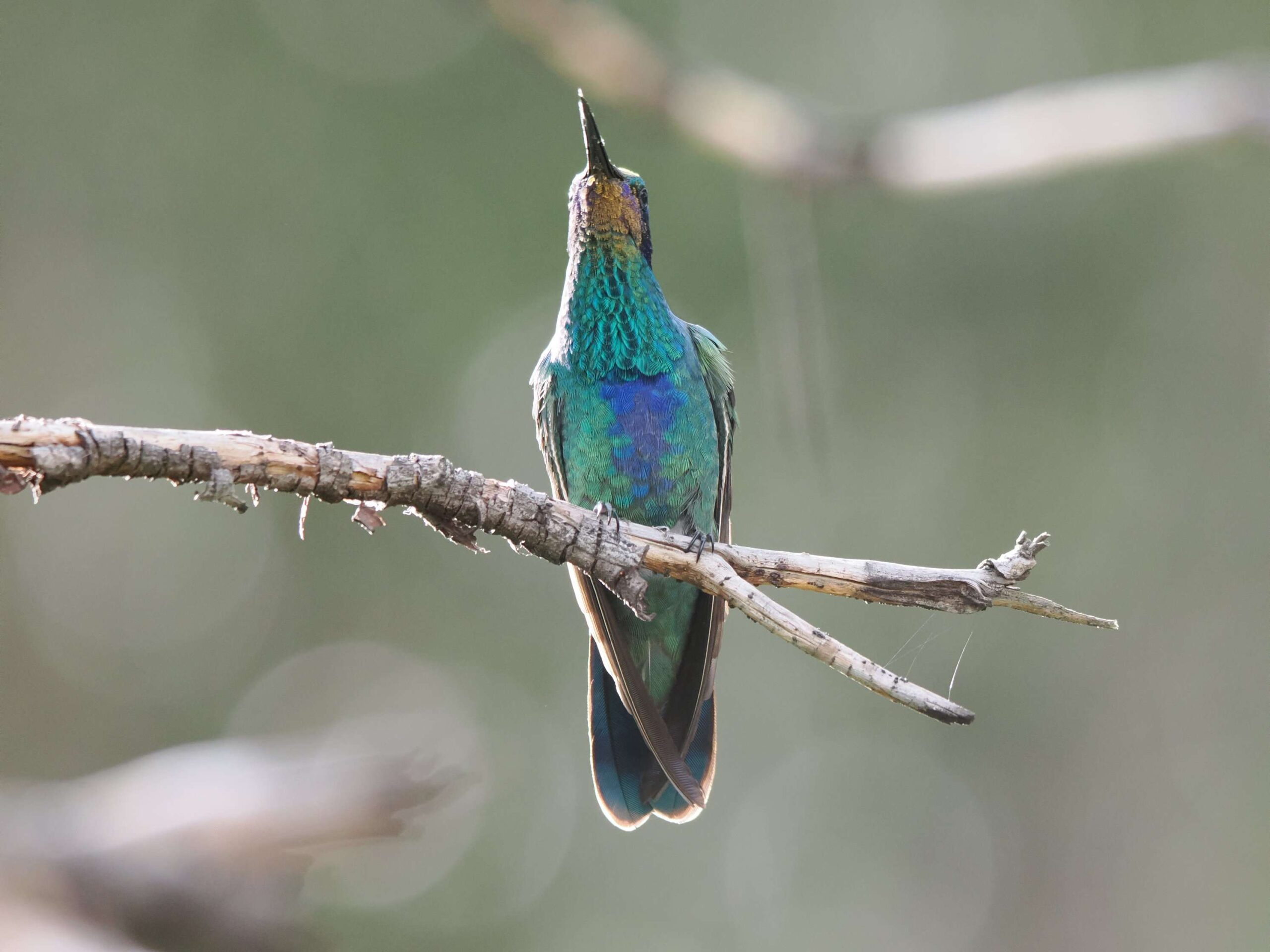
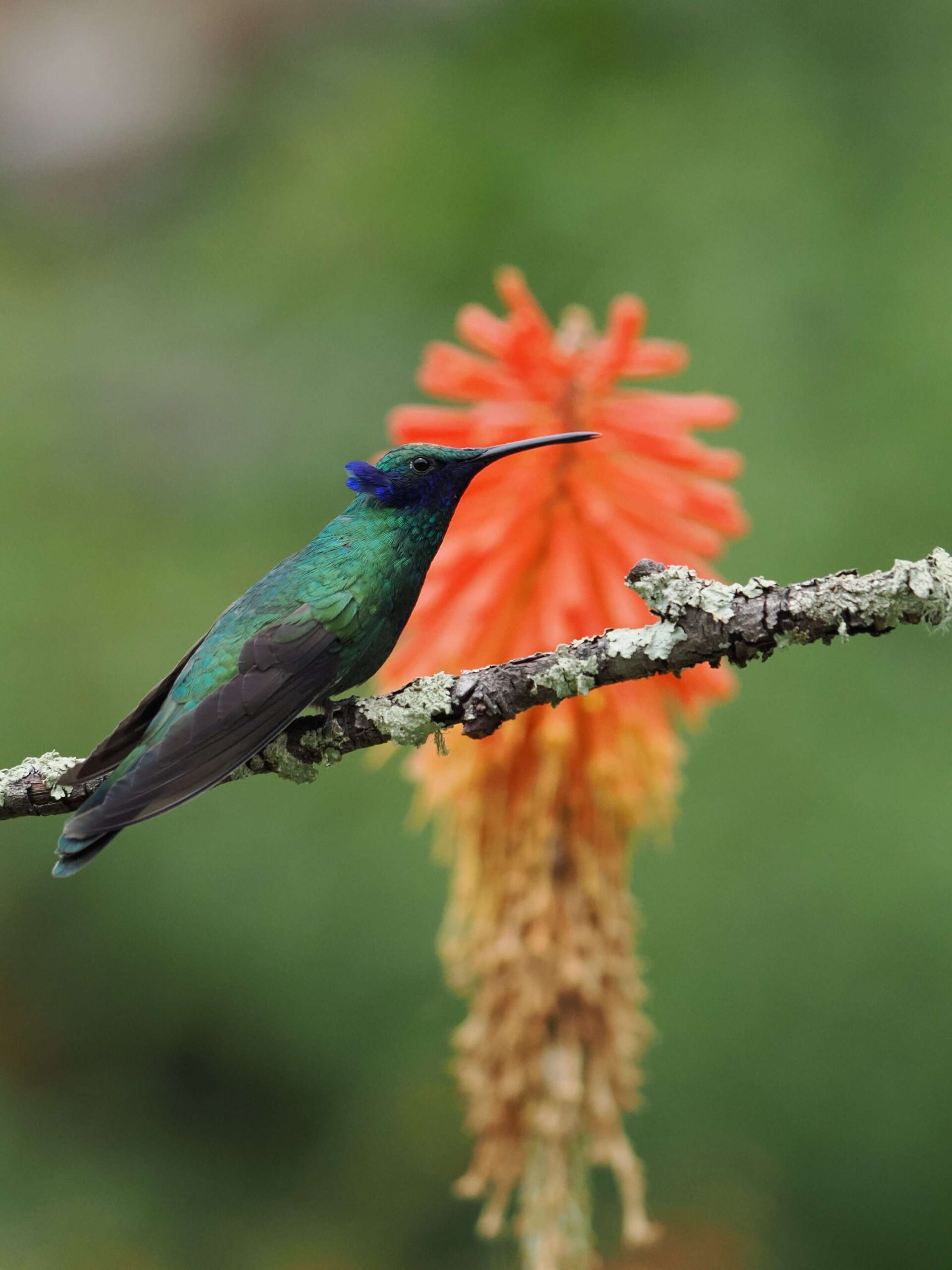
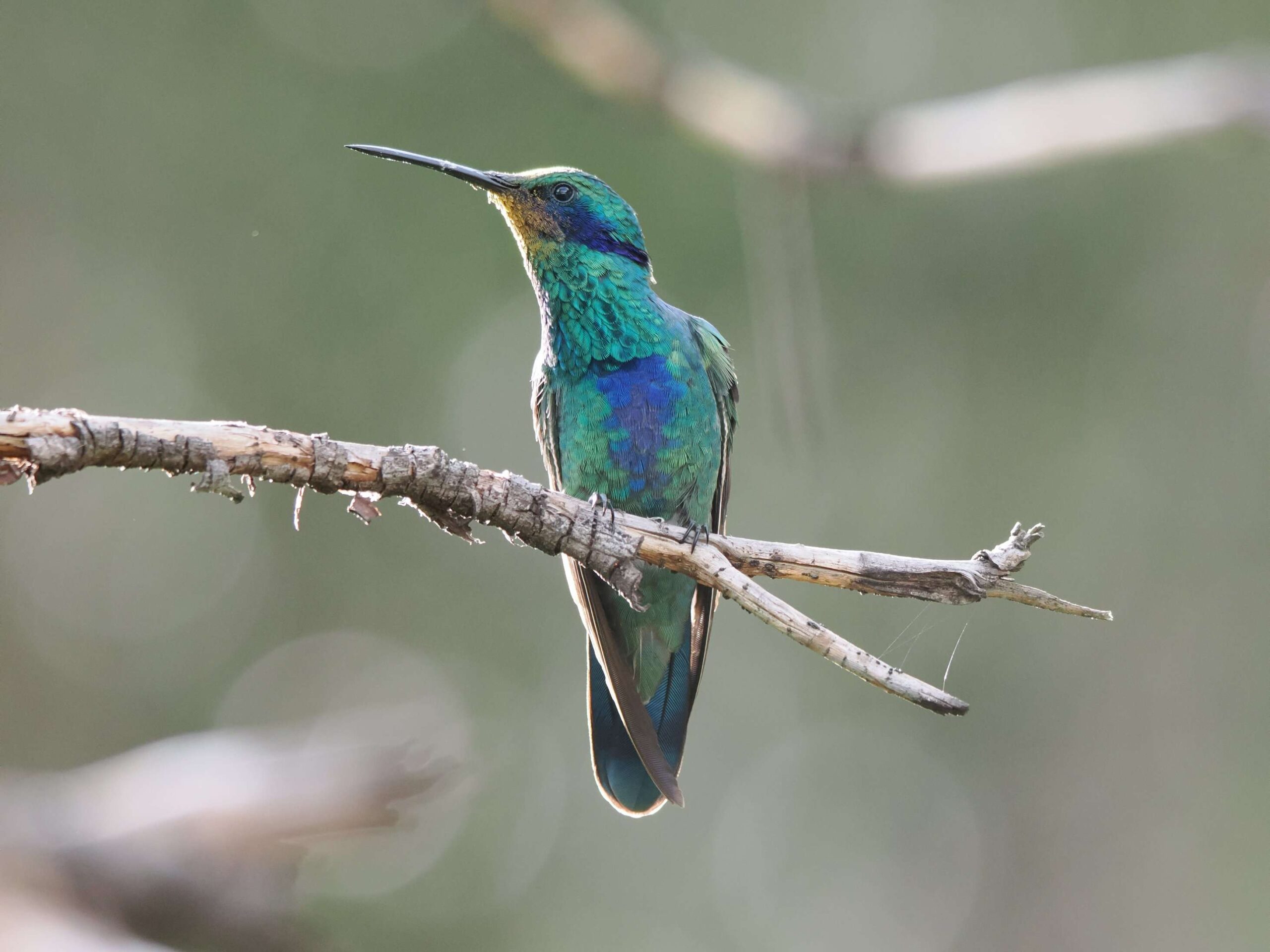
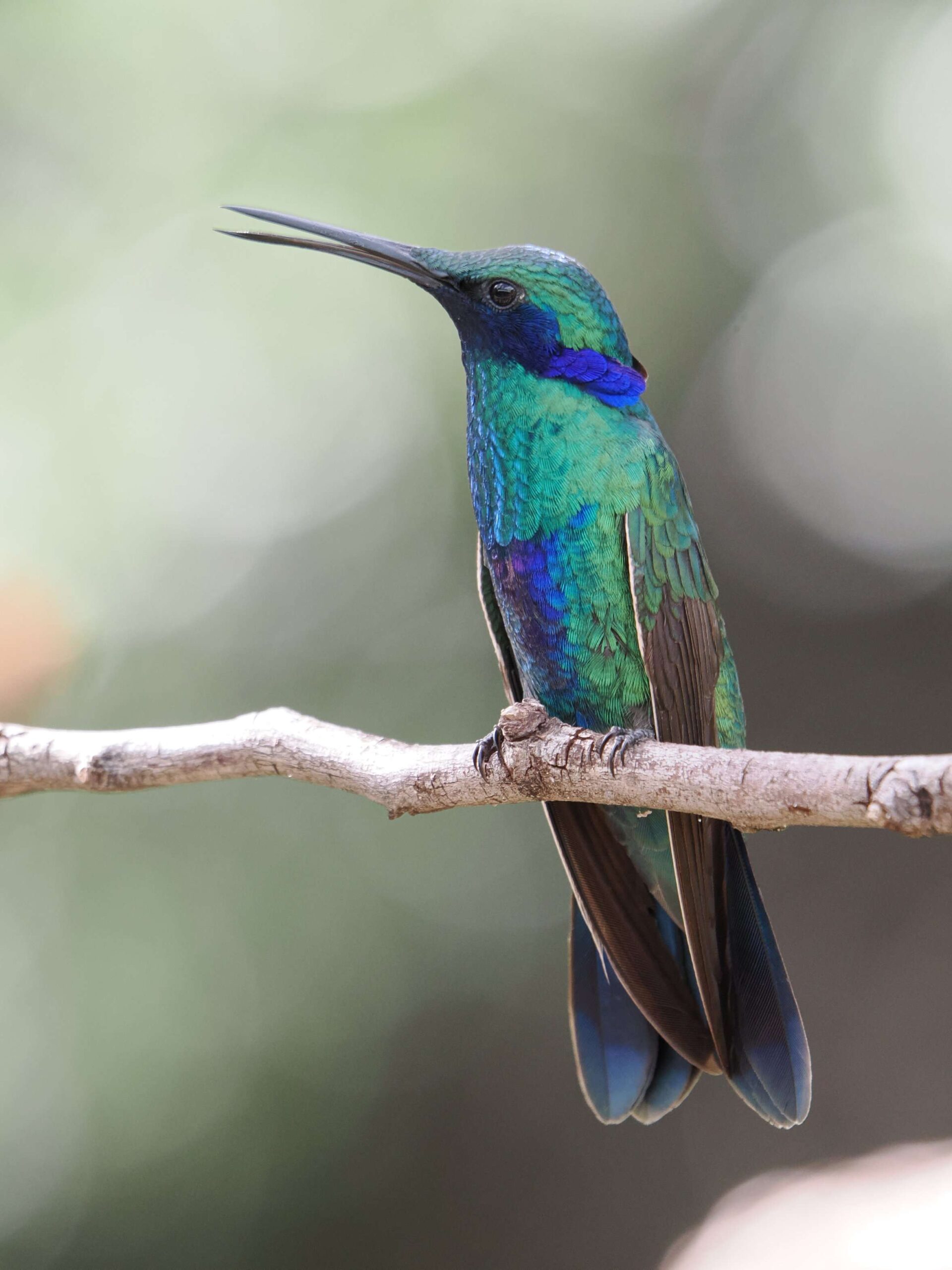
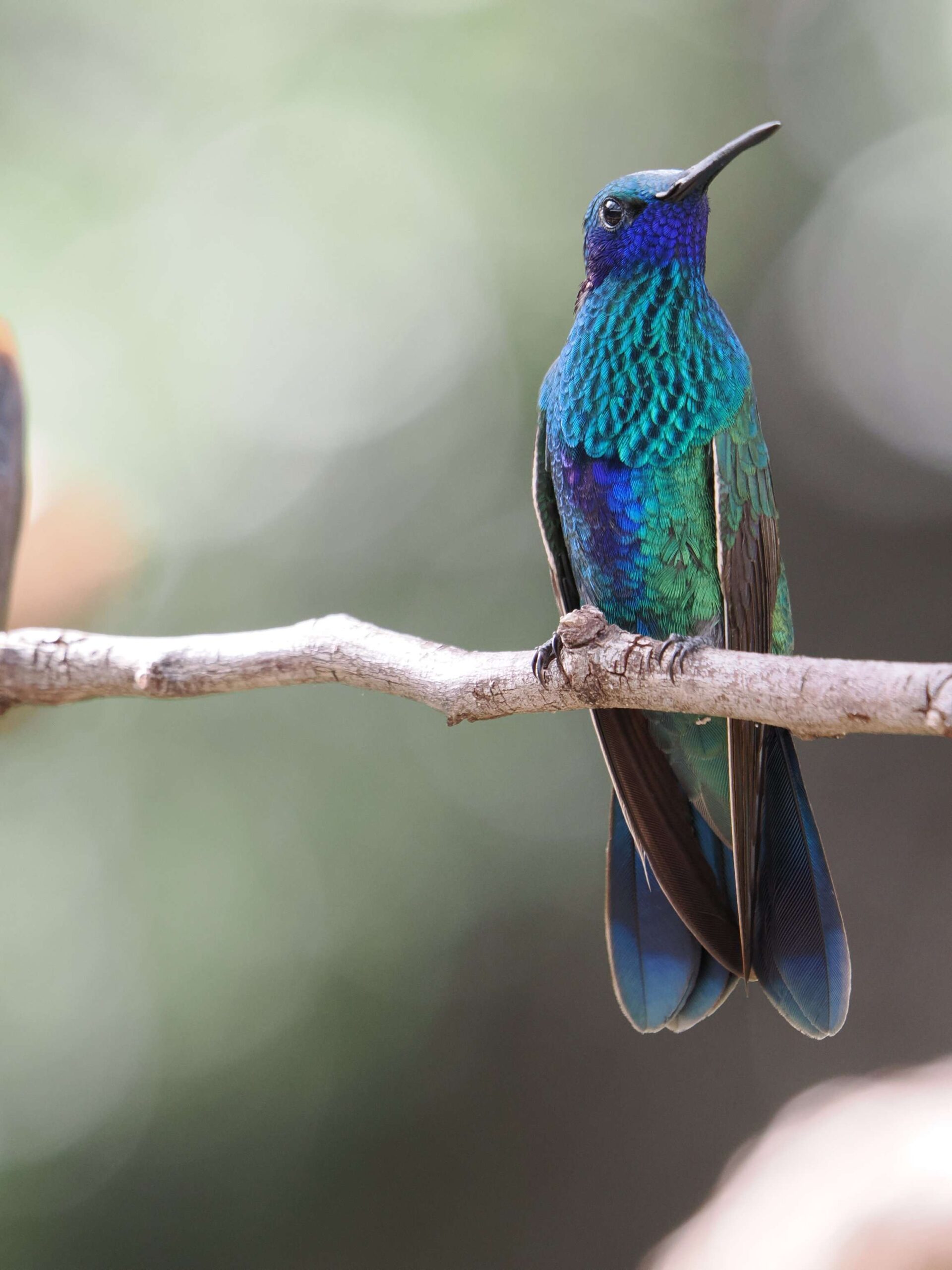
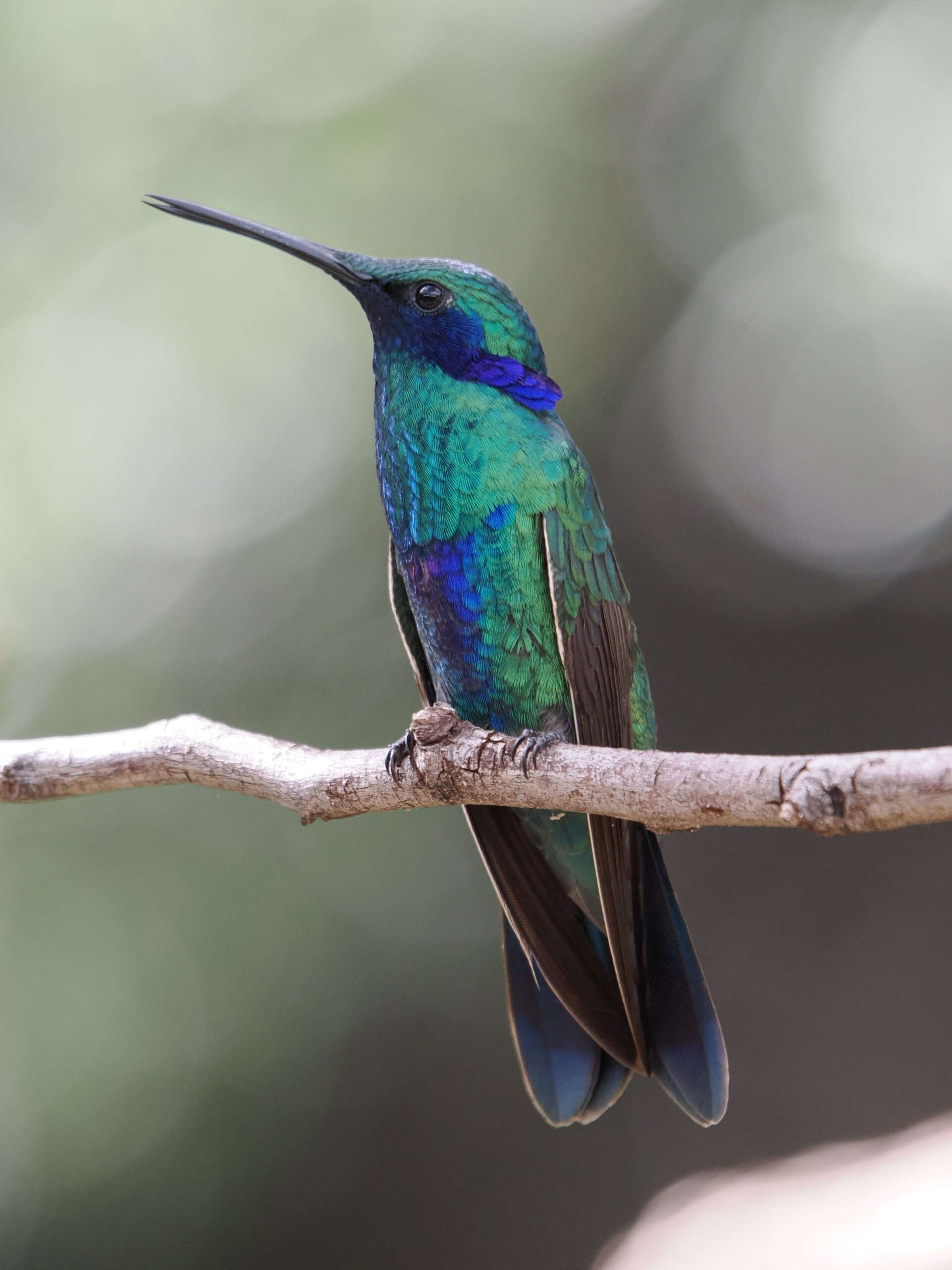
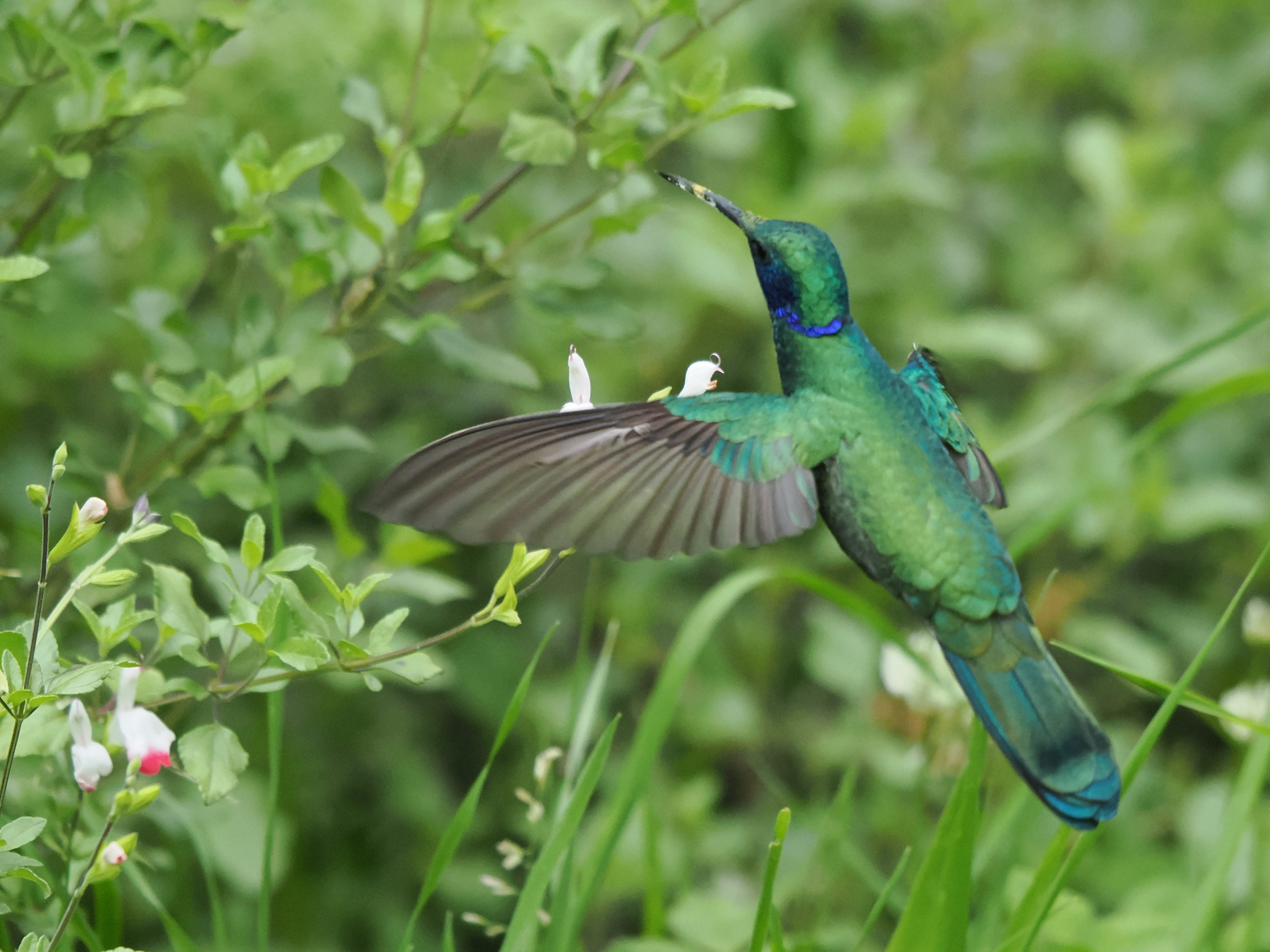
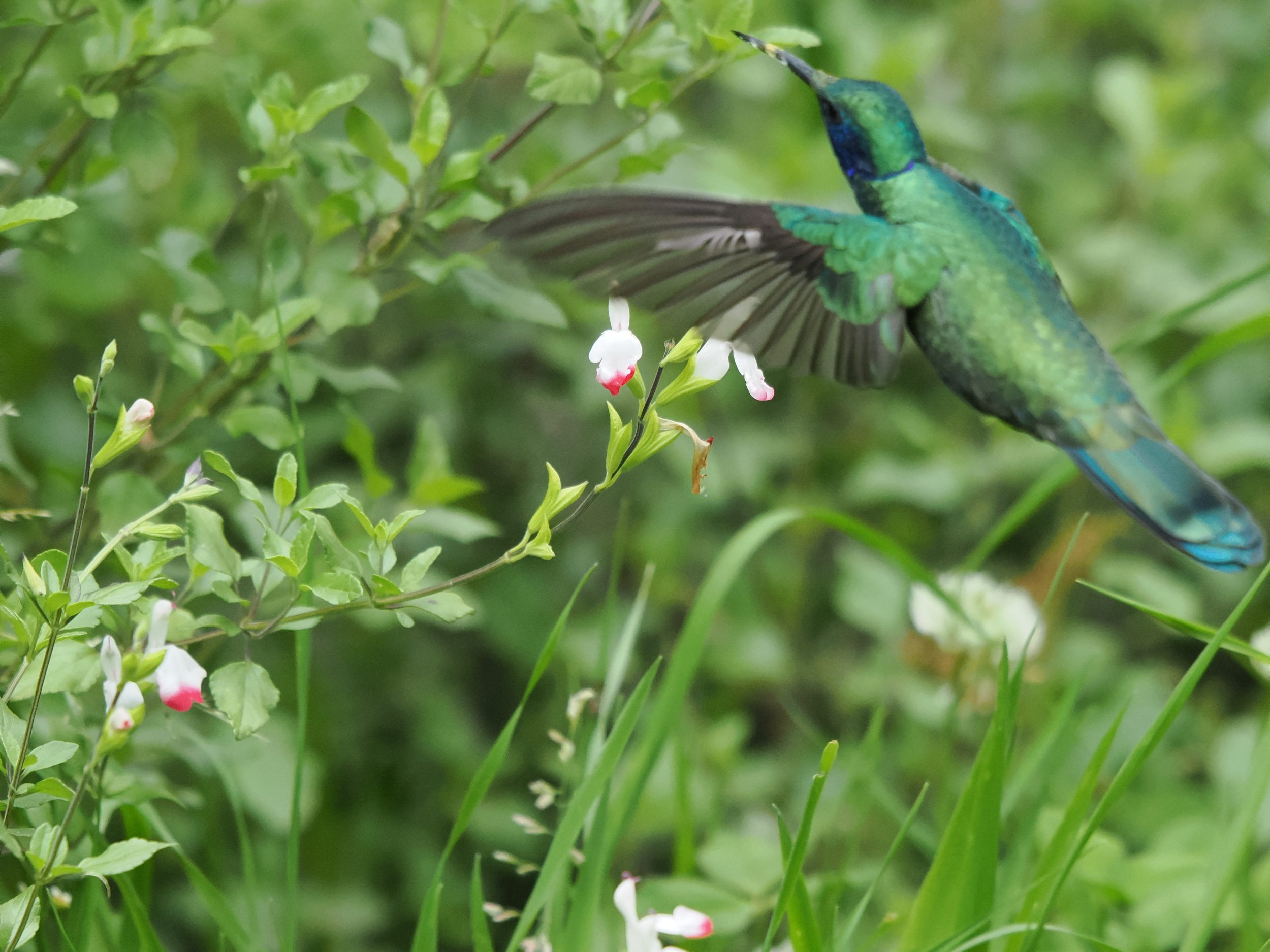
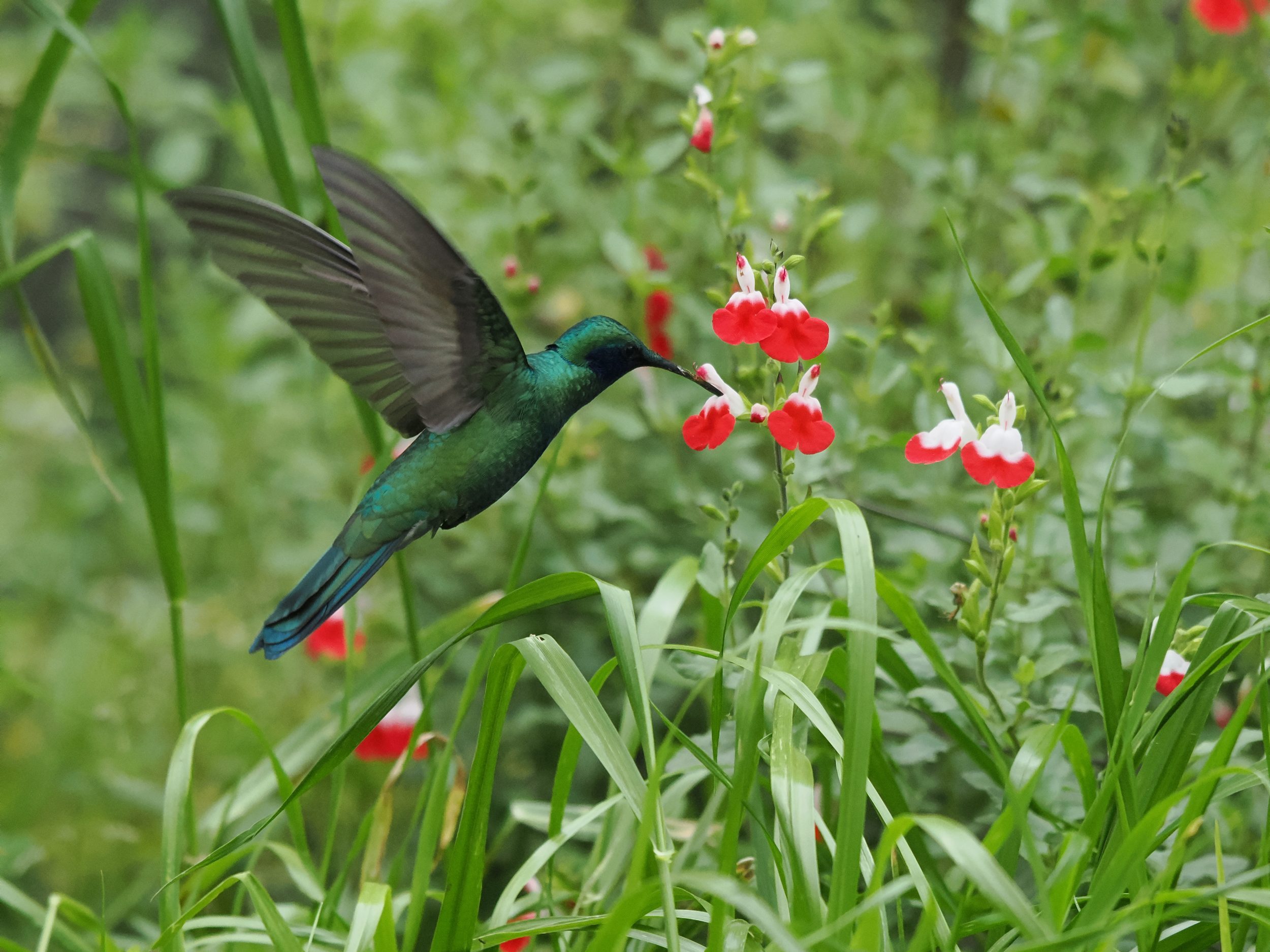
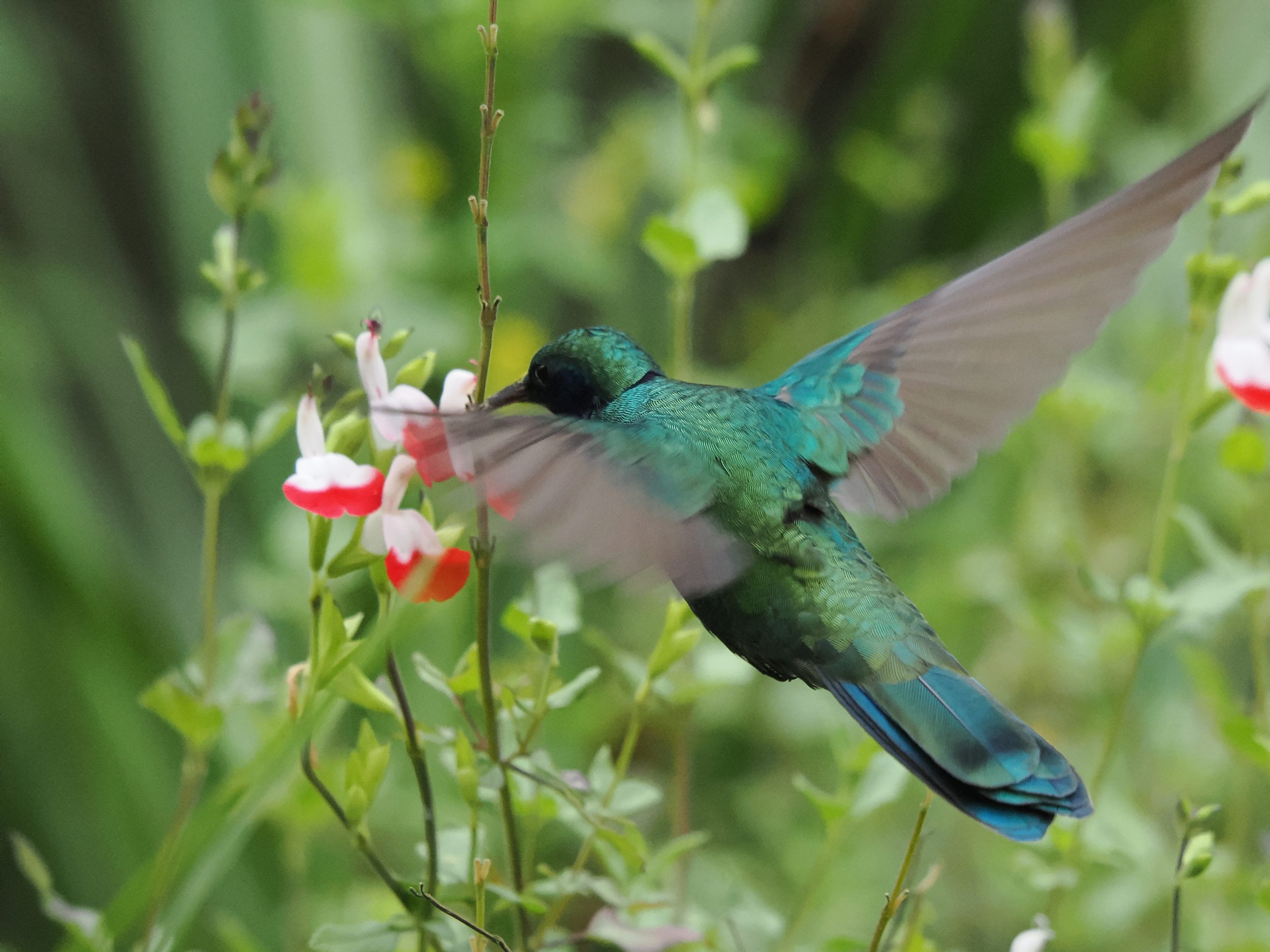
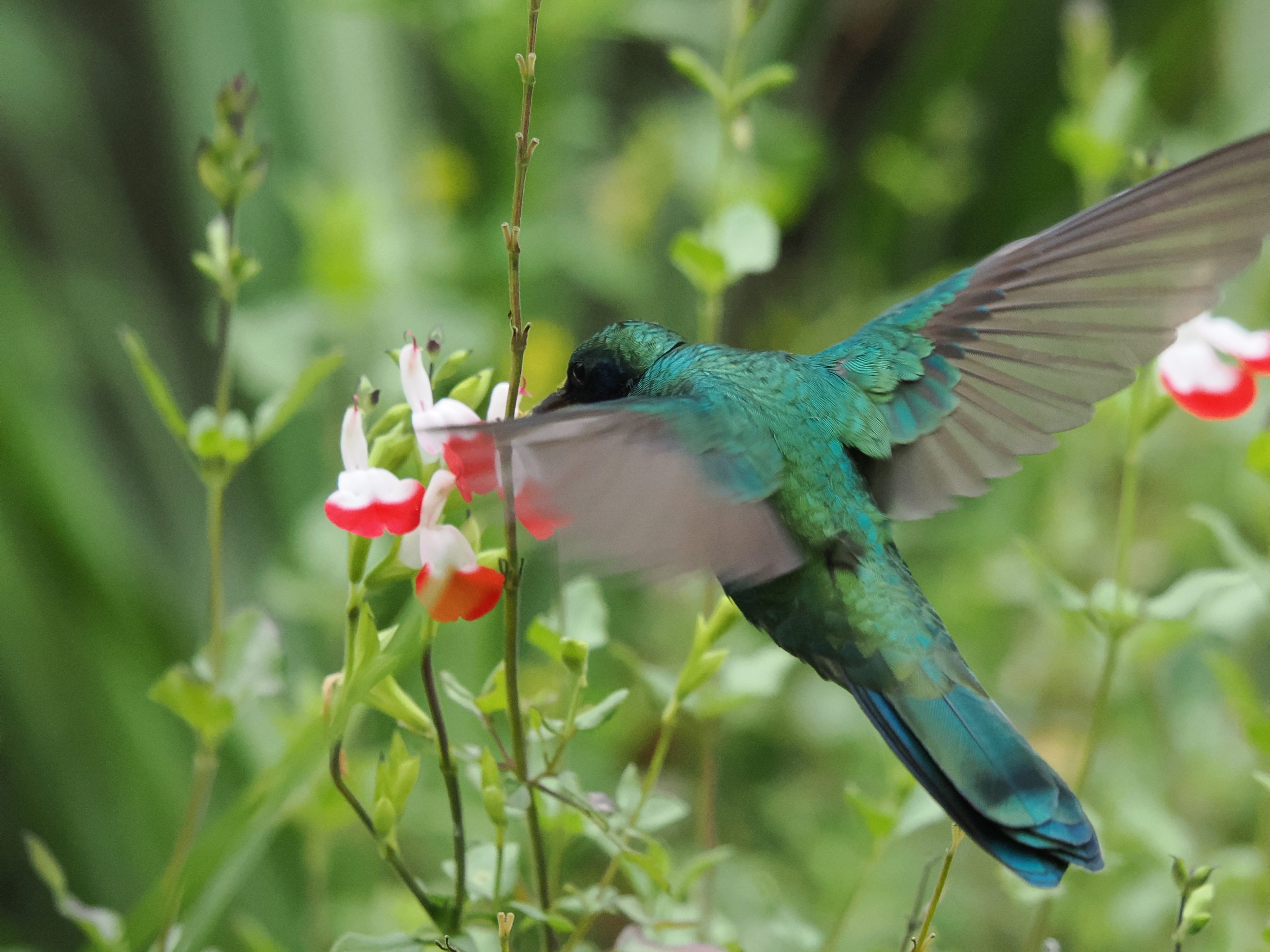
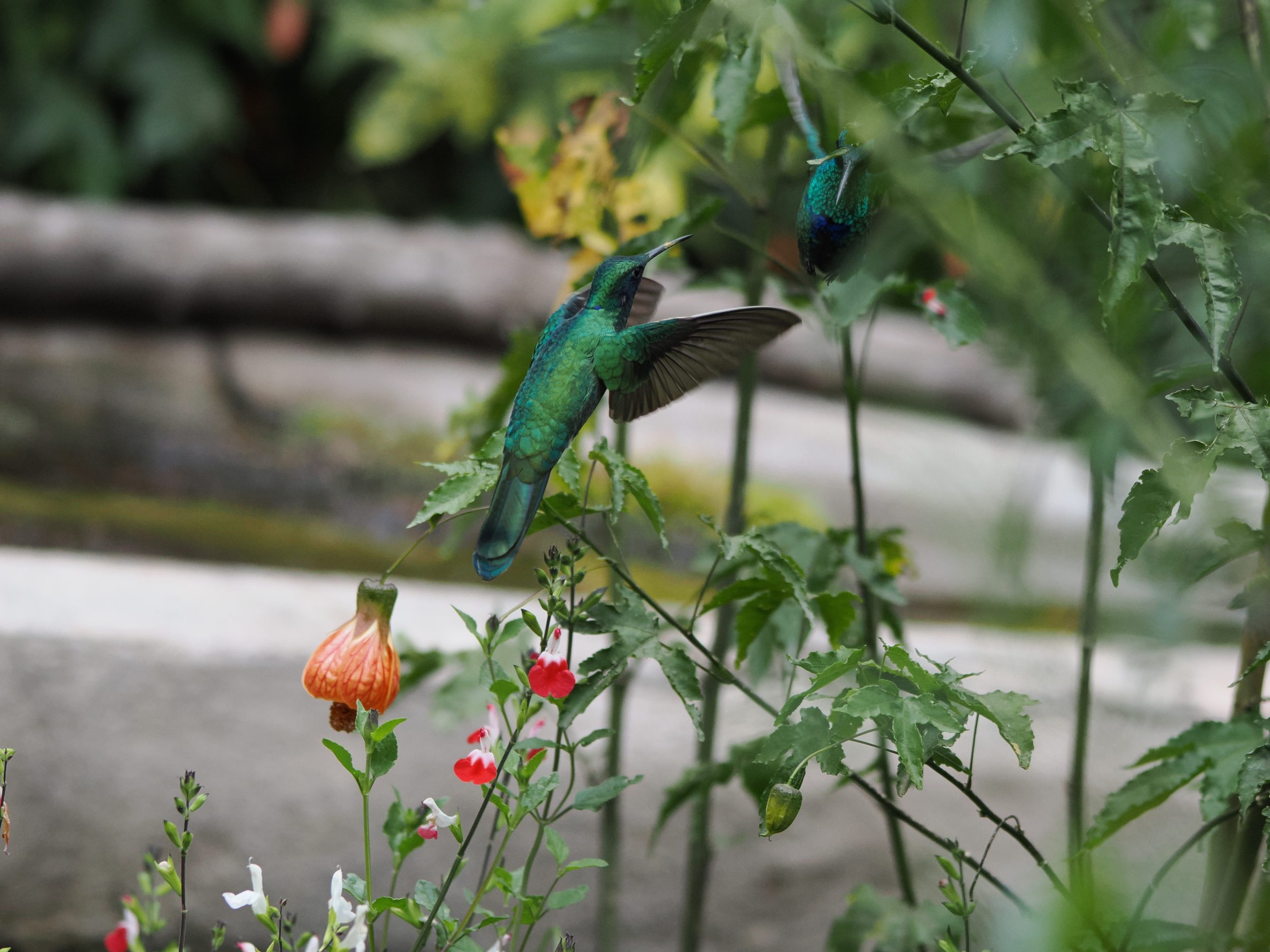
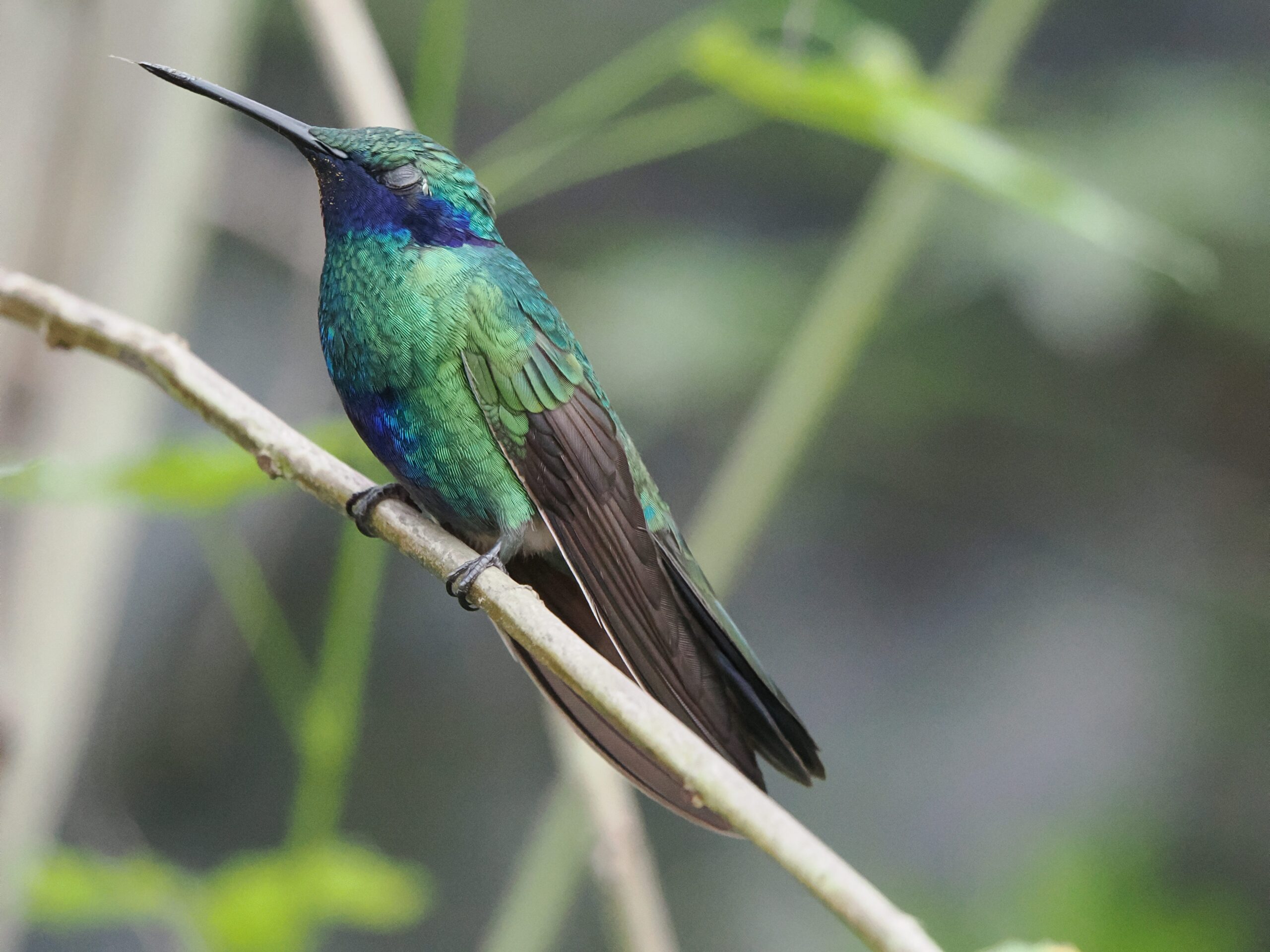
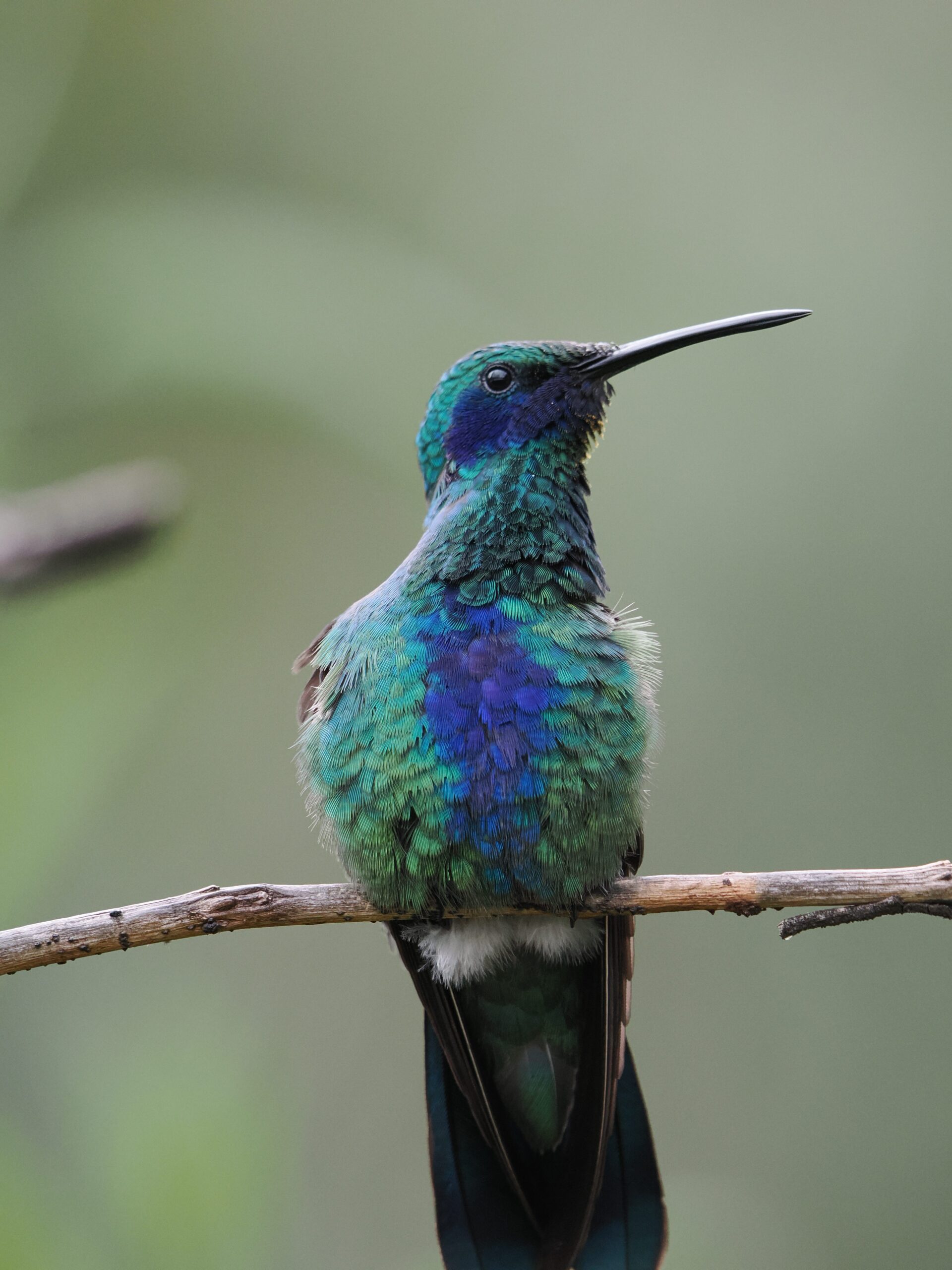
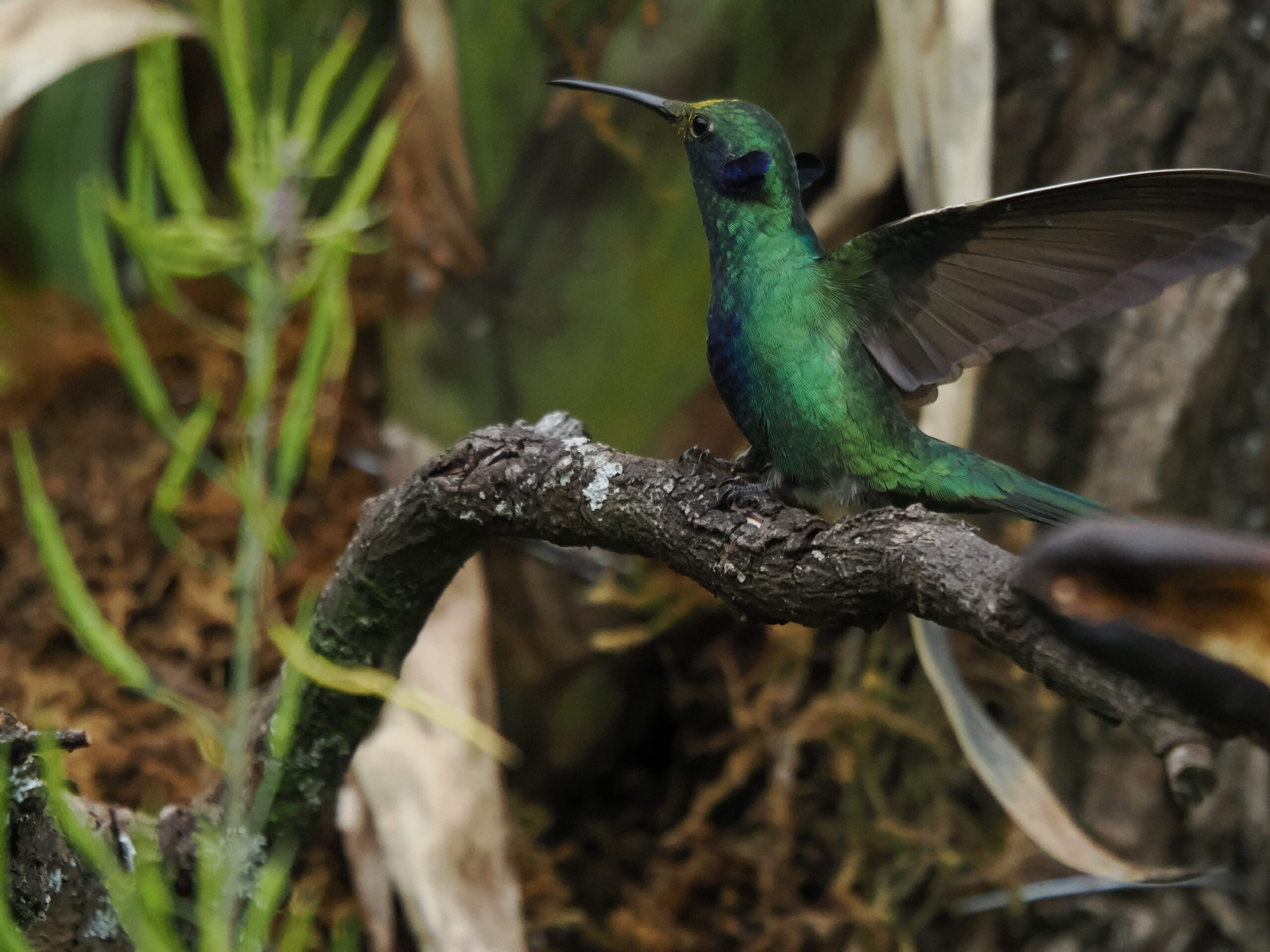
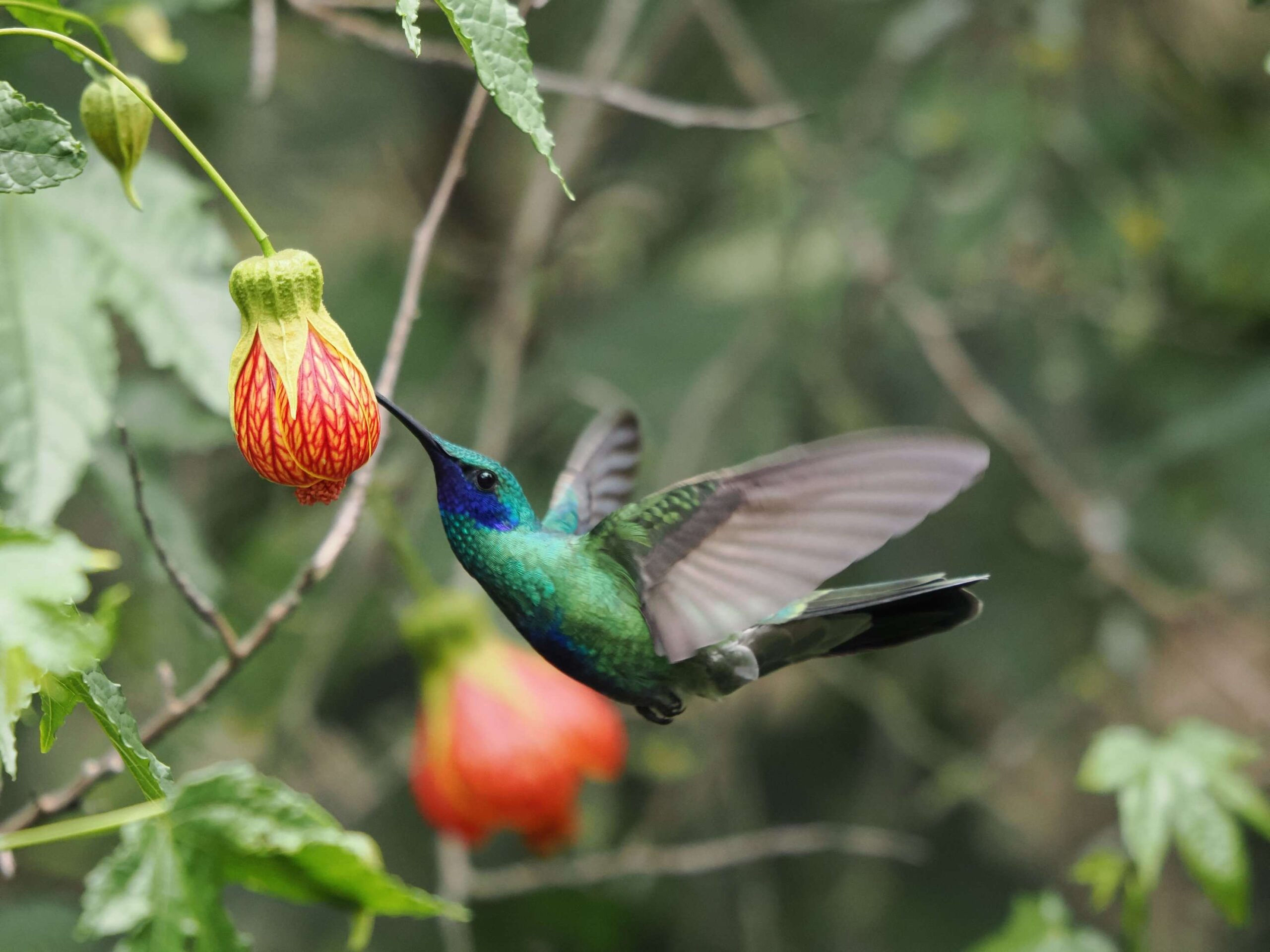
At Pachacútec Andean Forest – Hummingbird Observatory, in San Jerónimo, Cusco, this species is not a secondary visitor. It is one of the most visible, dominant, and ecologically influential birds in the system. Its metallic green body, violet cheeks, and belly with blue-violet flashes make it one of the most striking hummingbirds of the high-Andean landscape. But its true importance is not in its color. It is in what it does.
Colibri coruscans is a pollinator, territorial sentinel, nectar consumer, competitor chaser, user of open habitats, and, in many Andean landscapes, one of the hummingbirds that best tolerates proximity to humans. It can appear along forest edges, shrublands, gardens, fields, villages, ravines, and bird observatories. It can dominate native flowers, use introduced plants, and move among different altitudinal belts depending on the season. In a restored ecosystem such as Pachacútec, where the flowering of Nicotiana glauca, Nicotiana spp., native shrubs, bromeliads, and other nectar-producing plants organizes the life of the forest, the Sparkling Violetear functions as a key piece of the ecological network.
Understanding it requires going beyond field identification. It requires seeing it for what it truly is: a structuring species within the assemblage of high-Andean hummingbirds.
1. A Hummingbird Impossible to Ignore
Size, Brilliance, and Authority
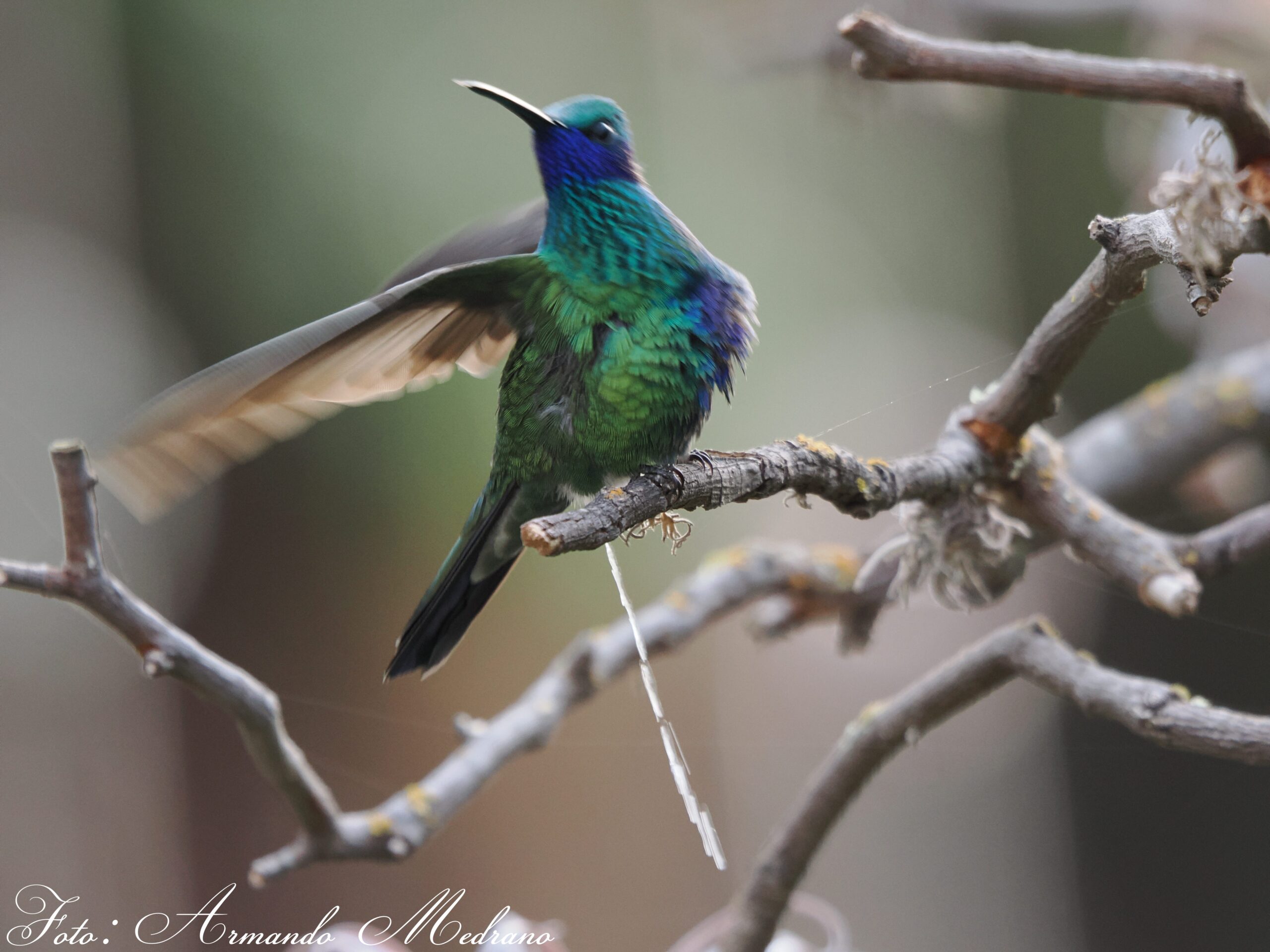
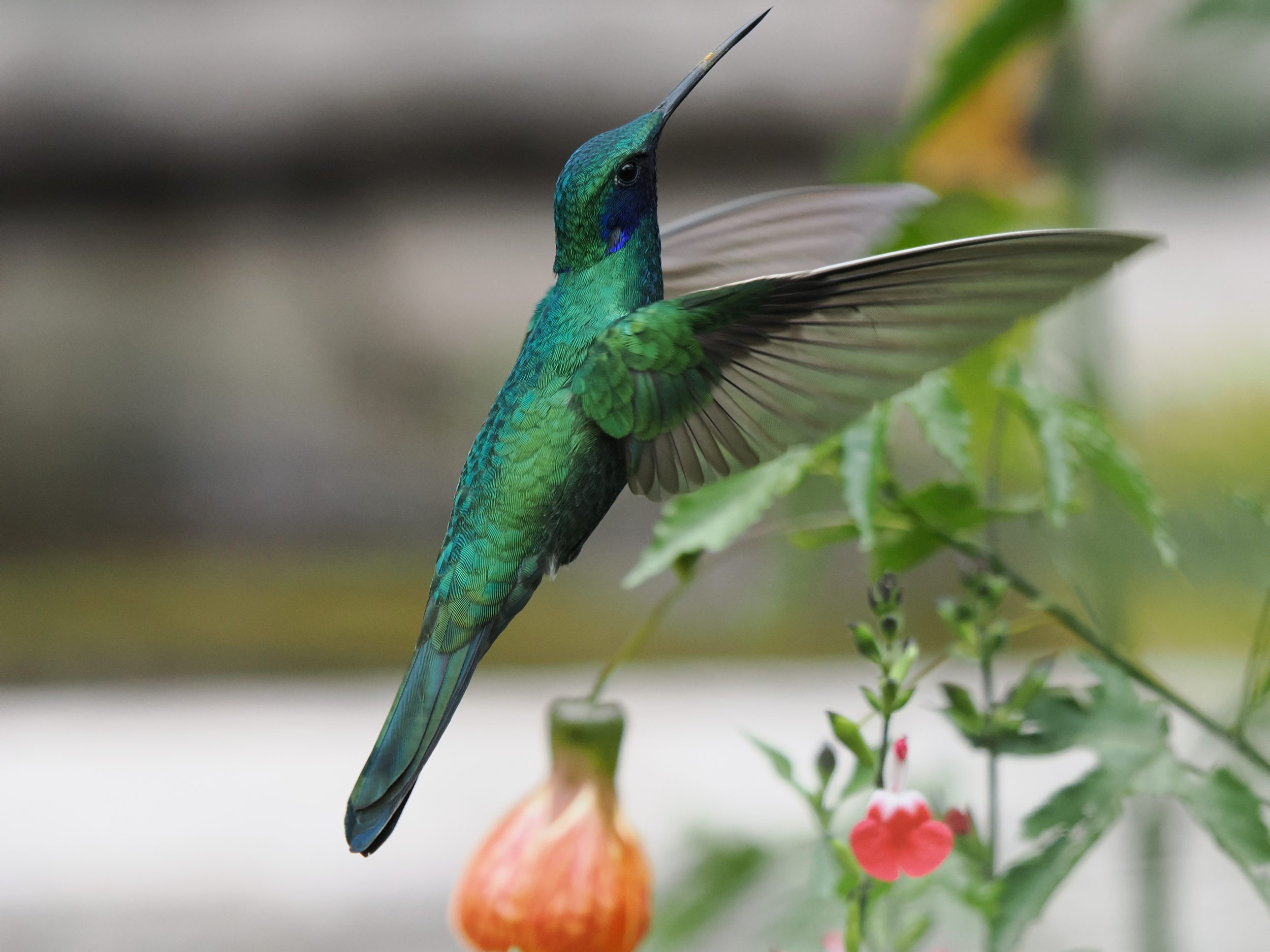
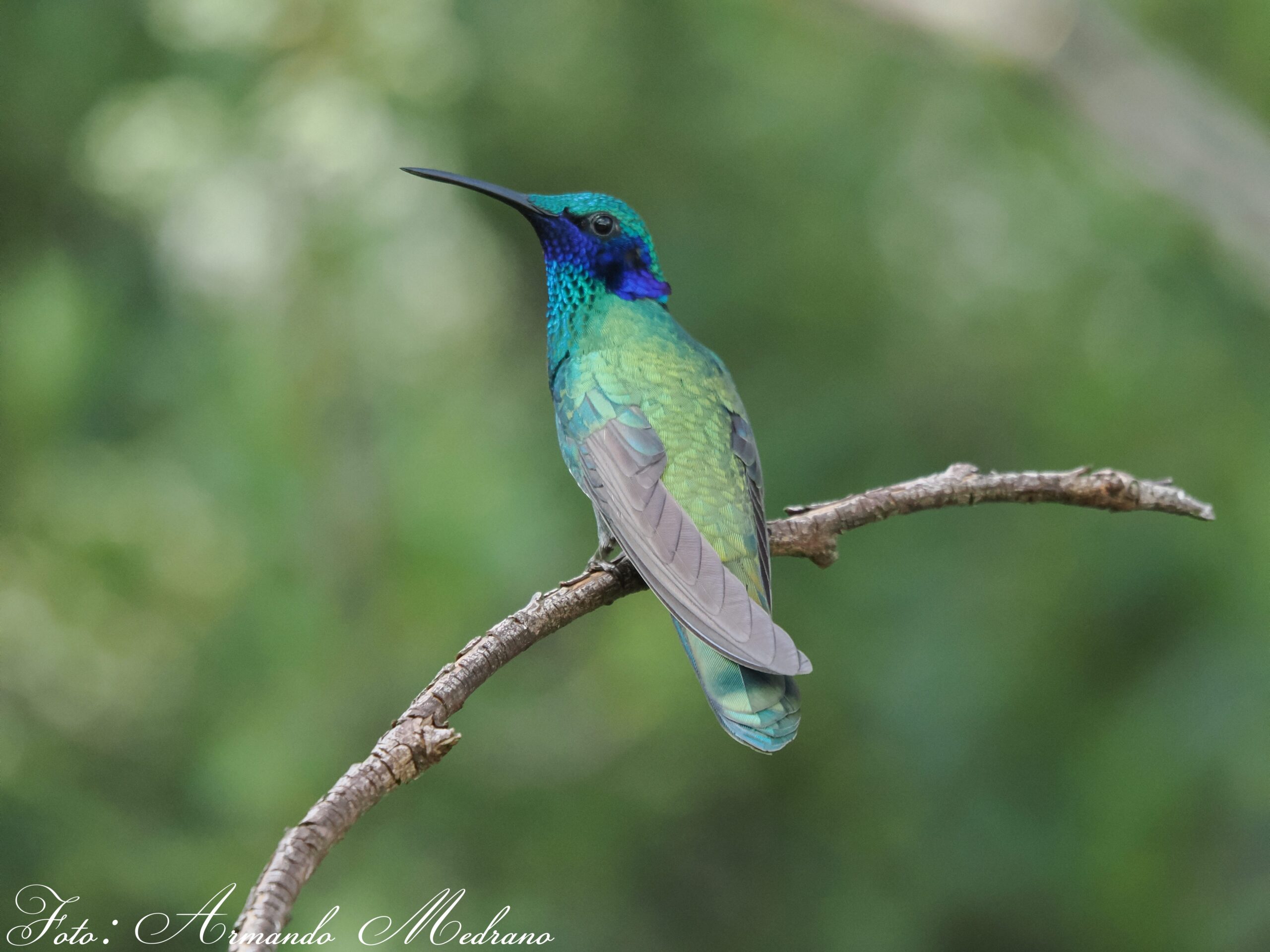
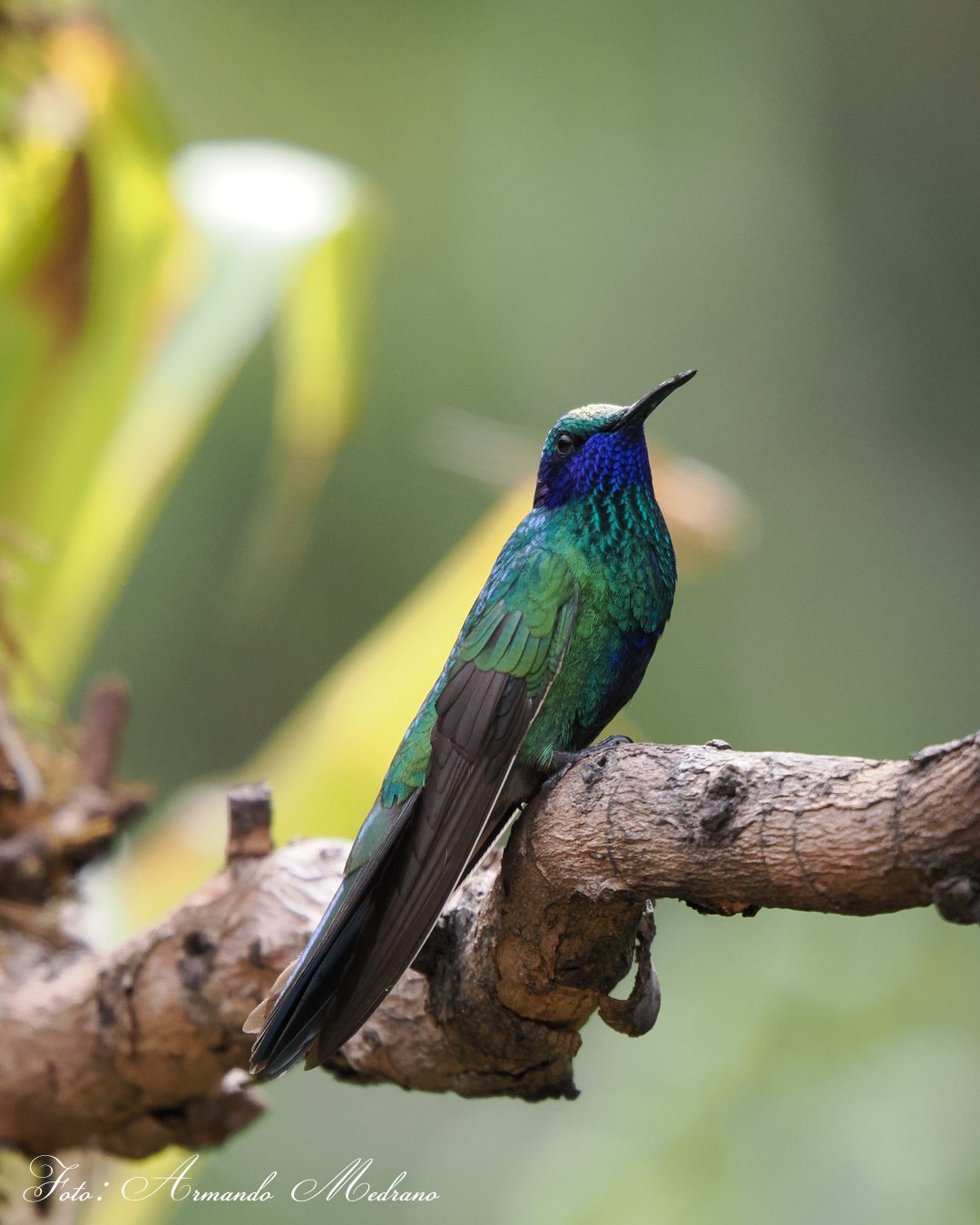
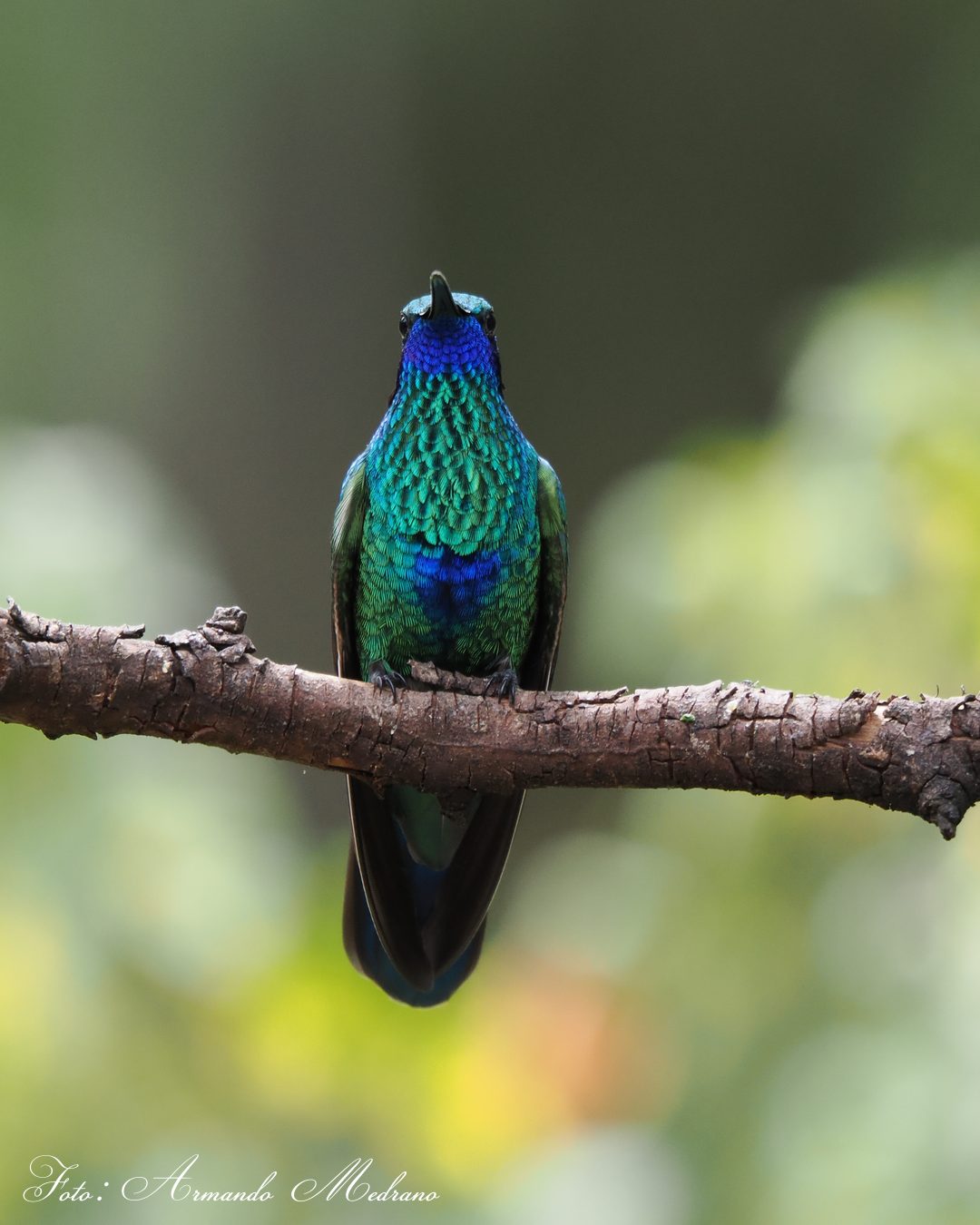
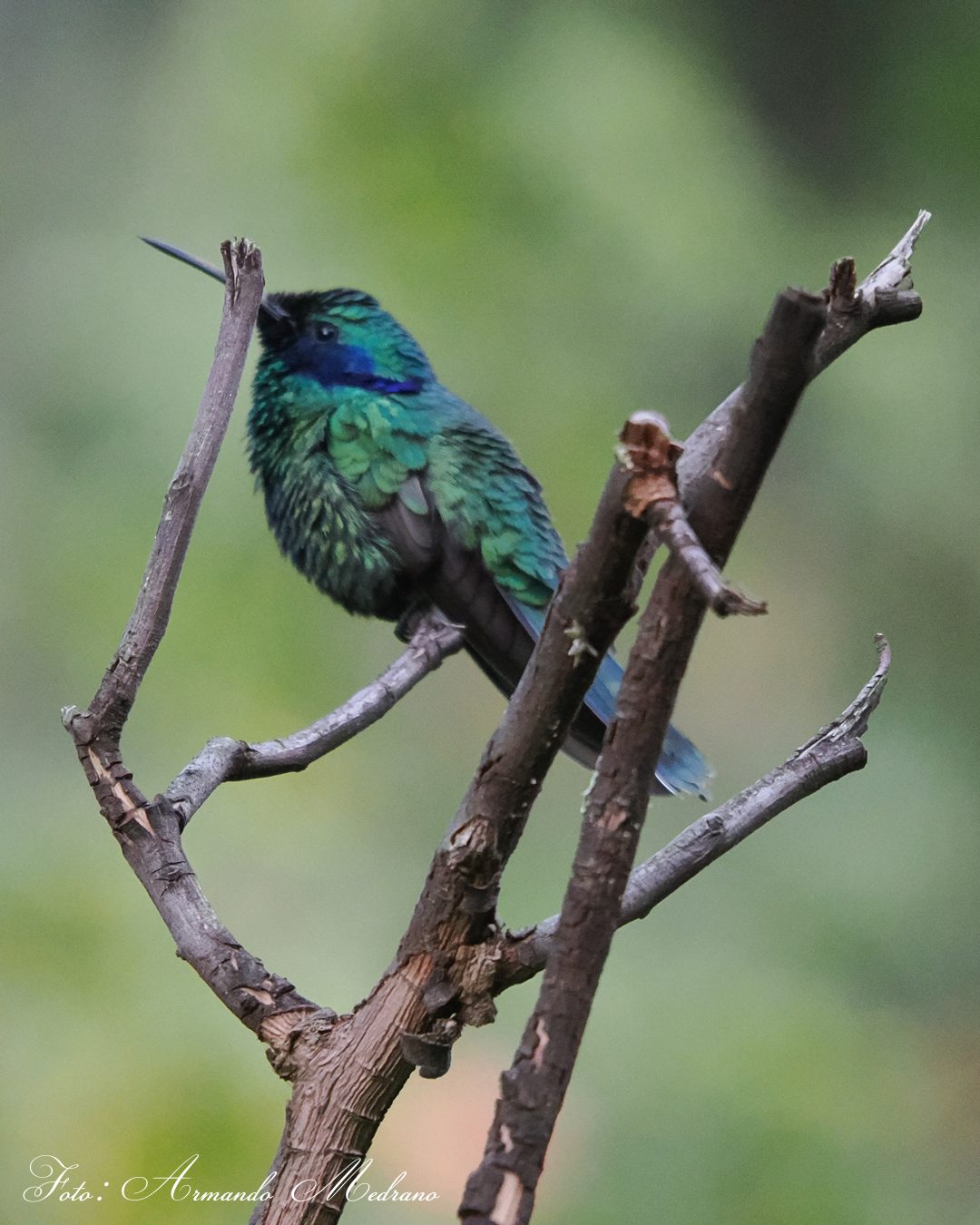
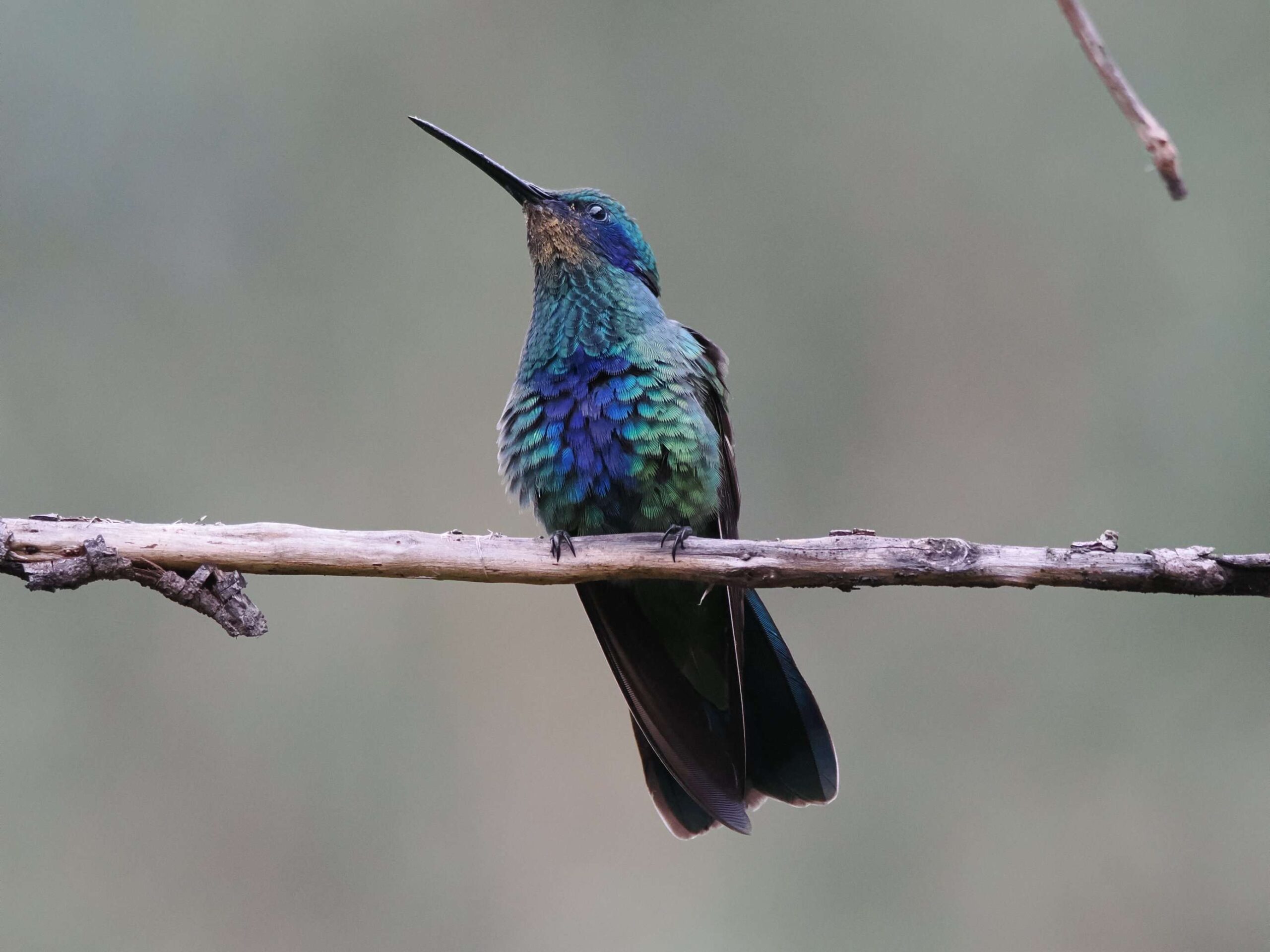
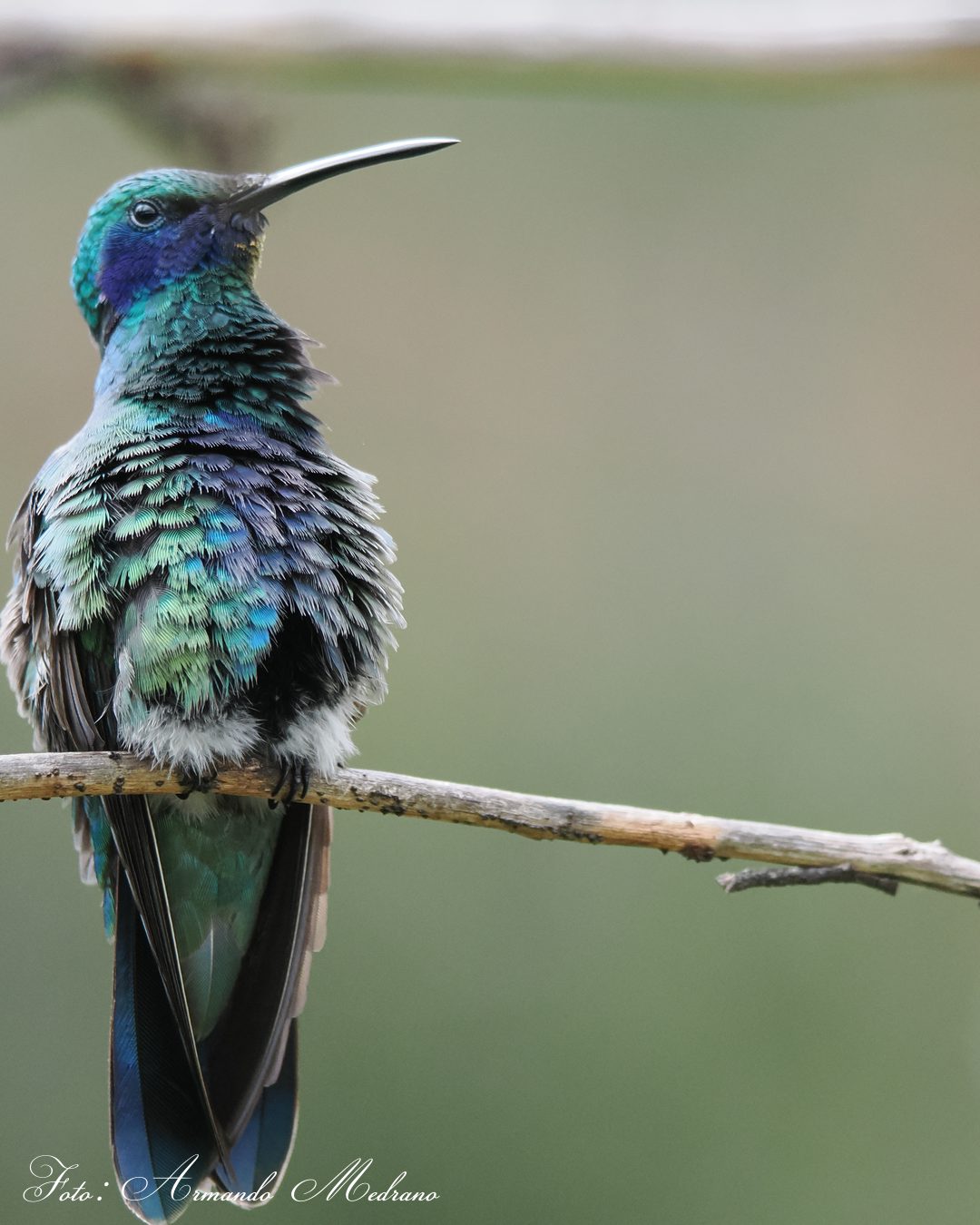
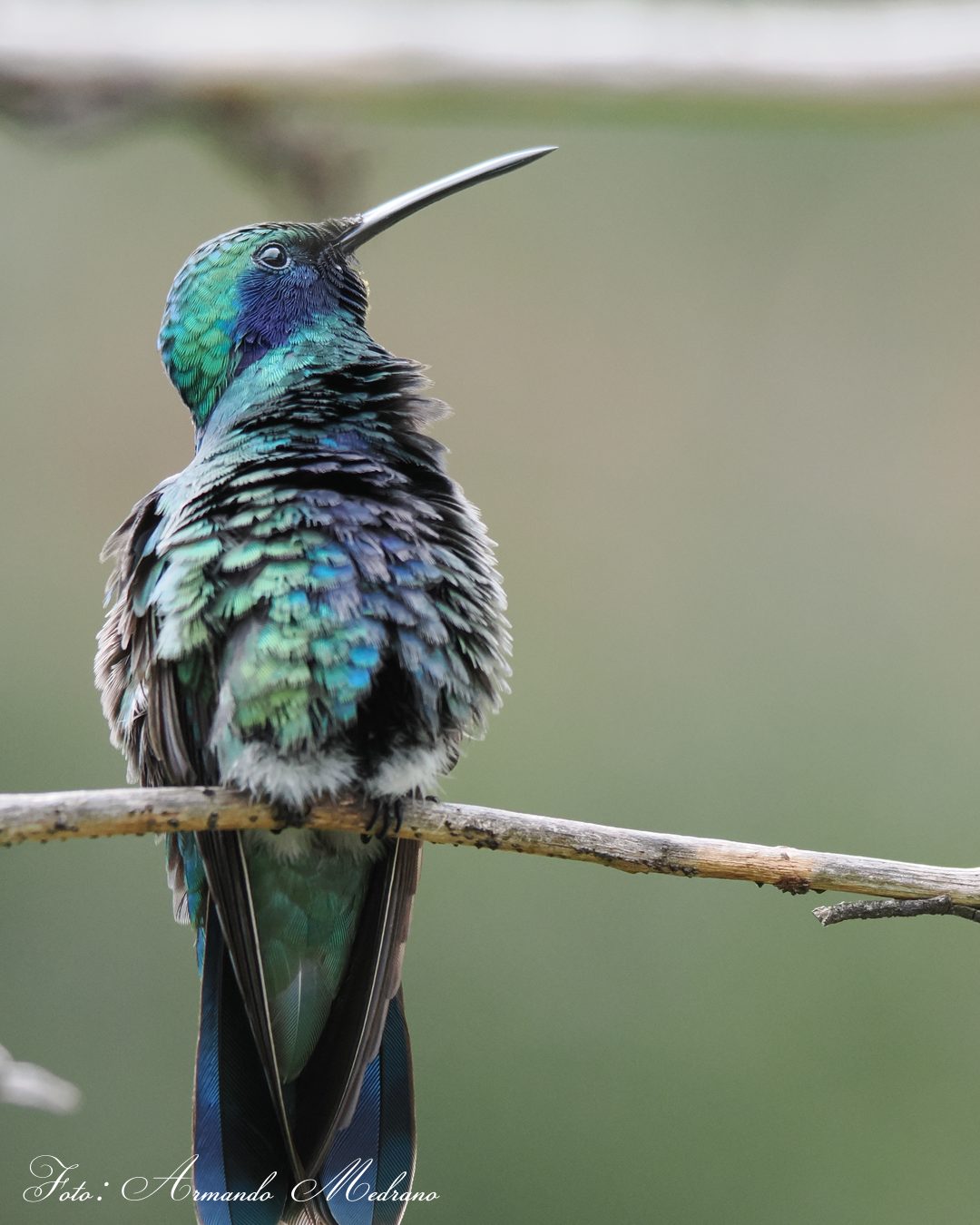
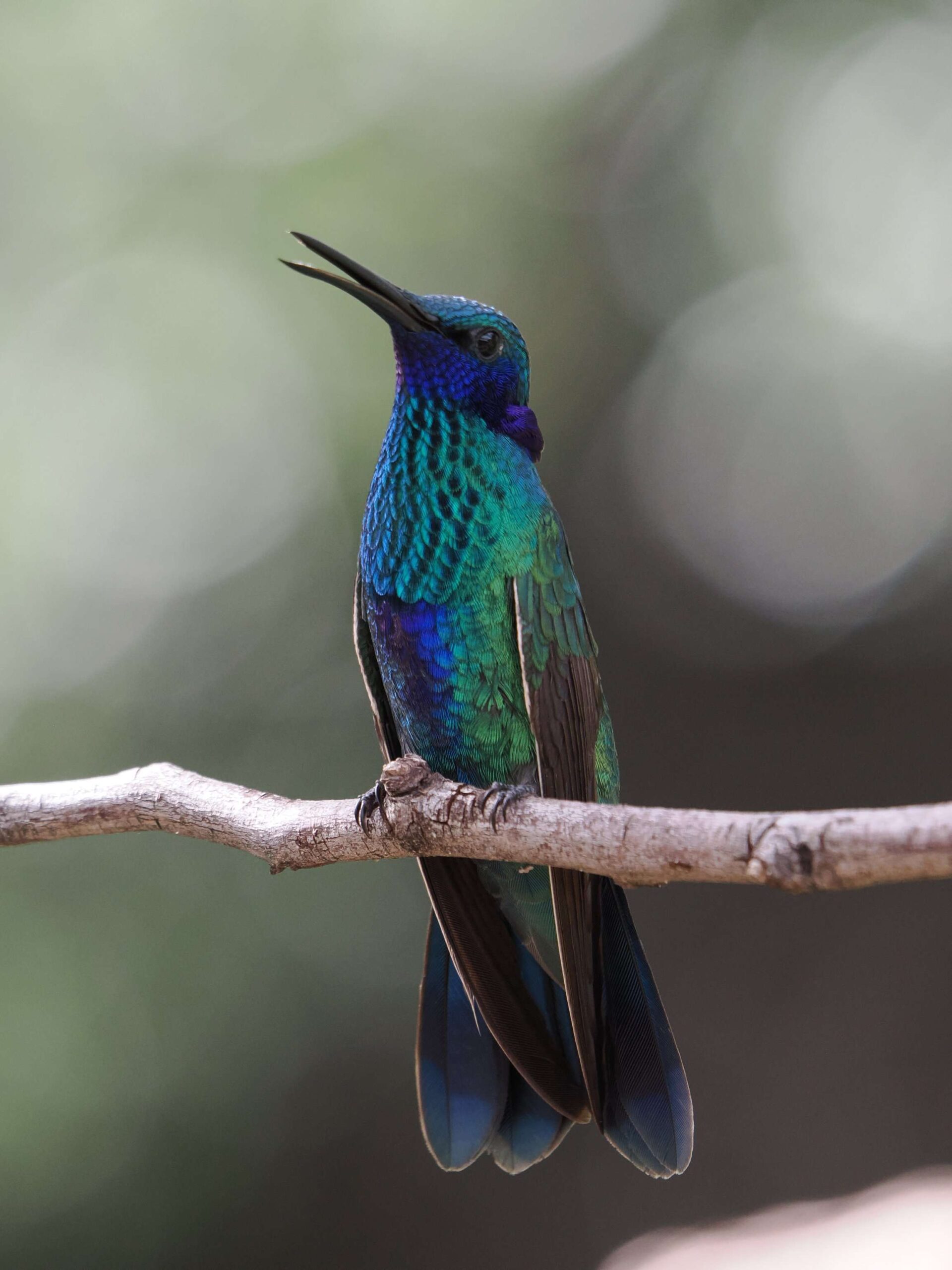
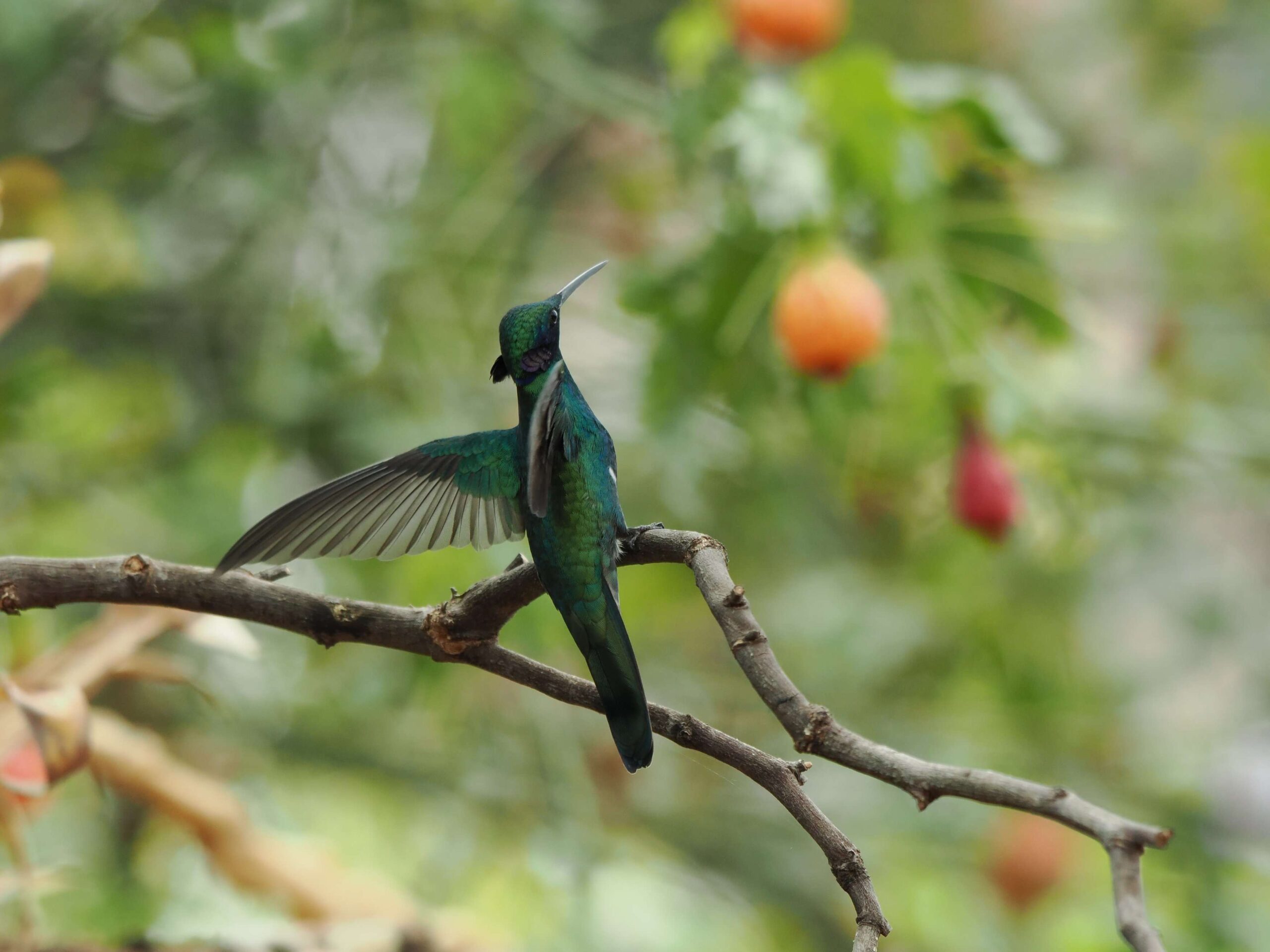
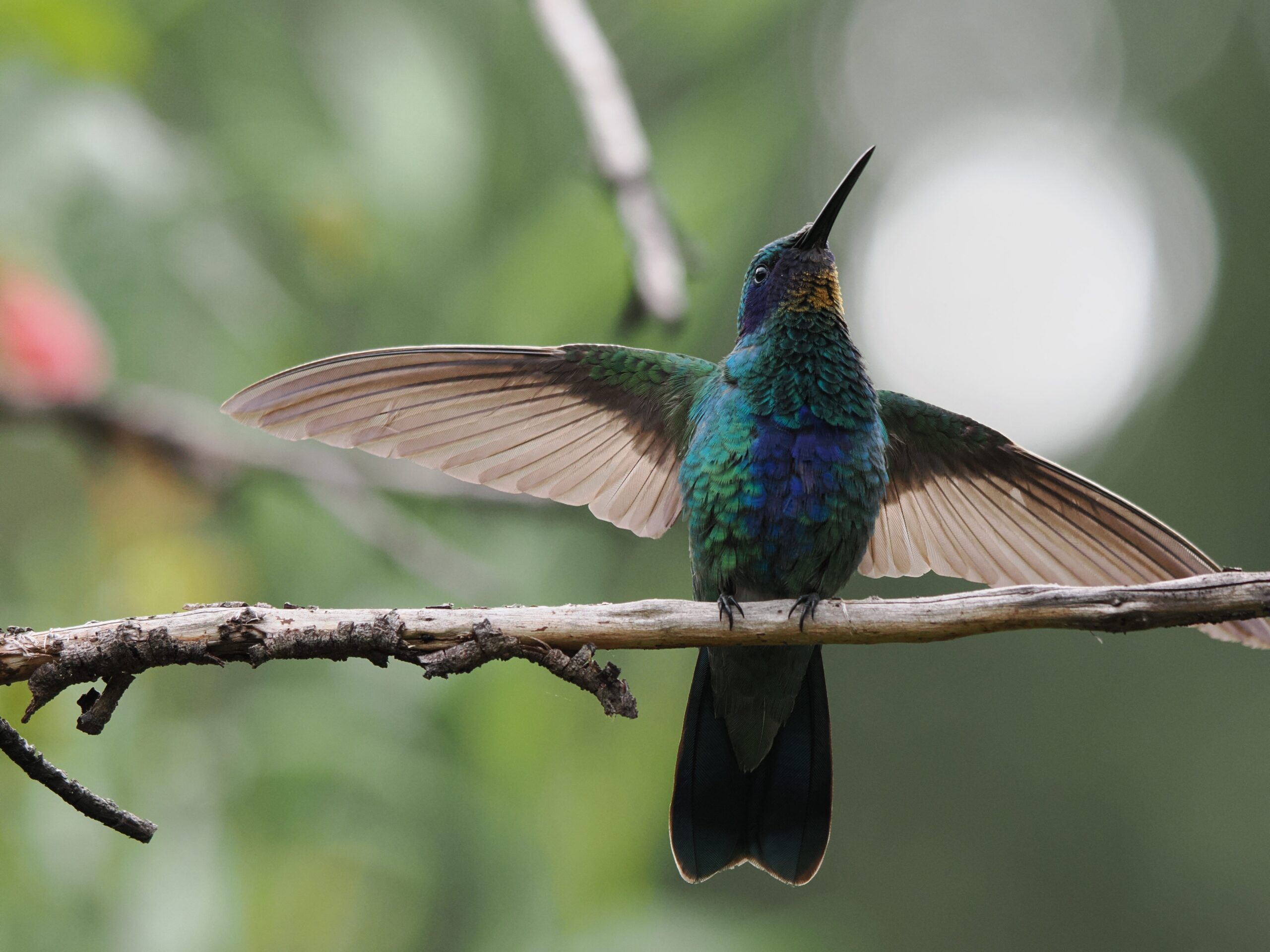
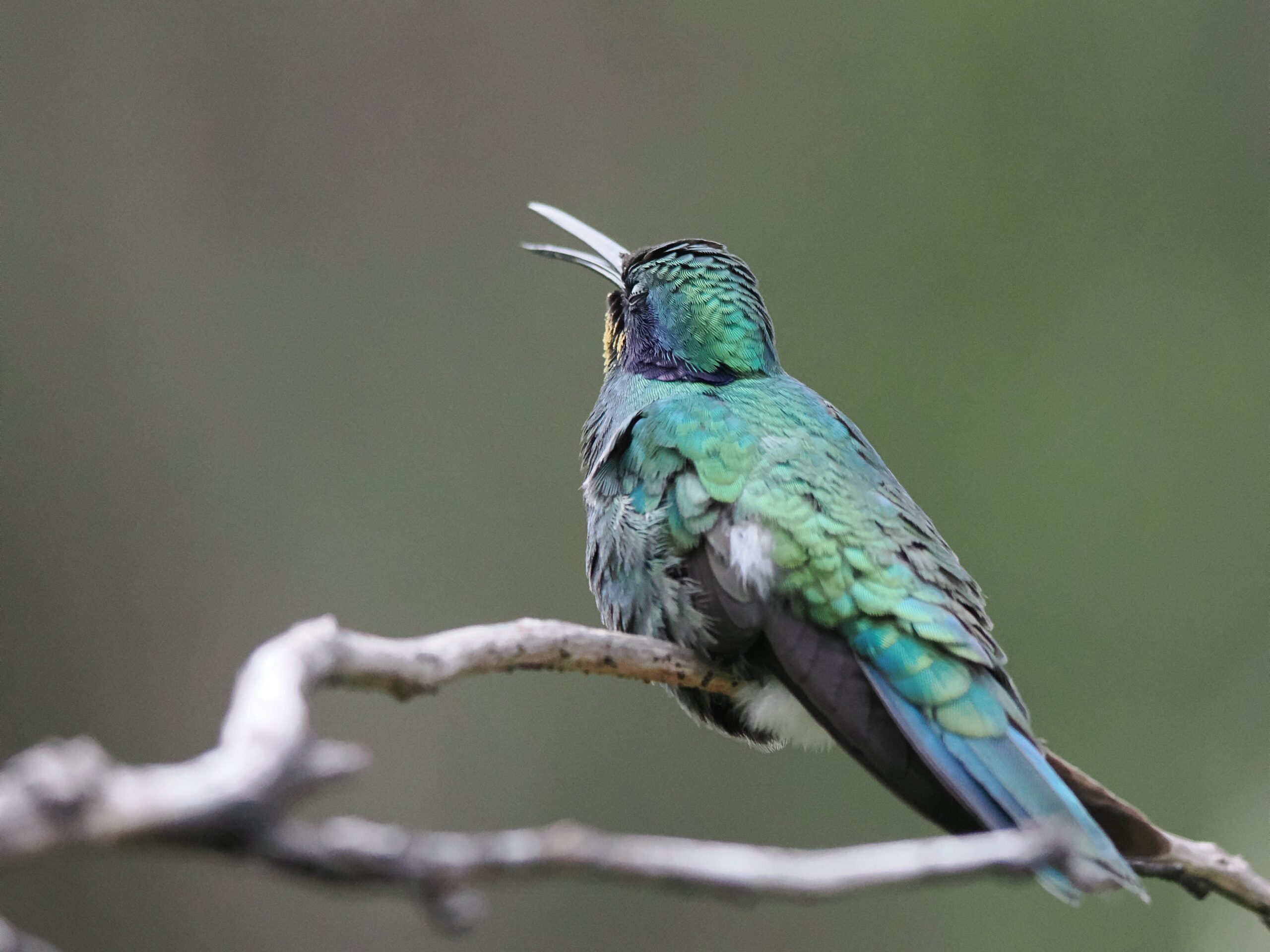
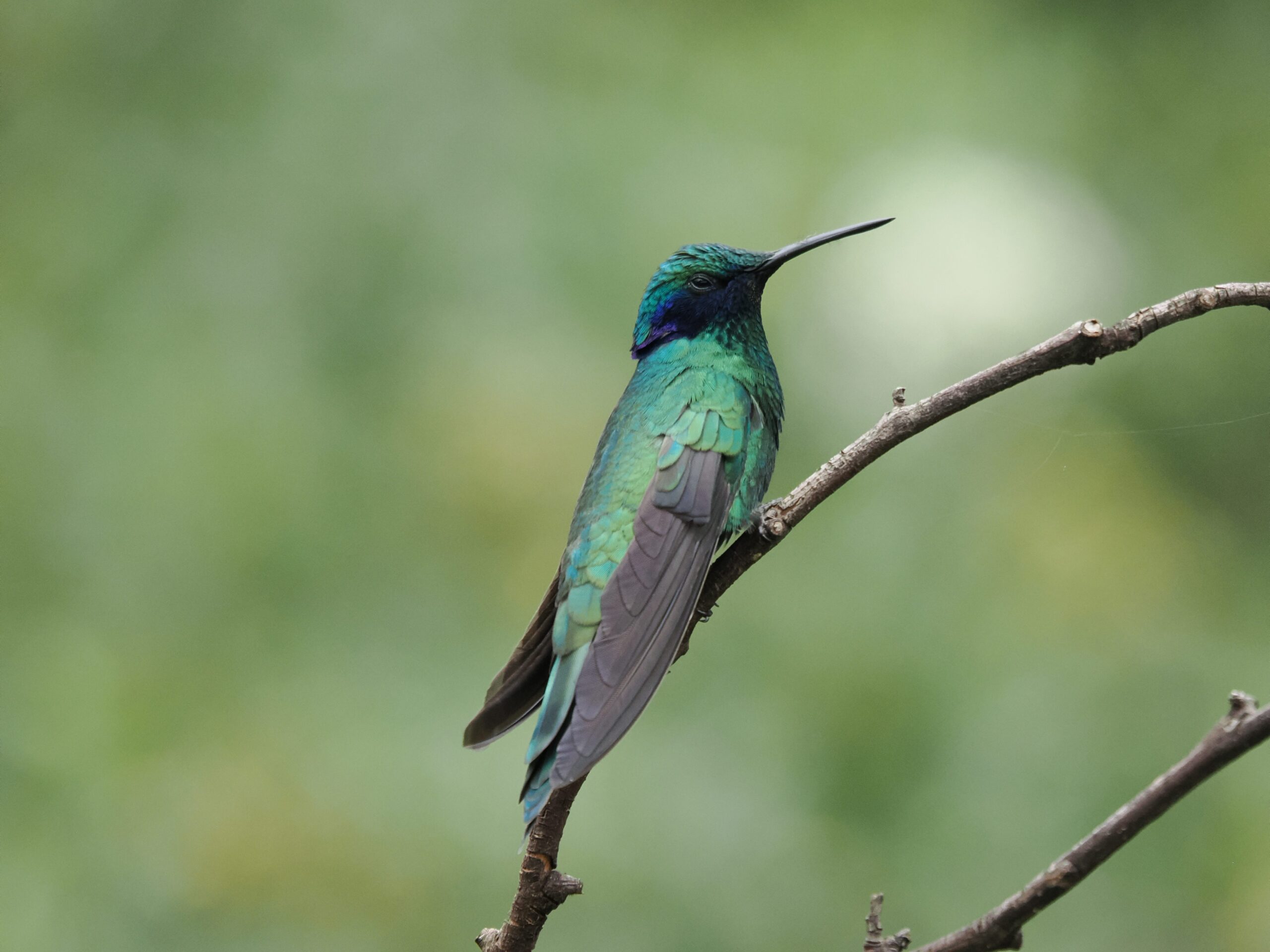
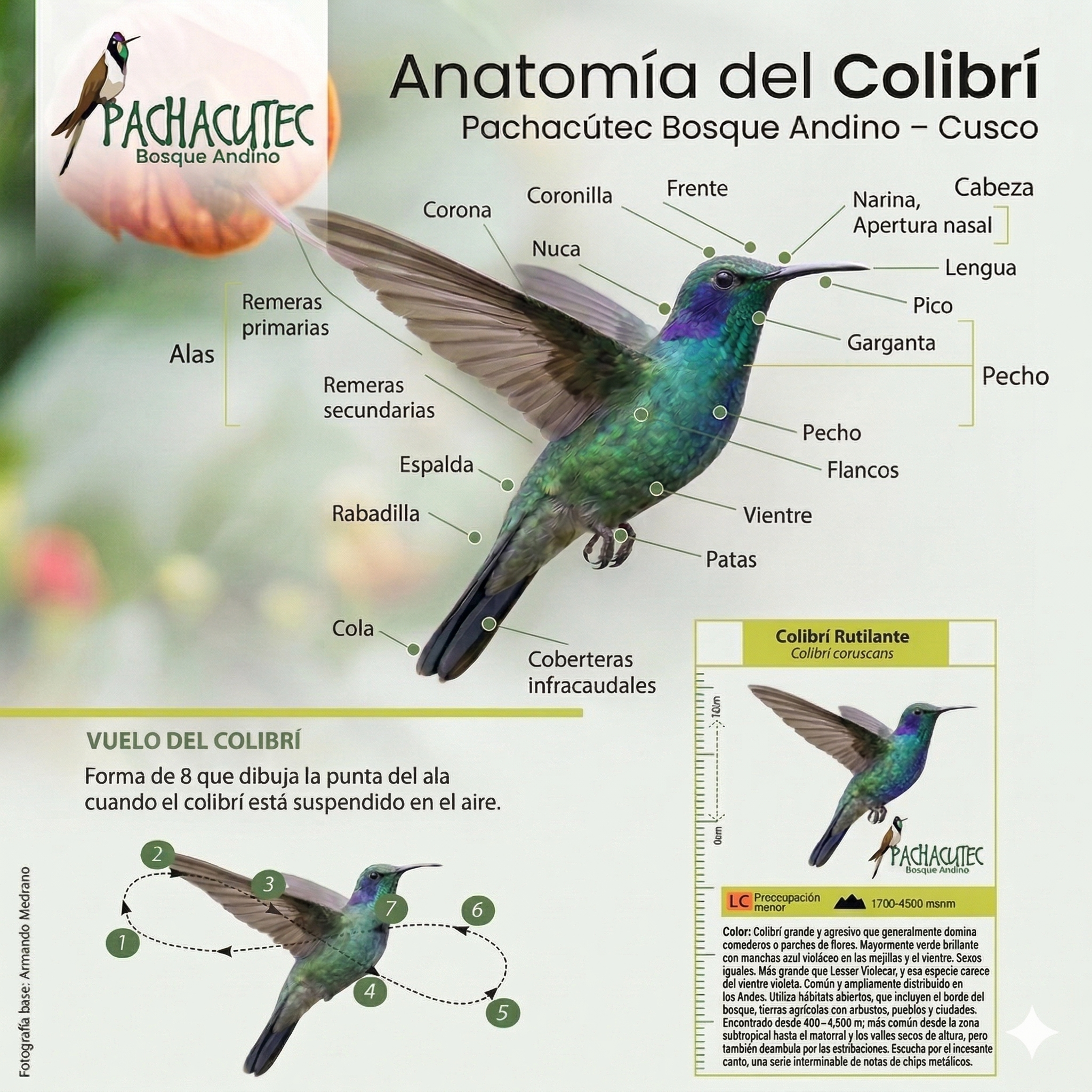
The Sparkling Violetear is one of the largest and most conspicuous hummingbirds across much of the Andes. Modern sources agree that it measures approximately 13–14 cm, making it the largest of the so-called “violetears” and a notably robust hummingbird by the standards of the family Trochilidae. Males usually weigh between 5.8 and 8.5 g, while females weigh approximately between 6 and 7.5 g. Its general plumage is iridescent green, with violet patches on the cheeks and a blue-violet patch on the belly, a particularly important feature for distinguishing it from similar species.
In the field, however, the first impression is not color, but attitude.
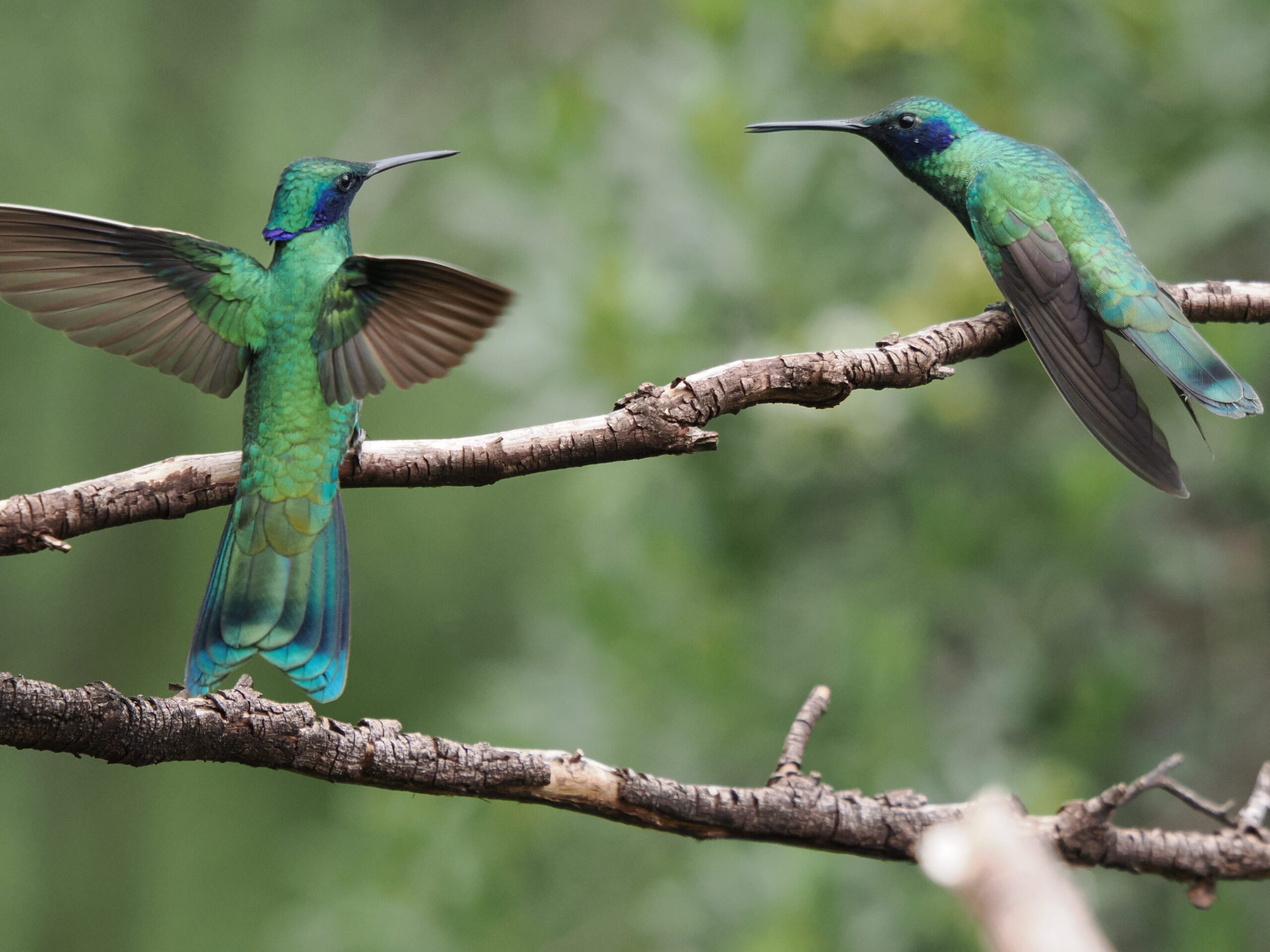
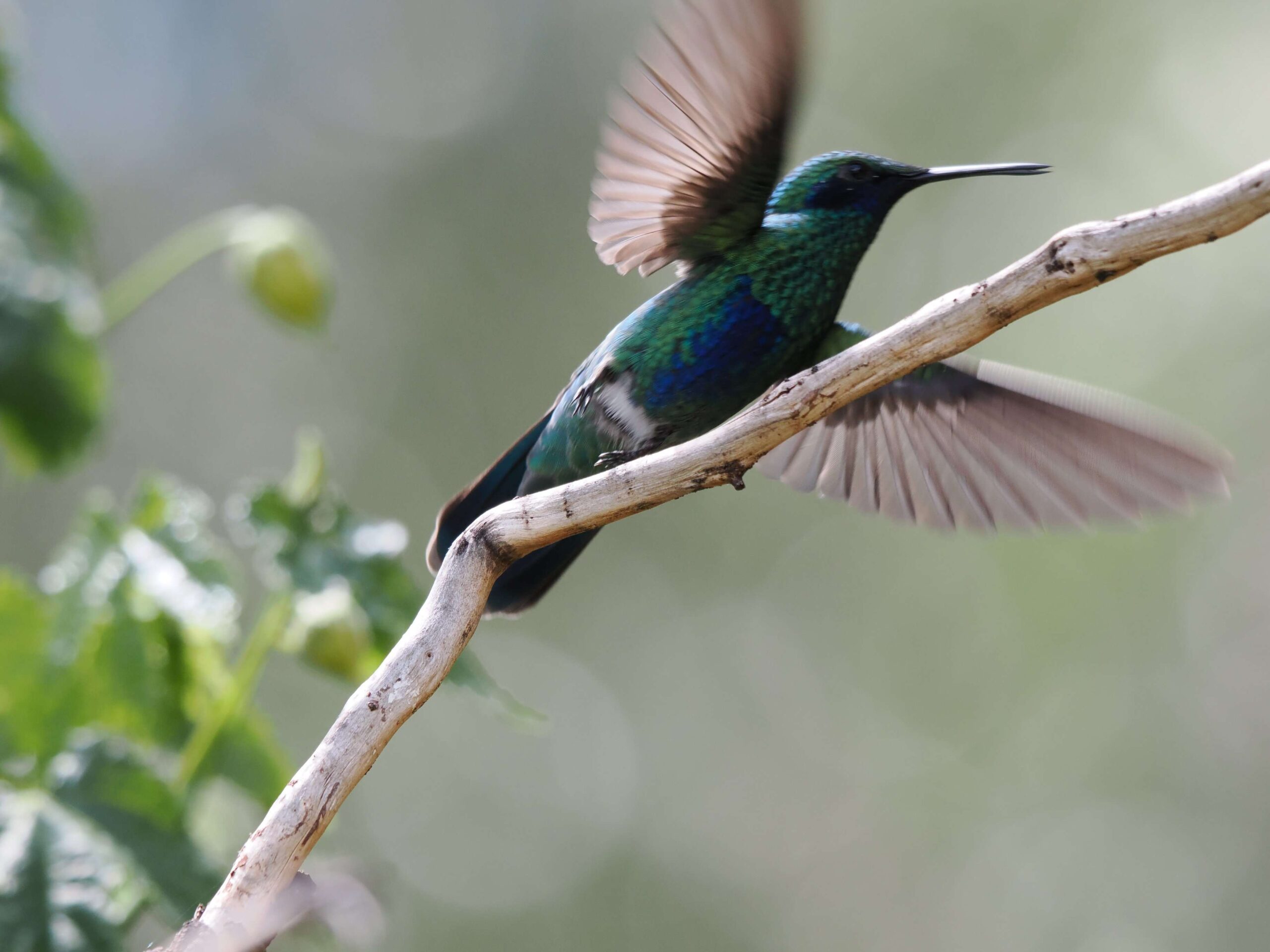
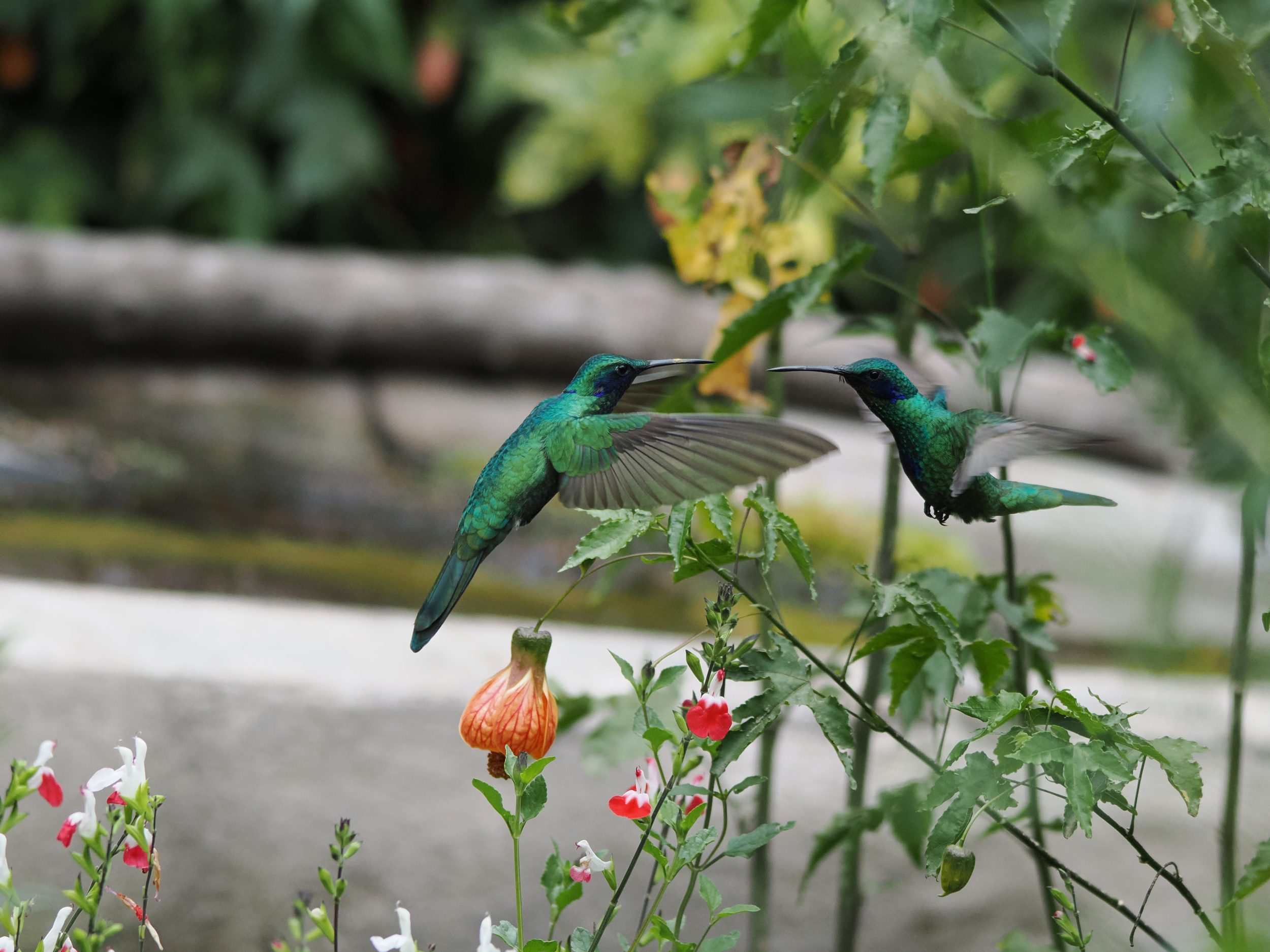
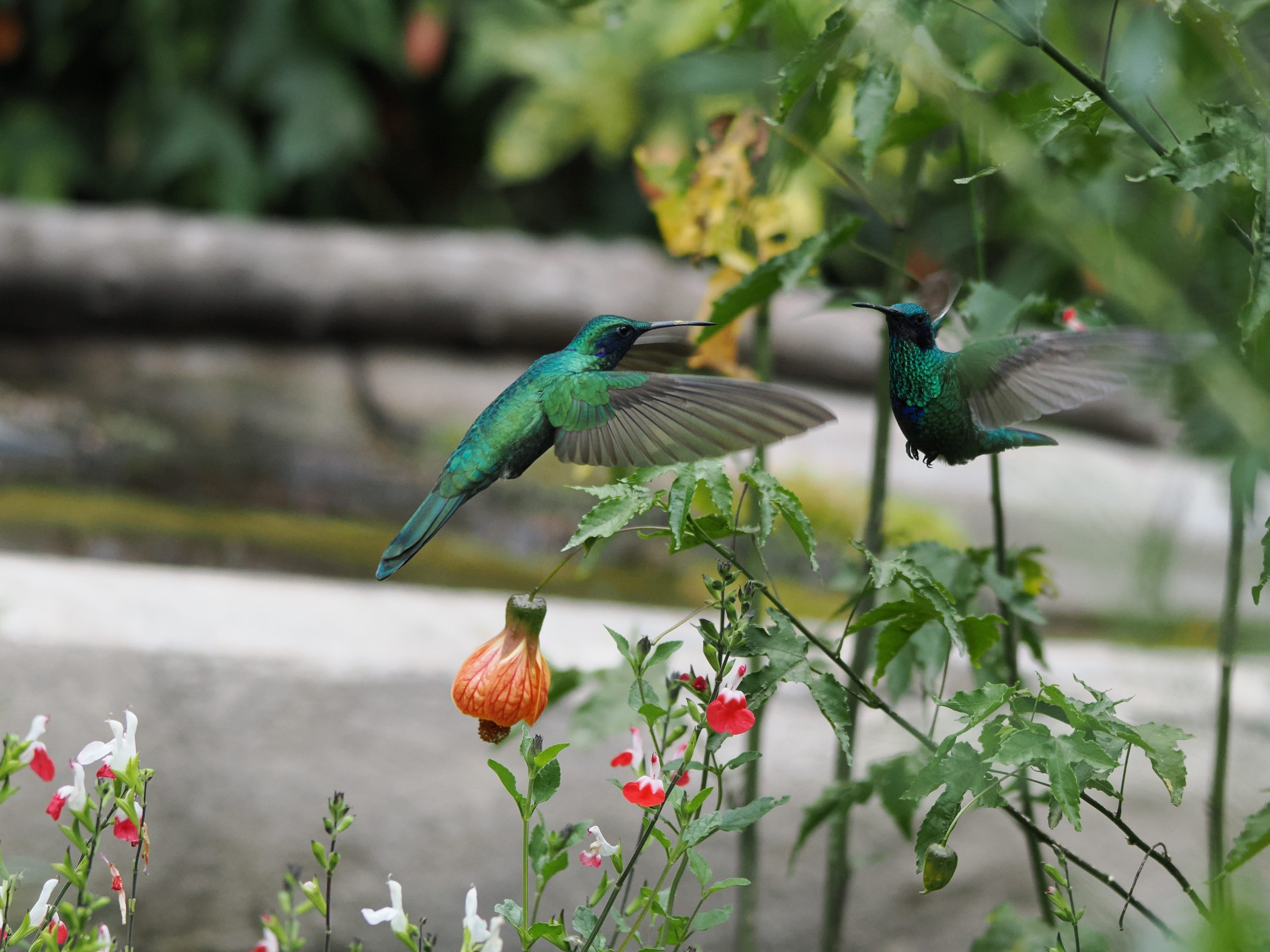
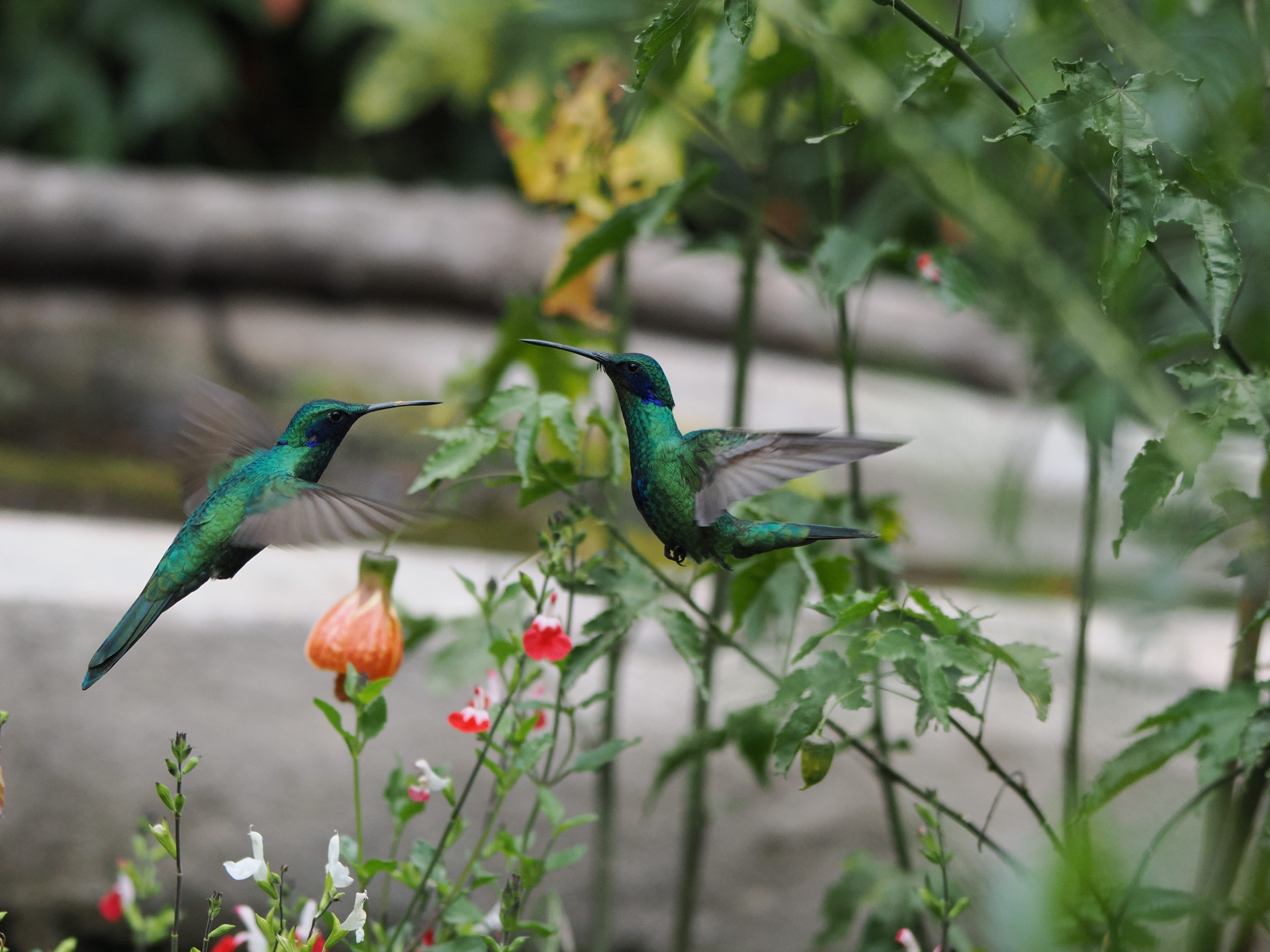
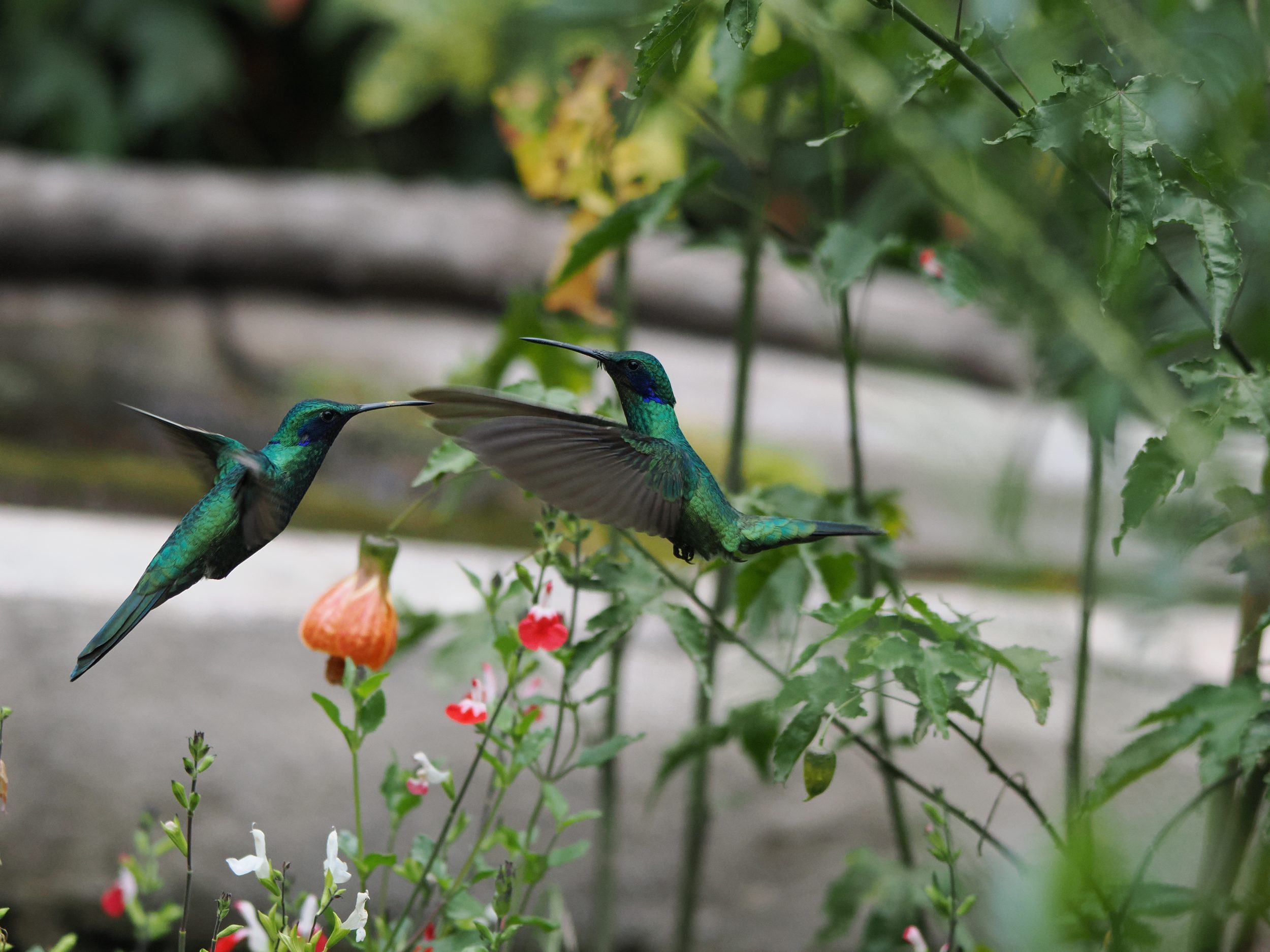
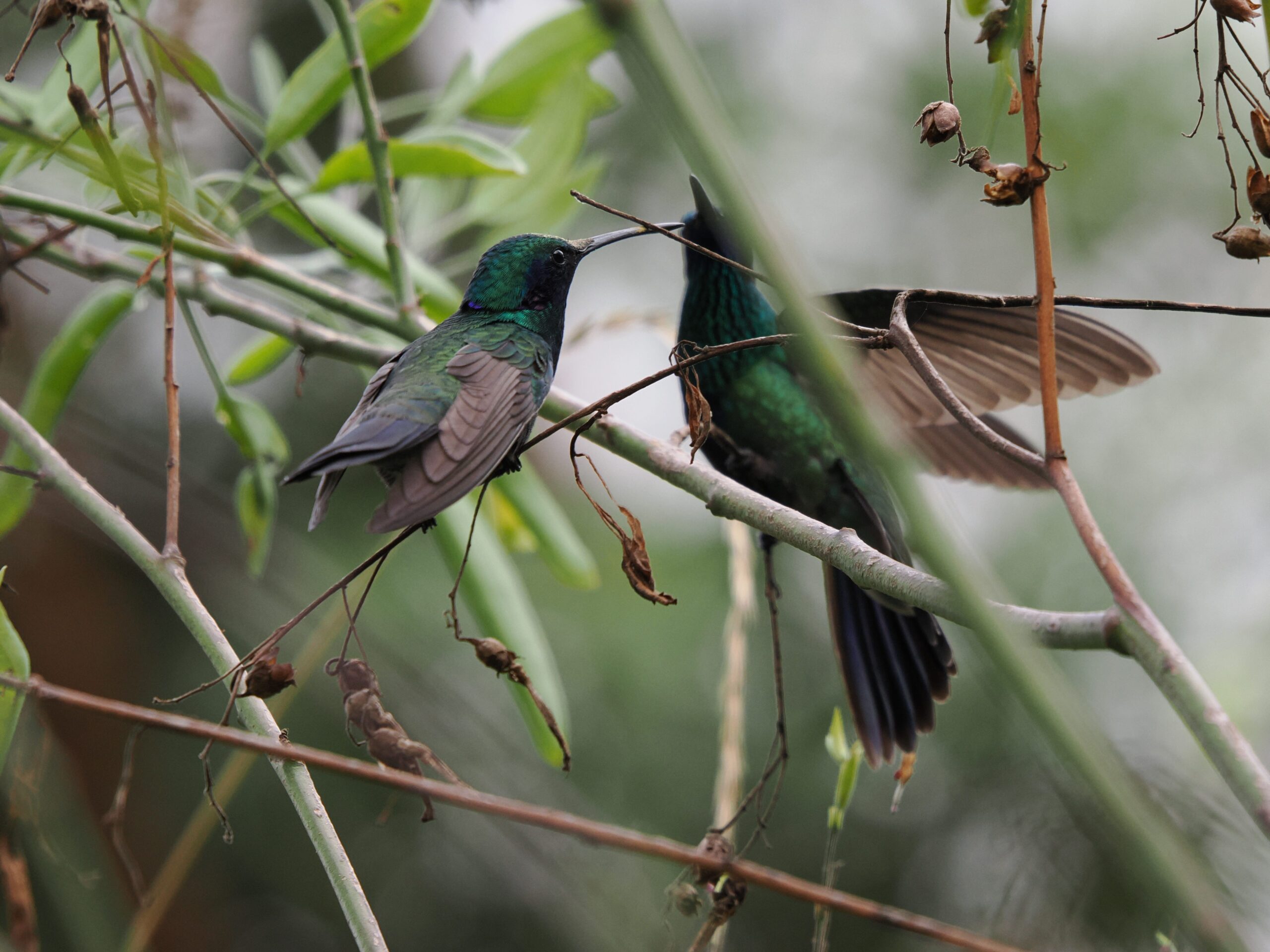
Some hummingbirds seem to always be passing through. The Sparkling Violetear, by contrast, often behaves as if the space belongs to it. It perches on exposed branches, emits repetitive metallic songs, patrols flowers and feeders, and launches lightning-fast chases against other trochilids. In many Andean localities, it is the dominant hummingbird of gardens, forest edges, and flower patches. This behavior is not anecdotal: it is part of its ecological strategy.
The Sound of a Territory
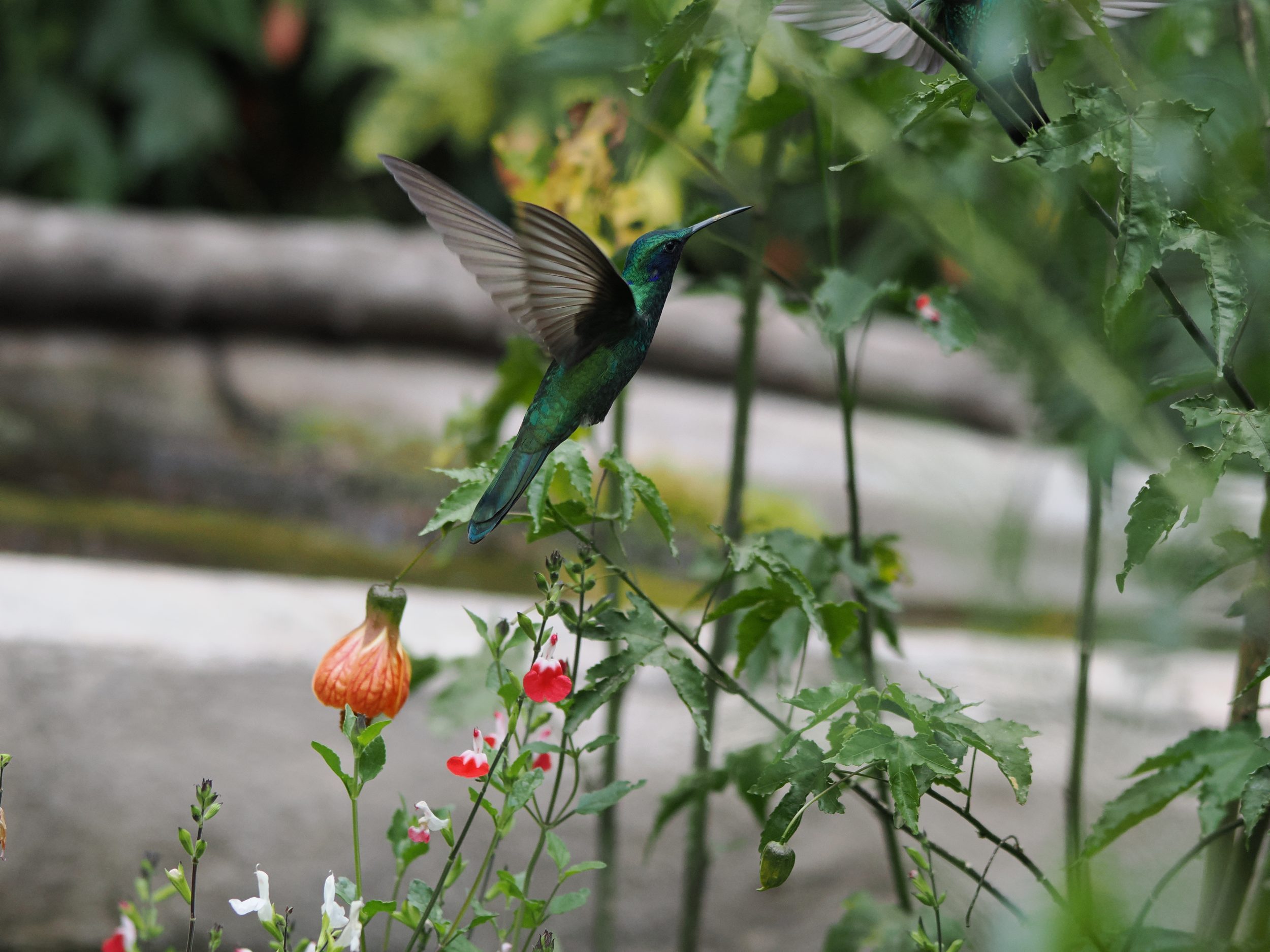
One of the clearest signs of its presence is its voice. The Sparkling Violetear emits a persistent sequence of metallic, repetitive, high-pitched notes that can be heard for long periods from the same perch. This “song from a perch” behavior is typical of the species and forms part of its territorial defense and social signaling system. The vocalization is not a simple sound ornament of the landscape; it is a declaration of occupation.
In a restored forest such as Pachacútec, where several hummingbird species share floral resources, the ability to warn, intimidate, and exclude competitors through vocal displays and chases can directly modify who accesses nectar, how long they remain in a patch, and which flowers they visit.
2. Taxonomy, Distribution, and Pachacútec’s Place on Its Map
An Andean Species, Not a Local Rarity
Colibri coruscans belongs to the family Trochilidae and to the genus Colibri, a group of relatively large hummingbirds with brilliant plumage and often territorial behavior. The species is widely distributed throughout the Andes and adjacent highland regions, from Venezuela and Colombia to Ecuador, Peru, Bolivia, northern Chile, and northwestern Argentina. It is also present in other montane systems of northern South America, including sectors of the Venezuelan coastal range and some tepui landscapes.
Far from being a rare hummingbird, the Sparkling Violetear is one of the most widely distributed and common species of the Andes. Precisely for that reason, it is so important. Abundant species often sustain a large proportion of a system’s ecological interactions. They are not always the most charismatic for conservation, but they are often among the most influential.
Altitudinal Range: From Dry Valleys to High Montane Forests
The literature is not completely uniform regarding its altitudinal range, partly because the species occupies very different environments across an enormous distribution. In general, it is found between 1,700 and 4,500 m, although in some areas it may occur lower or move seasonally. Some field guides and regional summaries place it from around 400–4,500 m, while other reports emphasize its abundance especially from the subtropical Andean zone to shrublands and high dry valleys.
This range is crucial for interpreting what happens at Pachacútec Andean Forest, located at around 3,200 m in the Wanakauri micro-watershed. At that altitude, Colibri coruscans is not at the edge of its distribution: it is within a fully functional band of its Andean ecological niche. This helps explain why the species can be so dominant at the observatory and why it responds so quickly to changes in flowering and climate.
3. The Hummingbird of Open Spaces: Why Pachacútec Suits It So Well
It Does Not Depend Exclusively on Closed Forest
One of the most interesting traits of the Sparkling Violetear is that it is not a hummingbird strictly restricted to the interior of dense cloud forests. On the contrary, the species successfully uses a wide range of semi-open and open habitats: forest edges, shrub-covered slopes, inter-Andean valleys, gardens, crops with scattered vegetation, shrublands, villages, and Andean cities.
This fits almost perfectly with the ecological mosaic of Pachacútec Andean Forest: a restoration space where trails, observatories, patches of native vegetation, areas with Nicotiana glauca, Andean shrubs, regeneration zones, and edge sectors coexist as an interface between forest, garden, and peri-urban landscape. The Sparkling Violetear is precisely the kind of hummingbird that takes advantage of that mosaic.
Restoration Opens Opportunities for It
In ecological restoration, not all species respond in the same way. Some require mature forest, constant shade, and complex structures to return. Others, such as Colibri coruscans, can take advantage of early and intermediate stages of restoration, as long as there are enough floral resources, vigilance perches, and some continuity of vegetation.
This has a very important consequence: the Sparkling Violetear can function as an indicator of partial success in floral restoration. Its presence, abundance, and territorial activity can signal that the system is already producing enough nectar and structure to sustain a dominant hummingbird with high energy demands. At the same time, however, its dominance can hide a tension: if a single species monopolizes too many resources, smaller or subordinate species may be displaced from certain patches.
In other words, seeing many Sparkling Violetears at Pachacútec is good ecological news, but also an invitation to look more closely at the complete interaction network.
4. The Body of a High-Elevation Generalist
A Design for Dominating Flowers and Chasing Rivals
Hummingbirds are not “all the same with different beaks.” Body shape, size, mass, wing length, and bill curvature deeply affect how each species exploits nectar, which flowers it can use, and how well it can defend a territory.
Colibri coruscans is a medium-to-large species, with a relatively versatile bill and flight musculature sufficient to combine maneuverability with aggressive pursuit. It is not an extreme specialist of a single tubular flower. Rather, it is a strong generalist, capable of visiting a wide diversity of flowers and defending high-value patches.
This is reflected in studies of interaction networks and floral resource use. In Cajamarca, for example, a recent study on floral resources used by hummingbirds documented that Colibri coruscans was the species with the highest number of recorded floral interactions, associated with around 20 plant species within the sampled assemblage.
That information is extraordinarily useful for interpreting Pachacútec. It suggests that the Sparkling Violetear is not simply an opportunistic consumer of one or two favorite flowers, but a species with broad floral plasticity, capable of incorporating multiple resources in a diverse landscape.
The Advantage of Being Large in a World of Hummingbirds
Among hummingbirds, size matters. A larger bird often has a greater capacity to drive away a smaller one, although this also depends on maneuverability, persistence, and the profitability of the defended resource. The Sparkling Violetear appears to take advantage of that size advantage in many contexts. It is larger than the Lesser Violetear and several small Andean species, allowing it to act as a dominant species at concentrated flowers or feeders.
In a hummingbird observatory, this hierarchy becomes visible at first sight: the Sparkling Violetear may perch near the resource, vocalize, launch itself at an intruder, and return to the same perch within seconds. That routine of vigilance and expulsion is part of its energy economy. Defending a resource costs energy, but if nectar is abundant and predictable, the defense may be profitable.
5. Territoriality: The Sparkling Violetear as a Regulator of Nectar Access
It Does Not Only Visit Flowers; It Manages Them by Force
The romantic image of the hummingbird as a delicate being that “kisses flowers” hides a harsher reality: many hummingbirds are intensely competitive. Among them, the Sparkling Violetear stands out for its territoriality.
A recent study on heterospecific aggressive responses induced by playback in urban Andean hummingbirds found that Sparkling Violetears modulate their aggression according to the competitor, and that territoriality can vary in relation to the risk that another species may take the resource from them. The study supports the idea that the species does not attack indiscriminately, but adjusts its response to the identity and competitive potential of the intruder.
This is extremely relevant for Pachacútec Andean Forest. If Colibri coruscans, Lesser Violetear, trainbearers, woodstars, and other hummingbirds coexist at the observatory, the behavior of the Sparkling Violetear may be shaping the structure of resource use. It is not only important how many flowers exist, but who can use them, when, and for how long.
Dominance Does Not Mean Absolute Exclusivity
However, the dominance of the Sparkling Violetear does not mean it monopolizes all flowers all the time. Hummingbird ecology is often organized through a combination of strategies:
- territorial defenders of rich and predictable patches,
- trapliners that visit routes of dispersed flowers,
- opportunists that take advantage of windows of low vigilance,
- and subordinates that access marginal resources or moments when the dominant bird is absent.
It is likely that several of these strategies are occurring simultaneously at Pachacútec. The Sparkling Violetear may dominate certain plants or sectors of the observatory, while other species exploit less defensible flowers, different time periods, or more protected microhabitats. From a monitoring perspective, this is one of the most interesting questions in the forest.
6. Pollination: Why This Species Matters More Than It Seems
A High-Elevation Pollinator
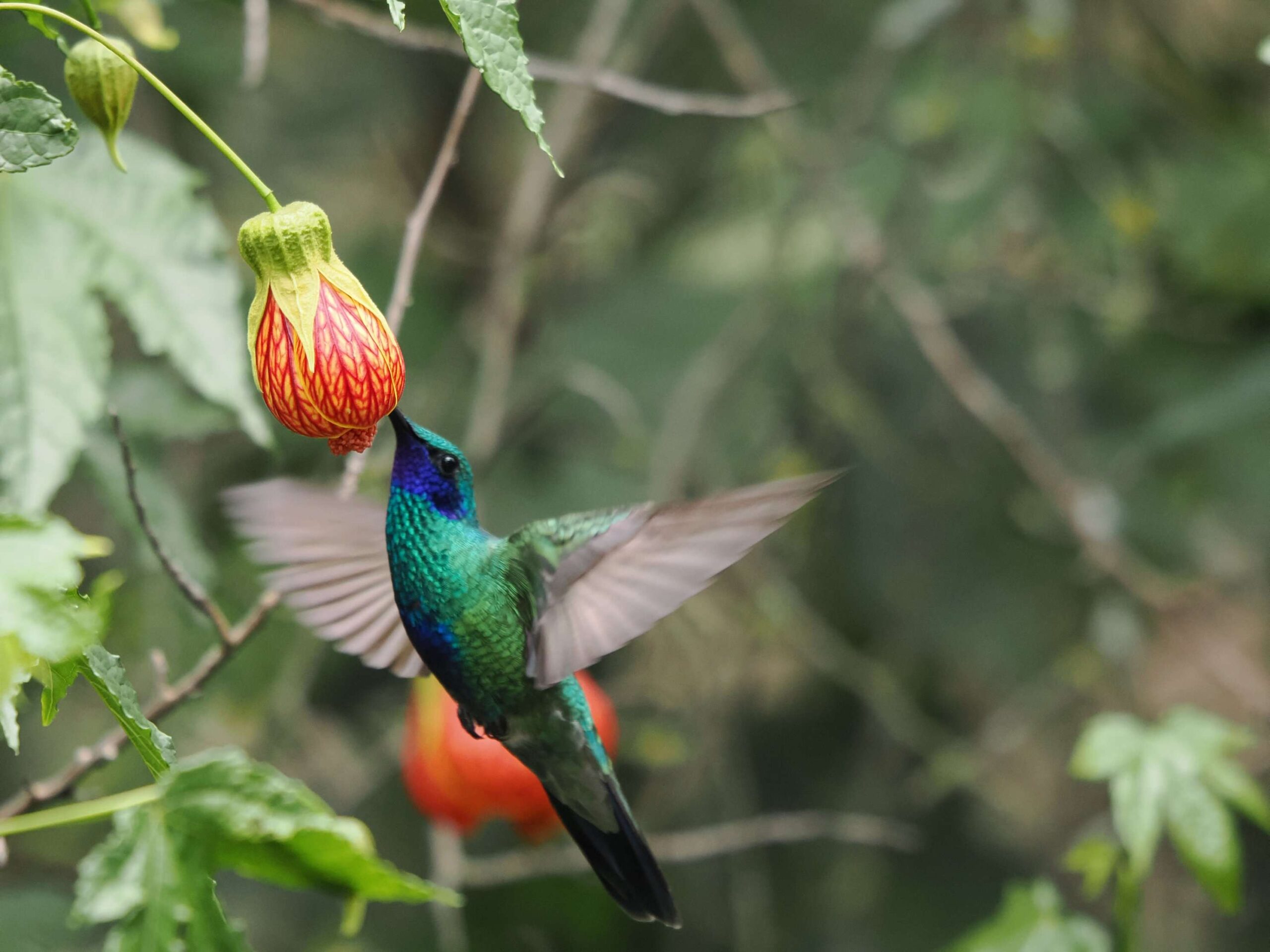
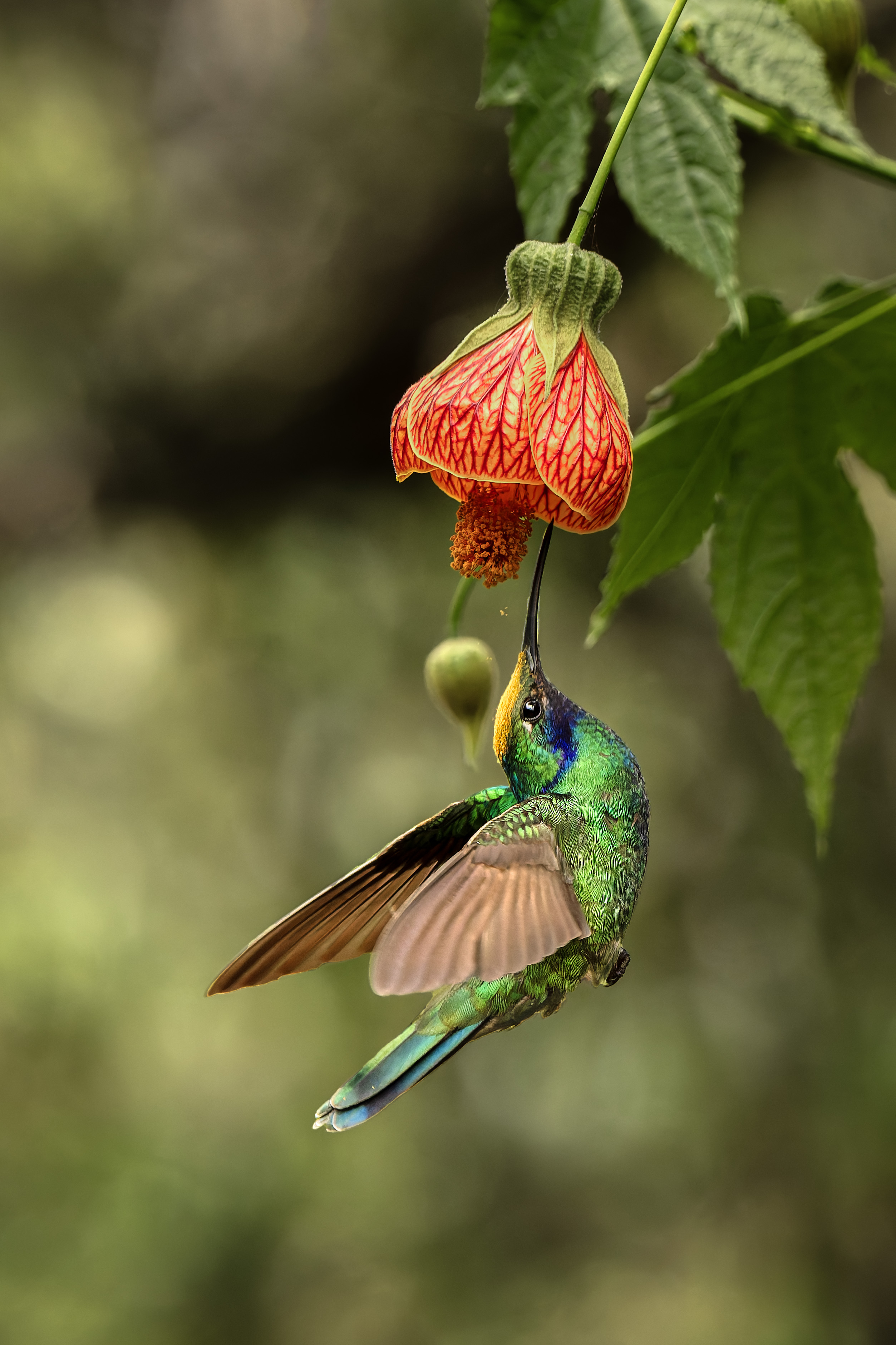
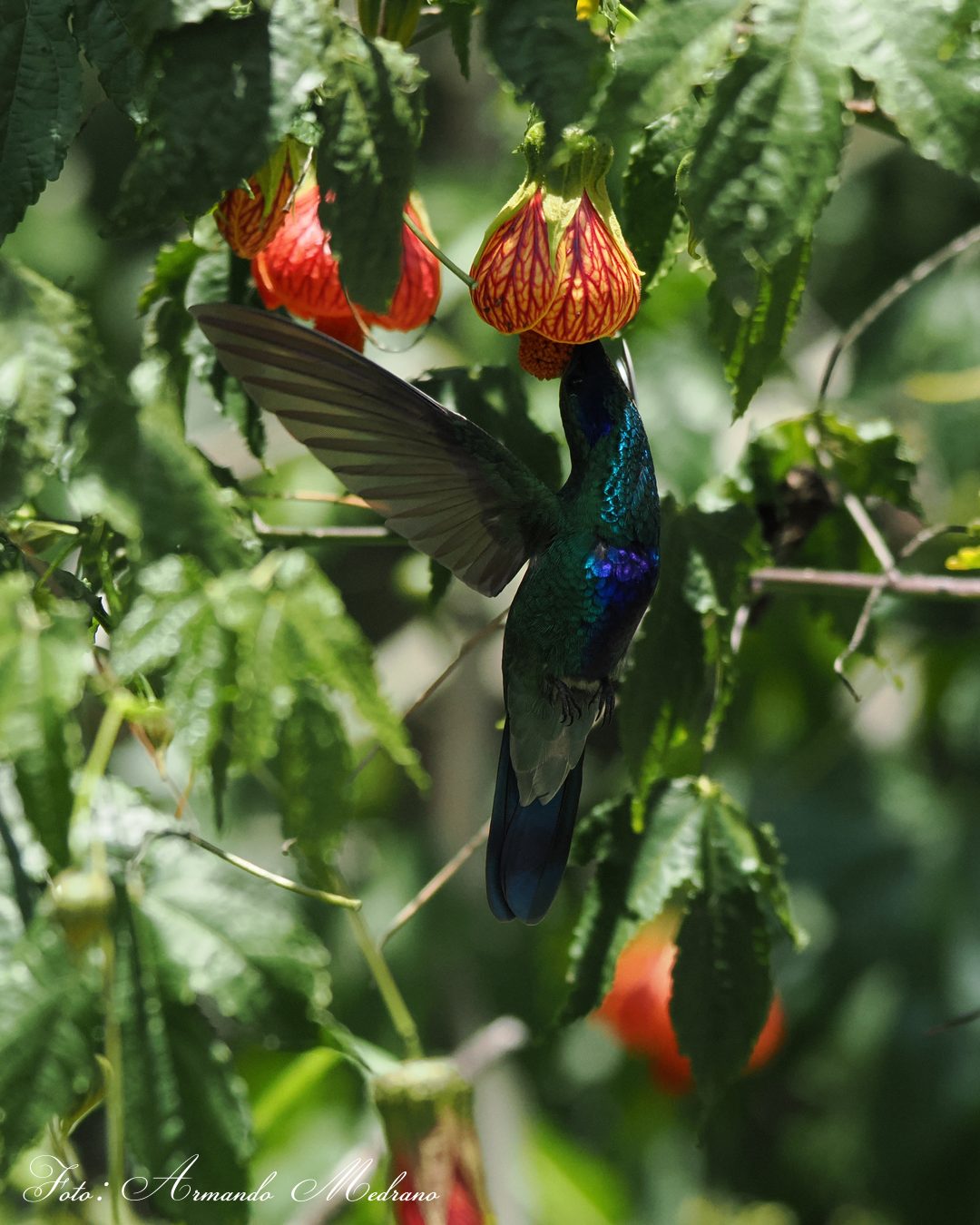
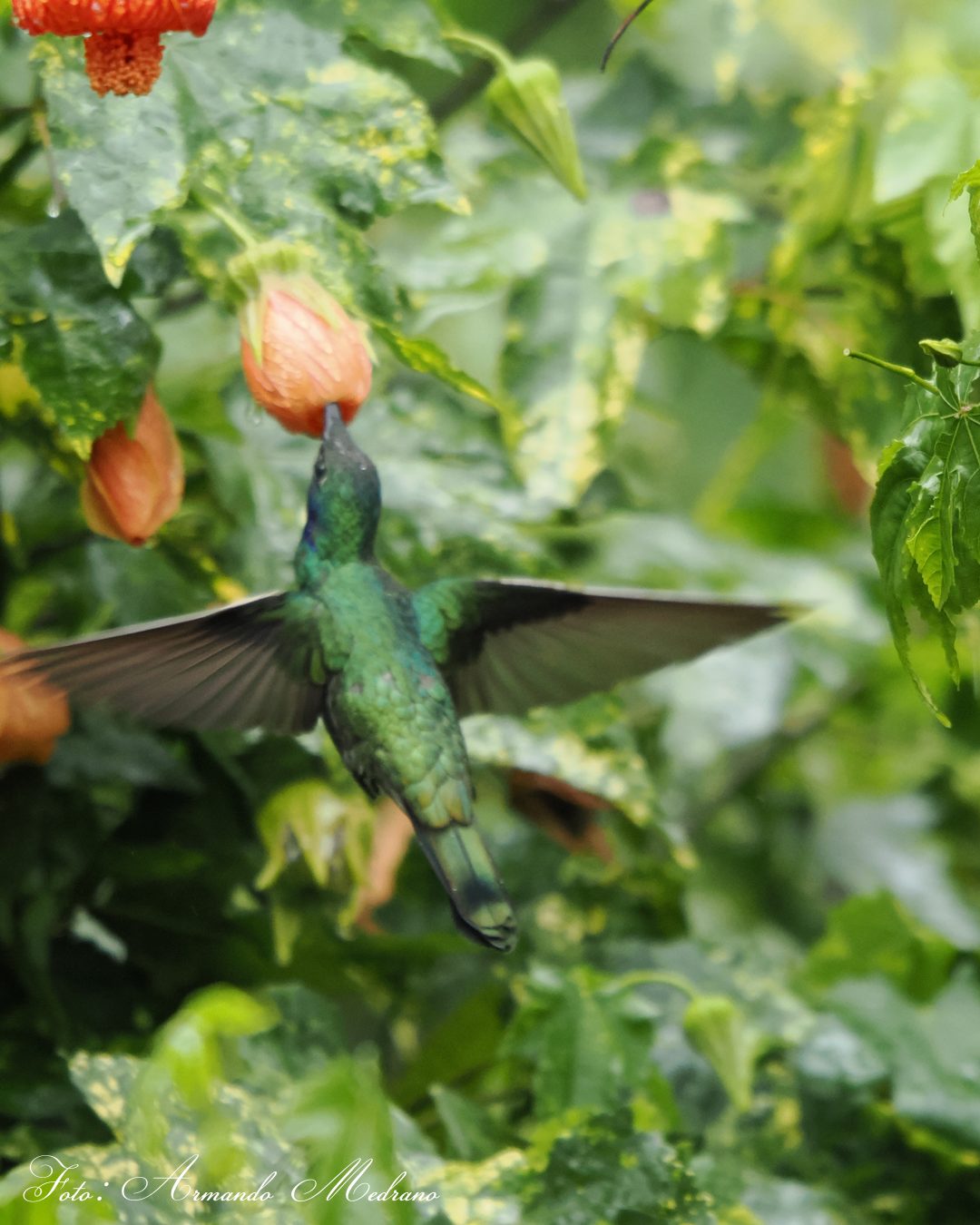
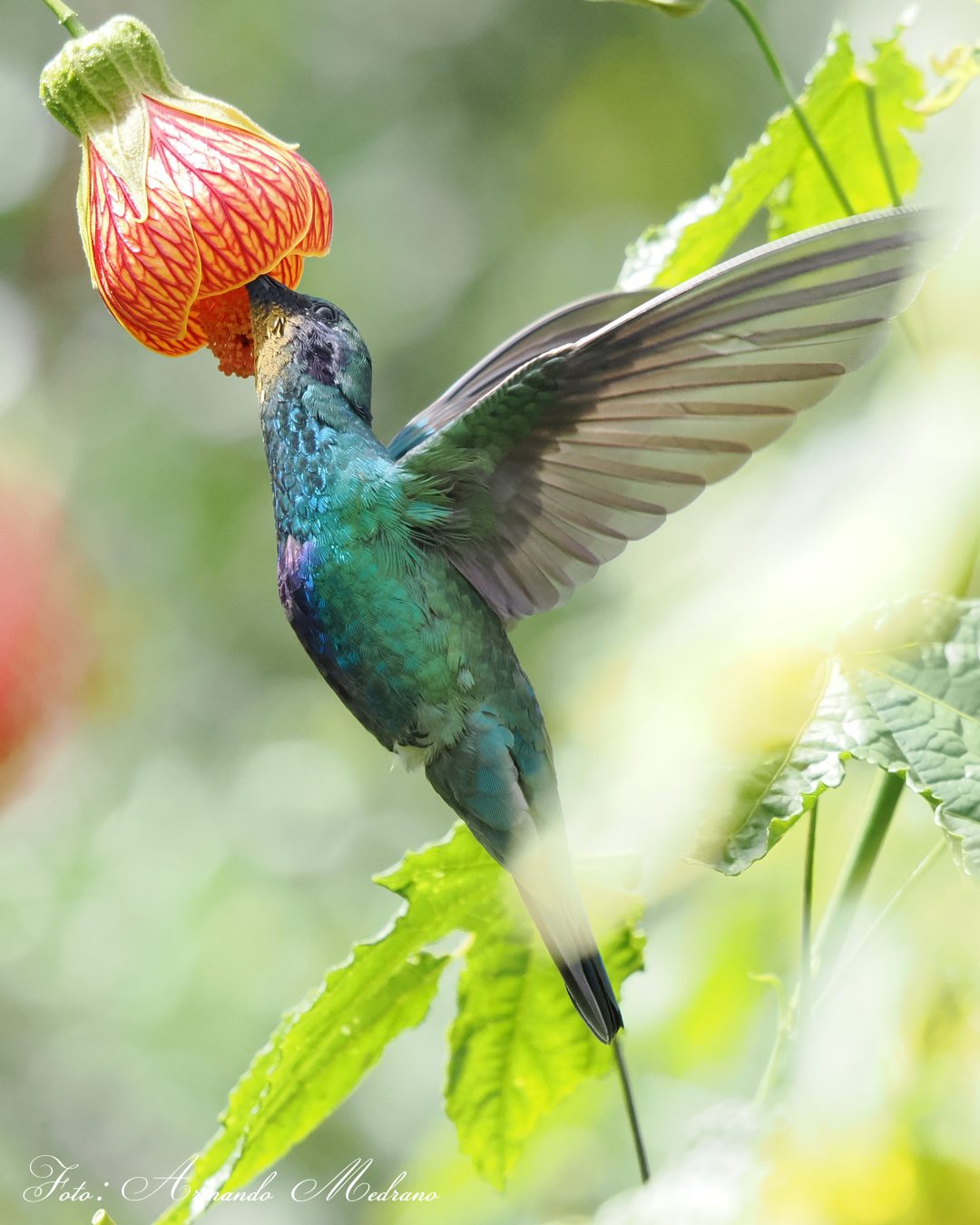
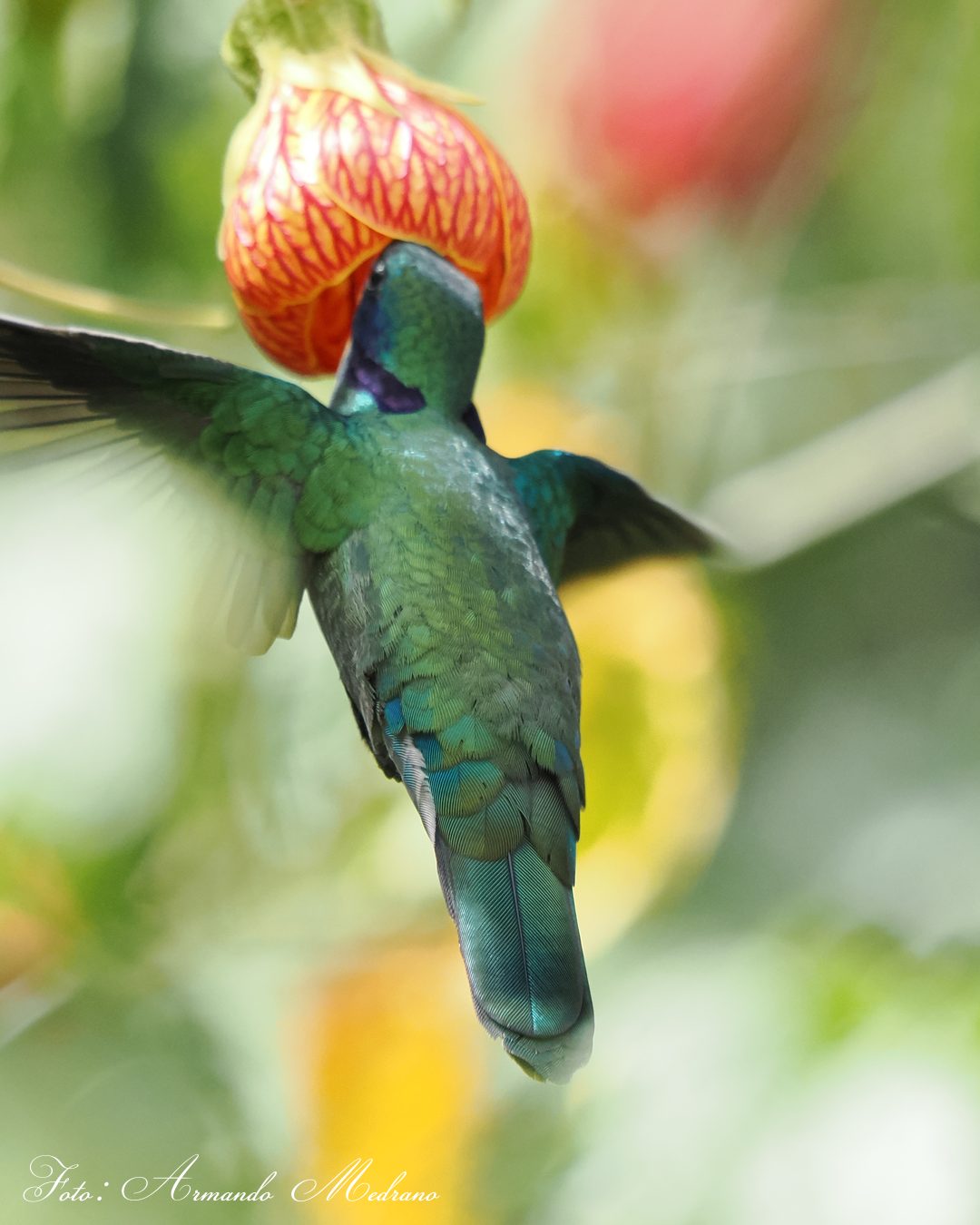
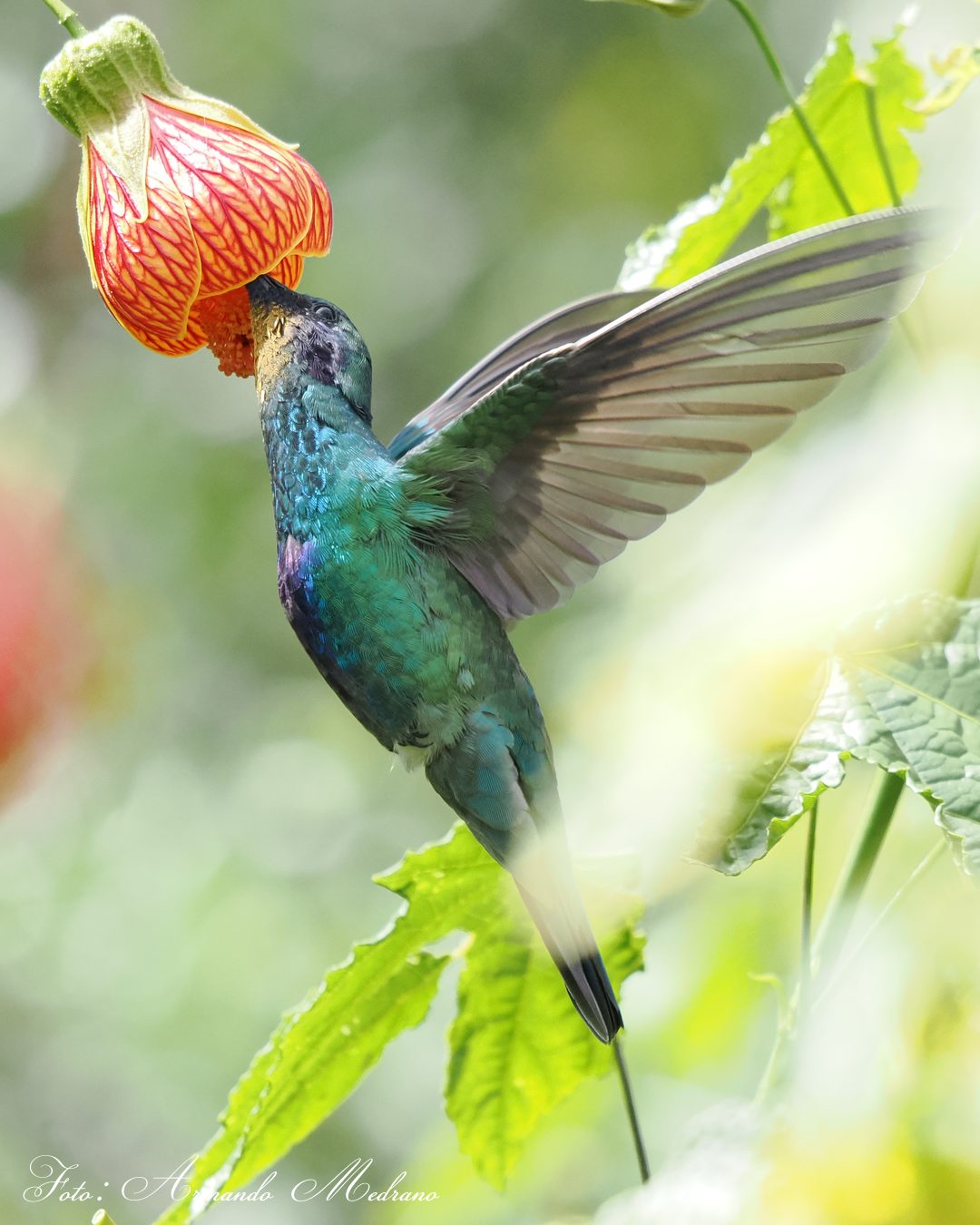
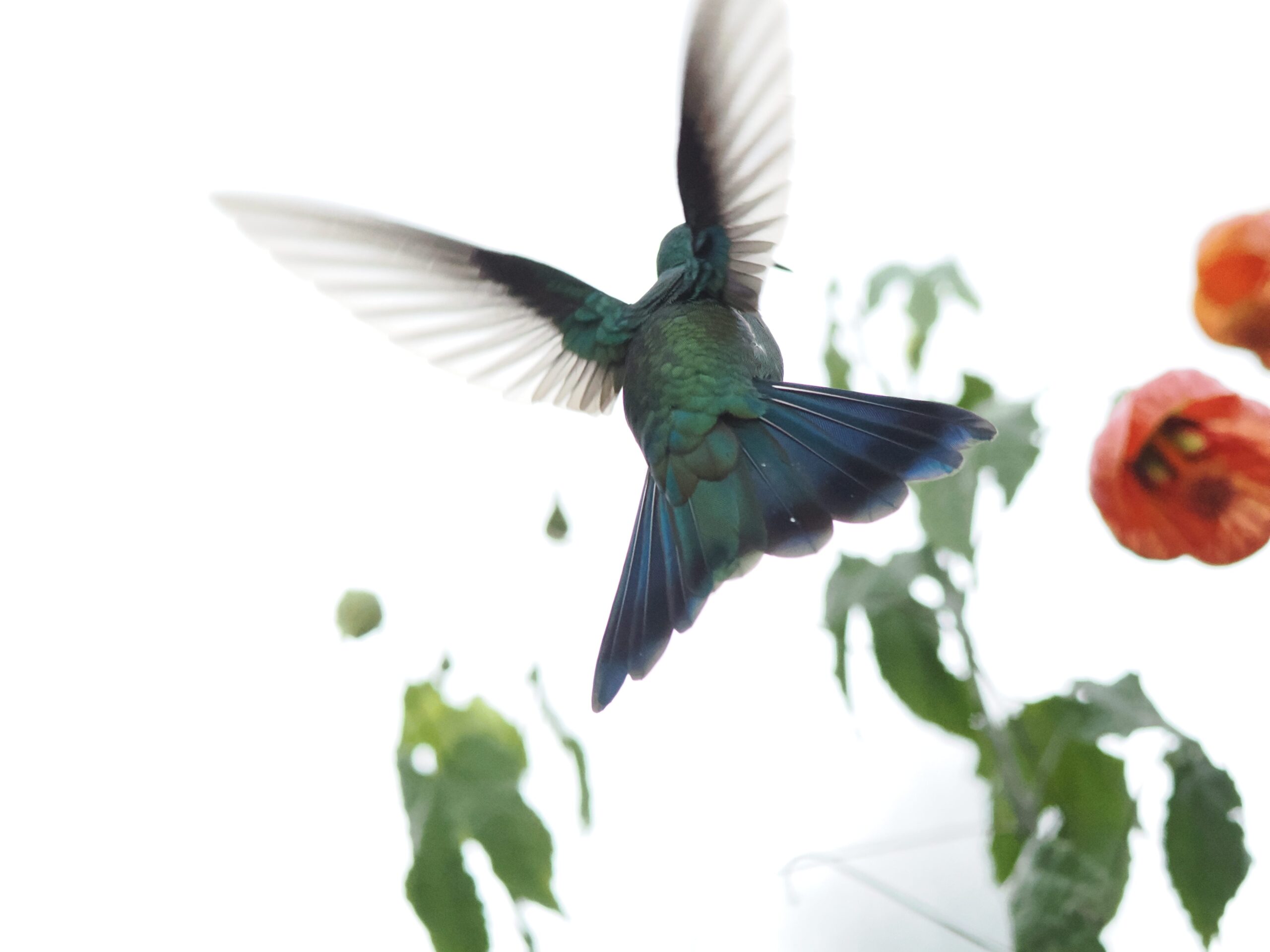
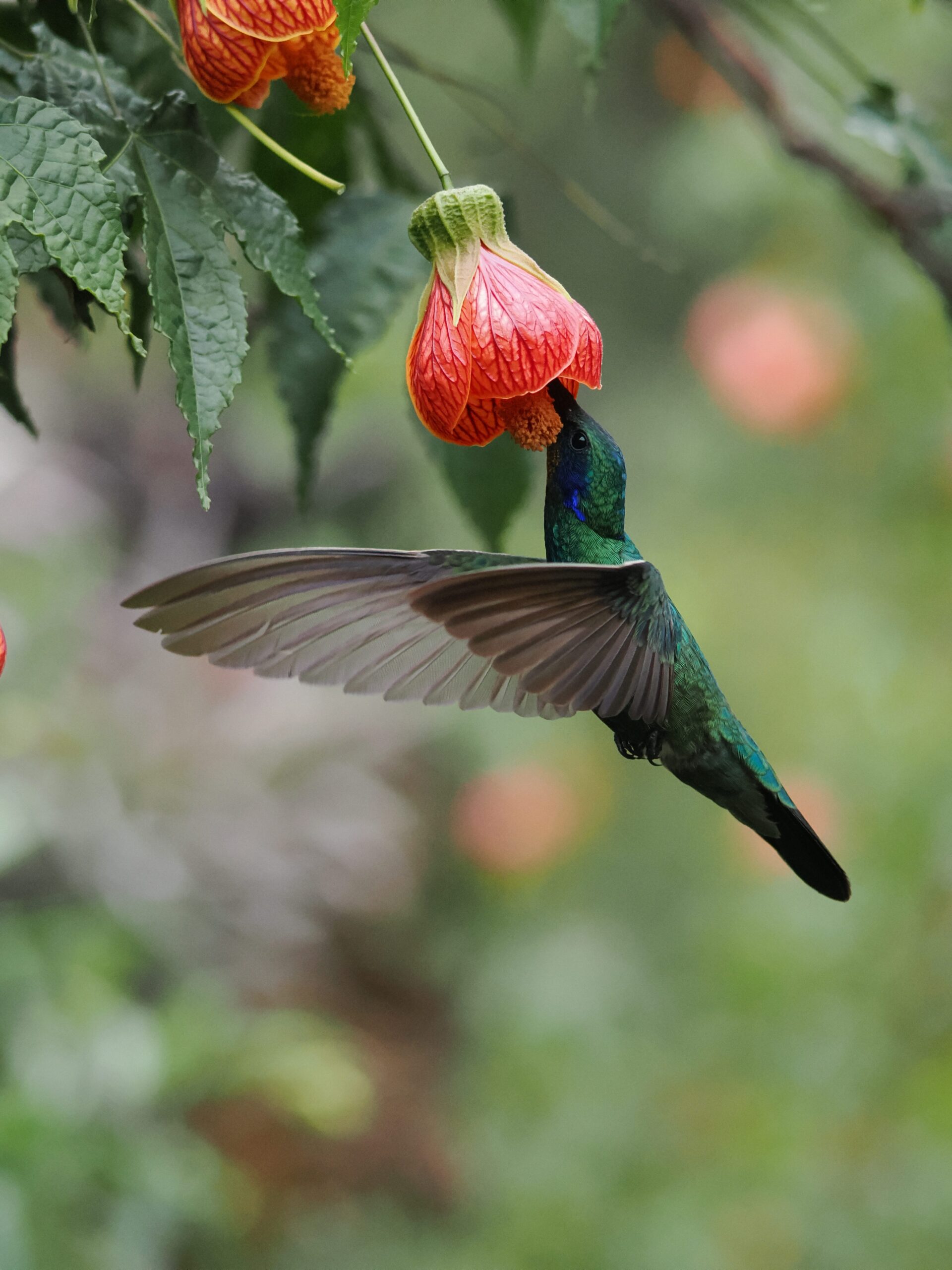
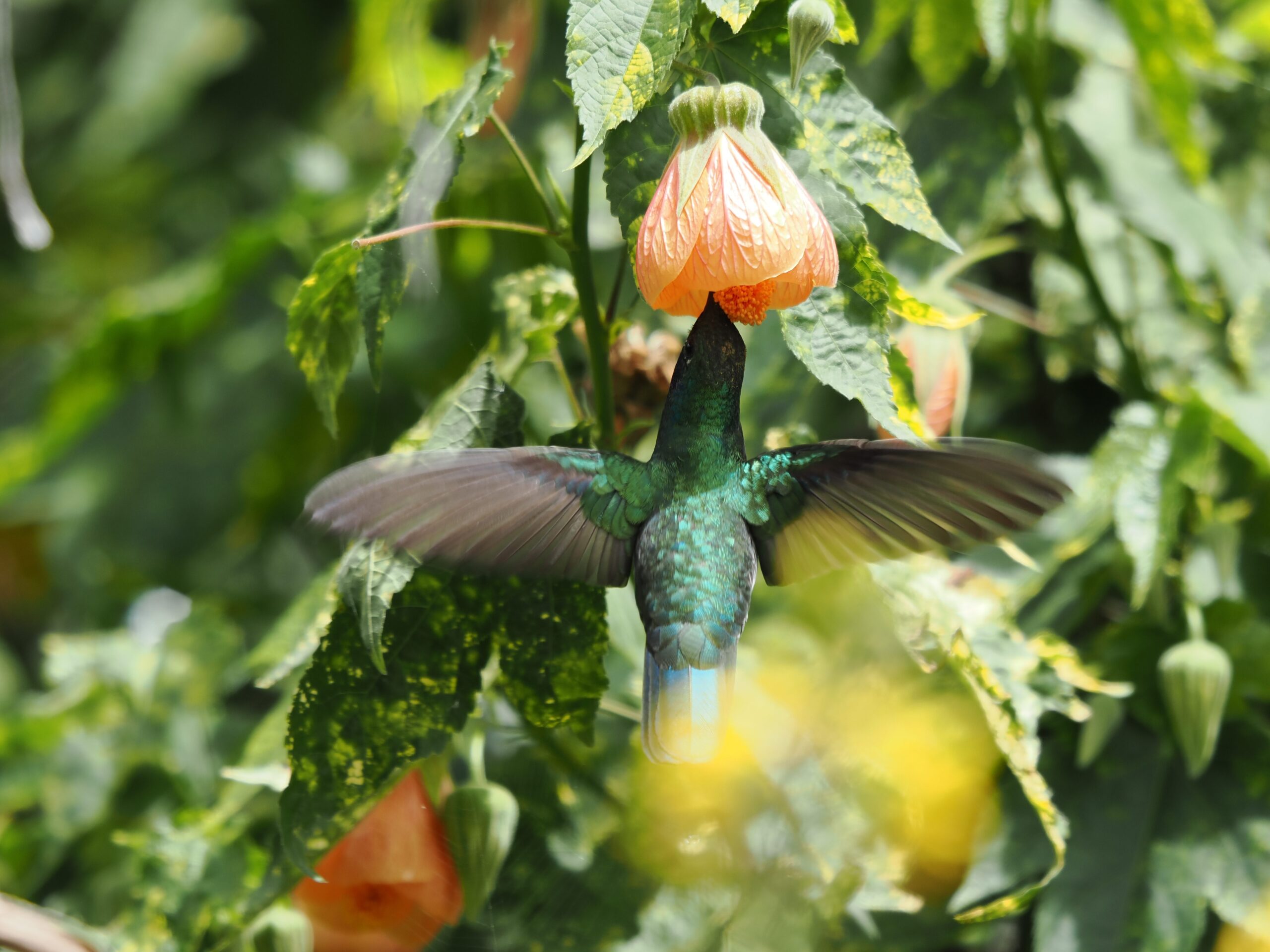
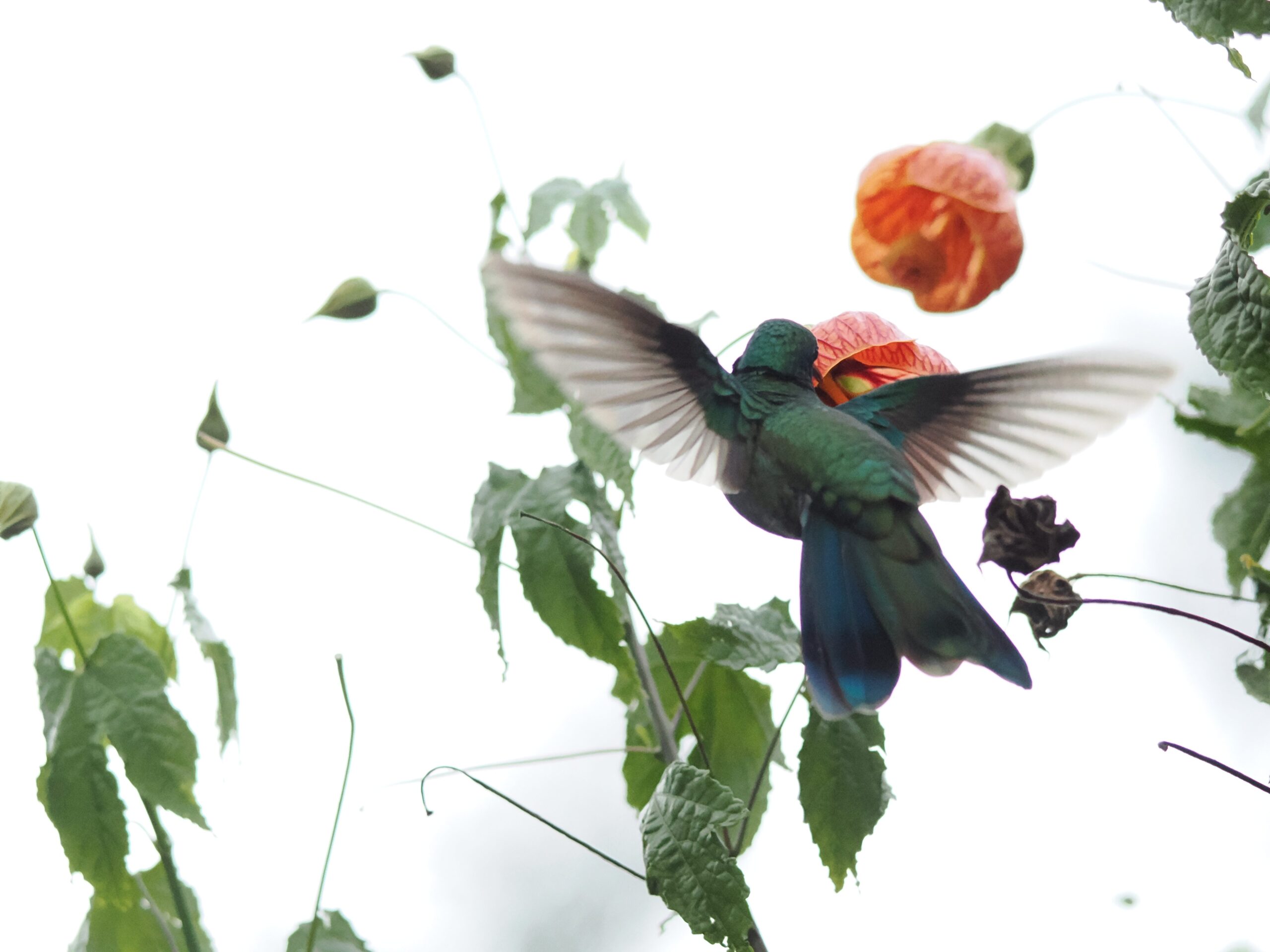
The ecological importance of the Sparkling Violetear is not limited to its abundance. What is decisive is that, as a large, mobile, territorial hummingbird, it can transfer pollen among plants at a landscape scale. In the Andes, where many flowers depend on birds for pollination, a species such as Colibri coruscans helps sustain the reproduction of native shrubs, herbs, and vines.
In the case of Pachacútec Andean Forest, your observations point to a particularly important relationship with Nicotiana glauca and Nicotiana tormentosa, plants present in the Wanakauri micro-watershed and heavily visited by hummingbirds. External literature is not always focused on Pachacútec, but it does support the relevance of Nicotiana glauca as a hummingbird-pollinated plant in the Andes. A study of the floral biology and pollination of Nicotiana glauca reports precisely the importance of interactions with hummingbirds in the species’ reproduction.
Not All Hummingbirds Pollinate in the Same Way
The fact that a hummingbird visits a flower does not automatically mean that it is an effective pollinator. Effectiveness depends on several factors:
- whether the bill and head contact the anthers and stigmas,
- whether the individual visits several compatible plants,
- whether it transports pollen between patches,
- and whether the floral resource is not exploited through “nectar robbing” without touching reproductive structures.
The Sparkling Violetear has several advantages as a potential pollinator:
- sufficient size to contact robust floral structures,
- mobility between patches,
- high frequency of visits to abundant flowers,
- and use of a wide range of plant species.
A study on hummingbird–plant interaction networks in an Andean inter-Andean valley found Colibri coruscans to be one of the species with the highest number of records, and Nicotiana glauca among the relevant plants in the network. This does not by itself prove pollination effectiveness in every flower, but it does suggest that the species occupies an important position within the interaction system.
Pachacútec as a Pollination Laboratory
What makes Pachacútec Andean Forest special is not only that it has hummingbirds, but that it is actively restoring the plants on which they depend. This turns the observatory into a living laboratory for studying pollination questions that often go unnoticed elsewhere:
- Which flowers does Colibri coruscans visit most by month?
- Which plants does it defend territorially?
- On which ones does it simply forage in passing?
- When does it displace other hummingbirds from Nicotiana glauca?
- How far does it move pollen between observatories or forest patches?
Answering these questions would allow a naturalist observation to become a scientific contribution of great value for Andean ecology.
7. The Forest Calendar: April, Drought, and Movement Toward the Mountains
What You Observed at Pachacútec Matters
One of the most valuable contributions of your text is not in the general description of the species, but in the local field observation: during April, when the climate shifts from the rainy season to the dry season, Sparkling Violetears begin to reduce their visits to the forest and move toward the mountains, where bromeliads and acchupayas are flowering. This observation deserves to be taken very seriously.
In Andean hummingbird ecology, seasonal altitudinal or local movements in response to flowering are entirely plausible. Many species do not perform “migrations” in the classic sense of long-distance latitudinal travel, but they do make seasonal movements within the landscape, following flowering pulses and changes in nectar availability.
The Mountain as a Dry-Season Refuge
If, in April, the flowering of certain resources at the observatory decreases while the availability of flowers on high slopes with bromeliads or puyas/acchupayas increases, the Sparkling Violetear has both the physiological capacity and ecological plasticity to move toward those patches. The energetic logic is clear: a hummingbird of this size needs a constant flow of carbohydrates. If nectar decreases in one sector and increases in another, following the flowering is an expected strategy.
Although specific studies on seasonal movements of Colibri coruscans remain limited and variable depending on region, general literature and field observations suggest that some populations or individuals move altitudinally according to the season and floral supply.
A Strong Hypothesis for Pachacútec
Based on your observations and what is known about the species, a solid hypothesis for Pachacútec would be this:
During the transition from the rainy season to the dry season, part of the local population of Colibri coruscans reduces its permanence at the observatory and increases its use of higher-altitude floral patches, especially those dominated by bromeliads, puyas/acchupayas, and other plants that concentrate nectar during the dry season.
This hypothesis can be tested with a relatively simple design:
- biweekly counts at the observatories,
- floral phenology of Nicotiana, bromeliads, and puyas,
- records of territorial behavior,
- and short altitudinal transects between Pachacútec and higher slopes.
If the pattern is confirmed, Pachacútec would hold a very valuable result: evidence that the observatory is part of a broader functional landscape, connected with seasonal mountain flowering.
8. Reproduction: What We Know and What Still Needs to Be Observed in Cusco
Nests of the Sparkling Violetear in Peru
One of the historical gaps regarding many Andean birds has been their reproductive natural history. In the case of Colibri coruscans, an important study for Peru described nests, eggs, and reproductive behavior based on observations in the Chillón River valley, Lima. That study documented details of the nest, egg dimensions, and several plant species visited by the species, representing one of the first detailed descriptions of reproduction for this hummingbird in the country.
The results are important because they show that the species:
- builds cup-shaped nests,
- uses plant materials and fine linings,
- and may associate with local ornithophilous flowers during the reproductive period.
Why This Matters for Pachacútec
If the Sparkling Violetear is resident, or at least a regular visitor in Pachacútec for much of the year, it is very possible that the restored forest also functions as a breeding space, not only a feeding site. This completely changes the conservation value of the site.
A hummingbird that feeds in one place may depend on specific flowers. A hummingbird that also nests there needs structure, safety, materials, and habitat stability. Detecting nests of Colibri coruscans at Pachacútec would be a powerful indicator of ecological quality.
SPARKLING VIOLETEAR
Colibri coruscans: The Hummingbird That Rules the Andean Forest
Part II: The King of Flowers, the War for Nectar, and Pachacútec’s Secret Calendar
If in the first part the Sparkling Violetear appeared as a dominant species of the Andean landscape, in this second part we must look at it more closely: how it feeds, which flowers it chooses, why it fights so much, how it changes with the seasons, and what it is telling us about the ecological future of Pachacútec Andean Forest.
Because the true power of Colibri coruscans is not only in its brilliance or its metallic song. It lies in its ability to turn the flowering of a forest into a map of biological decisions: which flower to defend, when to abandon a patch, which rival to expel, when to climb to the mountains, and when to return to the valley.
In a hummingbird observatory, that changes everything.
9. The Sparkling Violetear Does Not “Visit Flowers”: It Manages Energy
Nectar as High-Precision Fuel
To understand Colibri coruscans, we must abandon the romantic idea of the hummingbird as a decorative bird and think of it as a metabolic machine with extremely high demands. Hummingbirds live on the energetic edge: they must sustain extremely costly hovering flight, defend territory, thermoregulate during cold mountain nights, sing, chase rivals, and, during certain periods, reproduce.
All of that requires sugar. A lot of sugar.
Nectar is its main fuel, but it is not a uniform resource. It changes according to:
- plant species,
- time of day,
- temperature,
- age of the flower,
- sugar concentration,
- and number of previous visitors.
This means that the Sparkling Violetear is not simply “drinking nectar.” It is evaluating a complex system of energetic profitability. If a flower or floral patch offers enough reward, it may be worth defending. If it stops being profitable, the bird leaves it.
In other words: the hummingbird does not move through the forest at random. It reads flowering as an energy map.
10. Which Flowers Does Colibri coruscans Use? A Generalist Species, but Not an Indifferent One
The Breadth of Its Floral Diet
One of the most interesting traits of Colibri coruscans is that it does not appear to be an extreme specialist on a single plant. Various studies in the Peruvian and South American Andes show that it is a hummingbird with broad floral plasticity, capable of visiting multiple species and integrating into complex plant–pollinator interaction networks.
In a recent study carried out in Cajamarca, Colibri coruscans was recorded as the hummingbird with the highest number of floral resources used, interacting with approximately 20 plant species. This makes it a functional generalist within the Andean hummingbird assemblage.
This information is very important for Pachacútec Andean Forest, because it suggests that the Sparkling Violetear does not depend exclusively on one emblematic flower, but on a seasonal floral mosaic. It can use flowers of Nicotiana, bromeliads, native shrubs, cultivated plants, and even ornamental species if the resource is energetically profitable.
But generalist does not mean indiscriminate. The species may use many flowers, yes, but not all are equally attractive to it.
Resource Quality Matters
From an ecological point of view, a flower may be attractive to the Sparkling Violetear for several reasons:
- high nectar volume,
- adequate sugar concentration,
- morphological accessibility for the bill,
- spatial clustering of flowers,
- prolonged or predictable flowering,
- favorable position for defending the patch.
Flowers that combine several of these characteristics are ideal candidates for territorial defense. It is no coincidence that species such as Nicotiana glauca or certain Andean bromeliads appear so frequently associated with large and dominant hummingbirds.
11. The Case of Nicotiana glauca: A Key Plant at Pachacútec
Not Just Any Flower
At Pachacútec Andean Forest, Nicotiana glauca occupies a central place within the ecological story of the Sparkling Violetear. And rightly so. This plant, with its yellow tubular flowers and sustained nectar production, is an extremely important resource for several Andean hummingbirds.
Various studies on floral biology and pollination in Andean and semi-arid environments show that Nicotiana glauca can be intensely visited by hummingbirds, which act as its main pollinators or at least as high-frequency visitors.
In the case of Colibri coruscans, your field observation suggests something even stronger: that the species not only uses the plant, but could be one of its main pollinators in the Wanakauri micro-watershed. This makes strong biological sense for several reasons:
- the hummingbird’s size facilitates contact with floral structures,
- the tubular flower matches the bird’s foraging type,
- the local abundance of the plant allows territorial defense,
- and the constant presence of the hummingbird increases the probability of pollen transfer among flowers and patches.
The Flower as Territory
In a system such as Pachacútec, where Nicotiana glauca can form visible and relatively predictable patches, the Sparkling Violetear could use the plant not only as food, but as a territorial base.
This means the bird could:
- choose a nearby perch,
- watch over the floral patch,
- expel other hummingbirds,
- and return repeatedly to the same resource.
If this is confirmed through systematic observation, Nicotiana glauca would be one of the plants structuring the territorial behavior of the Sparkling Violetear at Pachacútec.
12. Nicotiana tormentosa, Bromeliads, and Acchupayas: The Floral Network of the Dry Season
The Forest Does Not End at the Observatory
One of the most valuable ideas in your observations is that the Sparkling Violetear does not remain static inside the observatory. As April advances and the transition from rains to drought begins, its visits to the forest decrease and its presence increases in mountain sectors where bromeliads and acchupayas are flowering.
This completely changes how Pachacútec should be understood.
Pachacútec would not be only an observation point, but a station within a landscape of altitudinal movement. The Sparkling Violetear would use the observatory as part of a broader network of resources that includes:
- flowers of the restored valley,
- slopes with native vegetation,
- high-elevation bromeliads,
- puyas or acchupayas,
- and possibly other dry-season flowers.
The Logic of the Dry Season
In Andean ecosystems, the transition between seasons does not only change rainfall. It changes the flowering calendar. Some plants concentrate their supply in the wet season; others flower precisely when the landscape dries. For a generalist and territorial hummingbird, following these pulses can be the difference between a positive or negative energy balance.
If the availability of Nicotiana decreases in April and bromeliads or puyas increase on high slopes, the Sparkling Violetear may be doing exactly what one would expect from an opportunistic mountain hummingbird: moving upward following the flowering.
This opens a very strong hypothesis for Pachacútec:
The observatory functions as a feeding node during part of the year, but the Sparkling Violetear depends on a network of seasonal floral resources distributed between the valley and the surrounding mountains.
If this hypothesis is correct, conserving the hummingbird cannot be limited to the restored forest. It requires looking at the entire micro-watershed.
13. Aggression: Why the Sparkling Violetear Fights So Much
Aggression Is Not “Bad Temper”; It Is Strategy
In everyday language, people say that the Sparkling Violetear is “aggressive,” and that is true. But from an ecological point of view, that aggression is not anecdotal or merely a temperament. It is a strategy for accessing resources.
Defending flowers costs energy. Chasing rivals does too. So why do it? Because if the floral resource is valuable enough, the cost of defending it is compensated by the benefit of accessing nectar with less competition.
A dominant hummingbird such as Colibri coruscans can invest energy in:
- singing from a perch,
- patrolling a patch,
- launching short attacks,
- chasing a rival,
- returning to the resource.
If that behavior ensures several rounds of concentrated nectar, the strategy works.
Not All Rivals Are the Same
A recent study on territoriality in urban Andean hummingbirds found that Sparkling Violetears adjust their aggression according to the rival species. In other words, they do not respond the same way to all intruders. A large competitor or one with similar behavior may trigger a different response than a smaller, less threatening hummingbird.
This is fascinating because it suggests a finer level of decision-making in territorial behavior. The Sparkling Violetear does not simply “attack for no reason.” It evaluates risk, size, competition, and possibly the value of the resource.
At Pachacútec, this could explain why it sometimes fiercely expels certain hummingbirds and tolerates others more, or why its behavior changes depending on the flower, the time of day, and visitor density.
14. How Does It Affect Other Species in the Forest?
The Dominant Hummingbird Also Shapes the Community
When one species dominates flowers, it does not only change its own diet. It changes the entire community. It can force other species to:
- use less profitable flowers,
- change their schedule,
- move to another sector,
- exploit more hidden plants,
- or depend on brief windows when the dominant bird is absent.
In ecology, this is sometimes called competition-mediated resource segregation. And it is very likely that something like this is happening at Pachacútec.
If species such as the following coexist at the observatory:
- Lesser Violetear,
- Green-tailed Trainbearer,
- Black-tailed Trainbearer,
- White-bellied Woodstar,
- Bearded Mountaineer,
- Giant Hummingbird,
then the presence of Colibri coruscans as an aggressive defender may be structuring the partitioning of nectar.
A Hummingbird Community Is Not a Peaceful Garden
Hummingbird observatories often present an image of harmony: flowers, birds, color, stillness. But from an ecological point of view, they are scenes of intense competition. Nectar is a finite and highly valuable resource. Species do not simply coexist; they negotiate that coexistence through dominance, avoidance, speed, specialization, and opportunism.
In that ecological theater, the Sparkling Violetear is one of the main actors.
15. Song, Perches, and Vigilance: The Architecture of Territory
The Importance of the Perch
A seemingly simple detail can be decisive for the behavior of the Sparkling Violetear: the availability of exposed branches. This species often uses visible perches from which it sings, watches, and takes off to expel rivals.
This means that the vegetation structure of the observatory directly influences its territorial behavior. A floral patch without suitable perches may be less defensible. An area with tall shrubs, dry branches, or well-positioned trees can become a perfect control post.
For Pachacútec, this is very useful. It is not only important which flowers are planted, but how the habitat architecture is organized:
- flowers near perches = greater possibility of defense,
- dispersed and hidden flowers = more opportunities for subordinate species,
- mixed heights = more use niches.
Song as an Invisible Fence
The repetitive song of the Sparkling Violetear functions as a signal of occupation. A perched male emitting metallic notes from a high branch is announcing something very clear: “this patch has an owner.”
In the field, this can be used as a monitoring tool. Recording:
- where it sings from,
- at what times,
- what flowers are nearby,
- which species it expels,
can help map territories and understand the spatial dynamics of the observatory.
16. The Sparkling Violetear as an Indicator of Restoration
Not a Perfect Indicator, but a Valuable One
In conservation, not every abundant species serves as an indicator. But some can provide useful signals about the state of a system. The Sparkling Violetear could be one of them for Pachacútec, as long as it is interpreted carefully.
Its presence and activity may indicate:
- availability of flowers,
- presence of perches and vegetation structure,
- continuity of resources in certain seasons,
- and the site’s ability to sustain a territorial hummingbird with high energy demands.
But there is a trap to avoid: more Sparkling Violetears does not always mean “better forest.” It could also mean that the system favors open and generalist resources, while more sensitive species have still not recovered. For this reason, monitoring must look not only at Colibri coruscans, but at the entire assemblage.
What It Can Contribute as an Indicator
What it can do very well is function as:
- an indicator of useful flowering,
- an indicator of seasonal use of the observatory,
- an indicator of competition and resource saturation,
- an indicator of connectivity with slopes and higher patches.
If, in a dry year, the species disappears early from the observatory, that could signal a decline in local floral resources. If it remains longer than usual, it could indicate a better nectar supply. If it concentrates in certain sectors, it may be revealing where the most important plants in the system are located.
17. Climate Change: Why This Species May Become a Sentinel of the Future
A Hummingbird Sensitive to Phenology
Hummingbirds depend on floral calendars. If climate change alters the timing of flowering, the duration of rains, or water availability in the valleys, the Sparkling Violetear will have to respond.
This may happen in several ways:
- advancing or delaying its movements,
- changing the flowers it uses,
- increasing its presence at higher altitudes,
- or reducing its permanence in certain valley patches.
For Pachacútec, this makes the species a potential sentinel of climate change. Not because it is the most threatened, but because its behavior can reflect changes in the synchrony between flowers and birds.
What Should Be Monitored from Now On
If Pachacútec wants to turn its observations into long-term science, it should begin recording each year:
- first and last flowering dates of Nicotiana glauca,
- flowering of bromeliads and acchupayas on nearby slopes,
- monthly abundance of Colibri coruscans,
- frequency of territorial behavior,
- use of observatories by hour,
- and observed altitudinal movements.
With five or ten years of data, this could become one of the best local series on hummingbirds and phenology in the Wanakauri valley.
18. What Makes the Sparkling Violetear Emblematic at Pachacútec
It Is Not Only Beautiful. It Is Functional.
Some species are emblematic because they are rare. Others because they are beautiful. The Sparkling Violetear can be emblematic for a different reason: because it makes the functioning of the forest visible.
Through it, several things can be read at once:
- the flowering of the valley,
- competition for nectar,
- connectivity with the mountain,
- the importance of restored plants,
- and the need to think of conservation as a network, not as an isolated point.
The Hummingbird That Tells the Story of the Landscape
If the observatory wants to explain to visitors what it means to restore an Andean forest, the Sparkling Violetear is a perfect species to tell that story. Because its story is not only that of a brilliant bird. It is the story of a relationship:
- without flowers, there is no hummingbird;
- without shrubs and trees, there are no perches or refuge;
- without connected slopes, there is no seasonal movement;
- without restoration, the observatory would be a floral emptiness.
Conclusion of Part II: The King of Nectar Does Not Live Alone
At first glance, the Sparkling Violetear seems like a self-sufficient hummingbird. Large, brilliant, aggressive, confident. But its power depends on something far more fragile than its flight: the continuity of the Andean floral landscape.
It depends on Nicotiana flowering at the right time.
It depends on the high-elevation bromeliads staying alive.
It depends on the existence of acchupayas on the slopes.
It depends on branches where it can sing and flowers it can defend.
Ultimately, it depends on the Andean forest remaining a functional system.
This turns Pachacútec Andean Forest into something more than a place to see hummingbirds. It becomes a space where one can observe, almost in real time, how a high-elevation pollinator negotiates its life with climate, flowers, competition, and the mountain.
And few stories are more powerful than that.
SPARKLING VIOLETEAR
Colibri coruscans: The Hummingbird That Rules the Andean Forest
Part III: Pachacútec Andean Forest and the Future of the Violet-Eared Hummingbird
At Pachacútec Andean Forest, the Sparkling Violetear is not simply one more species on the list of recorded birds. It is a living symbol of what happens when a degraded landscape begins to recover flowers, shrubs, trees, and refuges. Its presence allows us to understand that ecological restoration is not measured only by the number of plants planted, but by the relationships those plants recreate.
A hummingbird does not arrive because the landscape is beautiful. It arrives because it finds energy. It finds nectar. It finds perches. It finds territories to defend. It finds a network of plants that allows it to survive in a demanding, cold, dry, and changing environment.
For this reason, conserving Colibri coruscans at Pachacútec means conserving much more than a bird. It means conserving the floral calendar of the forest, the Wanakauri micro-watershed, the slopes where bromeliads and acchupayas flower, the shrubs where it perches, and plants such as Nicotiana glauca and Nicotiana spp. that support part of its diet.
19. A Dominant Hummingbird within a Diverse Community
The Sparkling Violetear shares Pachacútec with other hummingbirds and high-Andean birds. Species such as the Giant Hummingbird, Green-tailed Trainbearer, Black-tailed Trainbearer, White-bellied Woodstar, Tyrian Metaltail, and other floral visitors of the forest can be found there.
Each one fulfills a different function.
The Giant Hummingbird impresses with its size and powerful flight. The trainbearers stand out for their long tails and their relationship with Andean flowers. The White-bellied Woodstar, small and fast, represents another strategy: taking advantage of resources where larger hummingbirds do not always dominate. The Sparkling Violetear, in contrast, occupies the role of defender: it sings, patrols, expels, and controls.
This diversity shows that Pachacútec should not be managed with only one species in mind. If planting is done only for the Sparkling Violetear, the forest may favor a dominant hummingbird too much. If restoration is carried out with diversity of plants, heights, flowers, and microhabitats, the entire community benefits.
The key is to create a mosaic.
High and low flowers.
Open plants and hidden plants.
Abundant resources and dispersed resources.
Visible perches for territorial species and discreet refuges for subordinate birds.
A good forest is not uniform. A good forest offers options.
20. The Risk of Feeders and the Importance of Natural Flowers
In many hummingbird observatories around the world, feeders are used to attract birds. They can help with observation, photography, and environmental education, but they must also be managed very carefully.
The Sparkling Violetear often dominates feeders. When an artificial resource concentrates too much nectar in a single point, aggressive species can monopolize it. This can alter natural behavior patterns, increase conflicts, favor only a few species, and reduce observation opportunities for smaller hummingbirds.
For this reason, at Pachacútec Andean Forest, the most important strategy should be to strengthen natural flowers.
A feeder may be a temporary educational support, but a native flower is part of the ecosystem. The flower feeds, reproduces plants, attracts insects, connects pollinators, produces seeds, and sustains real ecological processes. A feeder shows birds; a restored plant builds forest.
For the future, the best path is clear: more gardens of native flowers, more nectar-producing plants, more Nicotiana, more bromeliads, more Andean shrubs, more structural trees, and less dependence on artificial resources.
The goal should not be for hummingbirds to visit only one point. The goal should be for the entire forest to have food.
21. The Sparkling Violetear as an Educational Flagship Species
A flagship species is one that helps communicate a conservation message. The Spectacled Bear may represent montane forests. The condor represents the Andean heights. At Pachacútec, the Sparkling Violetear can become a flagship species to explain the restoration of flowers and pollinators.
Its appearance helps: it is bright, visible, active, and easy to recognize. Its behavior also helps: it sings, defends territory, and allows people to observe interactions with other species. But its greatest educational value is that it connects simple questions with deep answers.
Why does it fight?
Because nectar is energy.
Why does it visit certain flowers?
Because those flowers provide food.
Why does it move toward the mountains in April?
Because it follows flowering.
Why does it return?
Because the restored forest offers resources.
In this way, a child, student, or tourist can understand that the hummingbird is not an ornament. It is part of an ecological network. And if that network breaks, the hummingbird disappears.
22. What It Means to Conserve Colibri coruscans in Cusco
Conserving the Sparkling Violetear does not only mean preventing someone from capturing or harming it. It means protecting the system that sustains it.
In Cusco, this means caring for:
- native and nectar-producing flowers;
- Andean shrublands;
- slopes with bromeliads and acchupayas;
- corridors between valley and mountain;
- ravines and micro-watersheds;
- trees that serve as perches;
- and the tranquility of the spaces where it feeds and possibly nests.
It also means educating visitors to observe without disturbing. Do not use excessive playback. Do not approach nests. Do not cut branches for a better photograph. Do not alter the natural behavior of birds. Do not turn wildlife into a spectacle.
Birdwatching must be a tool for conservation, not an additional pressure on species.
23. A Monitoring Plan for Pachacútec Andean Forest
To turn current observations into valuable scientific information, Pachacútec can implement simple but consistent monitoring.
A. Monthly Abundance Monitoring
Record how many individuals of Colibri coruscans are observed in each forest zone:
- Observatory 1
- Observatory 2
- Trails
- Areas with Nicotiana
- Nearby slopes
- Areas with bromeliads and acchupayas
B. Record of Visited Plants
For each observation, record:
- plant species;
- time of visit;
- approximate duration;
- number of flowers visited;
- whether there was territorial defense;
- whether it expelled another species.
C. Floral Phenology
Record each month which plants are flowering:
- Nicotiana glauca;
- Nicotiana;
- cantuta;
- ñucchu;
- bromeliads;
- acchupayas;
- other nectar-producing plants.
D. Territorial Behavior
Record:
- perches used;
- songs;
- chases;
- species expelled;
- times of greatest aggression.
E. Seasonal Movement
Compare presence at the observatory with presence in higher areas during:
- rainy season;
- April–May transition;
- dry season;
- beginning of new flowering periods.
With these data, Pachacútec could produce one of the first systematic local field logs on the ecology of the Sparkling Violetear in the Wanakauri micro-watershed.
24. Main Scientific Hypothesis for Pachacútec
Based on the observations made, a clear research hypothesis can be formulated:
Hypothesis:
During the transition from the rainy season to the dry season, Colibri coruscans reduces its activity at the observatories of Pachacútec Andean Forest and increases its movement toward high slopes where bromeliads, acchupayas, and other native plants are flowering, following the seasonal availability of nectar.
This hypothesis can become a research project for students of biology, ecology, nature tourism, or environmental management.
It can also strengthen the scientific value of the observatory, demonstrating that Pachacútec not only receives birds, but also generates knowledge about them.
25. Climate Change and Synchrony Between Birds and Flowers
Climate change can alter the relationship between hummingbirds and plants. If rainfall changes, flowers may open earlier, later, or for a shorter time. If drought intensifies, some plants may produce less nectar. If temperatures rise, hummingbirds may move to higher altitudes.
The greatest risk is the loss of synchrony.
A hummingbird may arrive at a place expecting flowers, but the flowers may have already passed. Or it may find flowers, but with less nectar. Or it may be forced to compete with more individuals in fewer patches.
For this reason, species such as the Sparkling Violetear can become sentinels of climate change. Their movements, abundance, and behavior can warn of changes in the availability of floral resources.
If Pachacútec maintains long-term records, it can provide valuable information on how Andean hummingbirds respond to environmental change.
26. The International Value of a Local Observation
Many people think that important science is done only in large laboratories or foreign universities. But natural history shows the opposite. Some of the most valuable observations come from people who watch the same place for years.
Pachacútec has that advantage.
It knows when the hummingbirds arrive.
It knows which plants they use.
It observes when they decline.
It recognizes which flowers appear in April.
It sees the relationship between climate, plants, and birds.
This knowledge, if recorded with method, can become science. It can become articles, theses, technical reports, and conservation programs.
The value lies in transforming daily observation into data.
27. Management Recommendations for Conserving the Sparkling Violetear
To protect Colibri coruscans and the entire hummingbird community of the forest, Pachacútec should prioritize:
- Increase native floral diversity.
Do not depend on a single plant. Create staggered flowering throughout the year. - Conserve key plants of April and the dry season.
Bromeliads, acchupayas, and mountain flowers must be protected both inside and outside the observatory. - Reduce dependence on artificial feeders.
Use them only as controlled support if necessary, prioritizing natural flowers. - Maintain natural perches.
Do not remove branches useful for song and vigilance unless they represent a risk. - Protect possible nesting zones.
Avoid noise, cutting, and excessive presence near nests. - Educate photographers and visitors.
A good photograph should never alter the life of the bird. - Record monthly data.
Conservation needs memory. - Connect the observatory with the micro-watershed.
The hummingbird does not recognize human boundaries. It uses the entire landscape.
28. Ecological Comparison with Other Hummingbirds of Pachacútec
The Sparkling Violetear dominates through size and aggression, but it does not replace the importance of other hummingbirds.
The Giant Hummingbird represents the strength of large Andean pollinators. Its slower flight and great size connect it with robust flowers and open spaces.
The trainbearers, such as the Green-tailed Trainbearer and Black-tailed Trainbearer, show a different strategy, with long tails and use of flowers in shrublands and edges.
The White-bellied Woodstar, small and fast, takes advantage of resources at another scale, moving more discreetly.
The Tyrian Metaltail represents hummingbirds of high-Andean environments, with adaptations to cold and high-elevation conditions.
The Sparkling Violetear interacts with all of them. Sometimes it competes. Sometimes it displaces. Sometimes it shares the landscape without direct contact.
For this reason, studying this species helps us understand the entire community.
29. Pachacútec as a Living Classroom of Ornithology
The Sparkling Violetear is perfect for teaching:
- bird identification;
- sexual dimorphism or sexual similarity;
- territoriality;
- pollination;
- competition;
- floral phenology;
- ecological restoration;
- climate change;
- field monitoring.
A student can learn more by watching a chase between hummingbirds than by reading many pages of theory. Theory is important, but experience fixes knowledge.
At Pachacútec, every observation can become a scientific question.
Why did it sing from that branch?
Why did it expel that hummingbird and not another?
Why did it visit that flower first?
Why does it disappear in April?
Why does it return later?
Science begins with observation.
30. Conclusion: The Hummingbird That Reveals the Soul of the Forest
The Sparkling Violetear seems small beside the mountains, but inside the forest its presence is enormous.
It is a bird that reveals the quality of the flowers.
It reveals the energy of the landscape.
It reveals the invisible competition for nectar.
It reveals the relationship between valley and mountain.
It reveals the importance of restoring native plants.
It reveals that a forest is not alive only because it has trees, but because it has interactions.
At Pachacútec Andean Forest, Colibri coruscans is more than a showy species. It is a sign.
When it sings, it announces territory.
When it fights, it reveals the importance of nectar.
When it pollinates, it sustains plants.
When it moves toward the mountain, it shows that the forest is connected to a larger landscape.
When it returns, it confirms that restoration has meaning.
For this reason, conserving the Sparkling Violetear means conserving the web of life that makes it possible.
And perhaps that is the most important lesson this hummingbird leaves us: no species lives alone. Every flight depends on a flower. Every flower depends on a soil. Every soil depends on water. And all conservation depends on people capable of seeing those connections and protecting them.
At Pachacútec Andean Forest, every time the Sparkling Violetear appears among the flowers, the forest seems to say something simple and profound:
Life returns when it is given back a place to live.
Autor: Armando Isaias Medrano Zuniga
Coautor: Percy Núñez Vargas
Fotografías: Armando Isaias Medrano Zuniga.
Camara: OM SISTEM OM-1 II lente 150 -600 mm.
Diseño y diagramación: Armando Isaias Medrano Zuniga
Corrección de estilo: Armando Isaias Medrano Zuniga